Latest Posts

Reflections in Nehemiah: The Butler Did It!

Bookmark and Share

Nehemiah 1:11
O LORD, I beseech thee, let now thine ear be attentive to the prayer of thy servant, and to the prayer of thy servants, who desire to fear thy name: and prosper, I pray thee, thy servant this day, and grant him mercy in the sight of this man. For I was the king’s cupbearer.

This is the end of Nehemiah’s prayer to God in which he asked for God’s mercy and guidance so that he could accomplish the task of rebuilding Jerusalem’s walls in accordance to God’s will and promises. In the very last sentence of the verse, right after the conclusion of his prayer, Nehemiah identifies himself as “the king’s cupbearer”.

And Jesus said unto them… If ye have faith as a grain of mustard seed… nothing shall be impossible unto you” ~ Matthew 17:20

A cupbearer is a butler. So, Nehemiah the butler was offering himself to God to spearhead the huge project of rebuilding the walls of Jerusalem. The people had been unable to accomplish this task for 94 years! But the king’s butler is now preparing to do the job.

The lesson for us is clear: God can use anyone to accomplish His will. God does not care about our worldly qualifications; He cares about our yielded spirit. Nehemiah worshipped God, Nehemiah knew God’s Word, Nehemiah was humble before God, Nehemiah would obey God’s will: those were ALL the qualifications that God was looking for.

When Jesus chose His disciples, He didn’t choose the “best and the brightest”, He chose fishermen, rebels and a tax collector. There is absolutely nothing wrong with being smart or ‘well qualified’. God Himself has blessed us with brains and various abilities. However, scholarship and other human accomplishments are not what qualify us for joining God’s workforce. God looks for devotion over degrees, desire over duty, enthusiasm over experience, fellowship over fame, and connection (to Him) over ‘connections’.

“Thus saith the LORD, Let not the wise man glory in his wisdom, neither let the mighty man glory in his might, let not the rich man glory in his riches” ~ Jeremiah 9:23

To accomplish the work God has planned for each of us does not depend on how much wisdom/knowledge we have (or don’t have), or how much might/power we have (or don’t have), or how much riches/money we have (or don’t have). To accomplish God’s will, to do what seems difficult or even impossible ALL we need is to know Him, to live in humble fellowship with Him, and to obey His commands.

“All scripture is given by inspiration of God, and is profitable for doctrine, for reproof, for correction, for instruction in righteousness: That the man of God may be perfect, thoroughly furnished unto all good works.” ~2 Timothy 3:16-17

“But let him that glorieth glory in this, that he understandeth and knoweth me, that I am the LORD which exercise lovingkindness, judgment, and righteousness, in the earth: for in these things I delight, saith the LORD.” ~ Jeremiah 9:24

God has already supplied ALL believers with EVERYTHING needed to do the work He has prepared from the beginning of time.

“According as his divine power hath given unto us all things that pertain unto life and godliness, through the knowledge of him that hath called us to glory and virtue” ~2 Peter 1:3

God used a butler to build a city wall; He can use you too… if you answer His call.

Bookmark and Share

(¯`•.¸.•°*°•.¸ .•°*°•.¸.•´¯)(¯`•.¸.•°*°•.¸ .•°*°•.¸.•´¯)

Encounters With Jesus: Paying Taxes


Bookmark and Share

"According as his divine power hath given unto us all things that pertain unto life and godliness, through the knowledge of him that hath called us to glory and virtue:" ~2 Peter 1:3

And when they were come to Capernaum, they that received tribute money came to Peter, and said, Doth not your master pay tribute?  He saith, Yes. And when he was come into the house, Jesus prevented him, saying, What thinkest thou, Simon? of whom do the kings of the earth take custom or tribute? of their own children, or of strangers?  Peter saith unto him, Of strangers. Jesus saith unto him, Then are the children free.  Notwithstanding, lest we should offend them, go thou to the sea, and cast an hook, and take up the fish that first cometh up; and when thou hast opened his mouth, thou shalt find a piece of money: that take, and give unto them for me and thee.~ Matthew 17:24-27

SONSHIP IS TAX-FREE
In the passage, Jesus asks: “Do kings tax their children?”. After Peter correctly answers, “no”, Jesus points out the logical conclusion: “Then are the children free”. In so doing, Jesus averts our eyes from the vulgar to the divine: The children of God do not pay taxes to God. The price to be full citizens of God’s Kingdom has already been paid by the Death of the Son.

Nowhere else in the world is this true. Citizens of any worldly ‘kingdom’ must pay a tax to obtain or retain full citizenship. In most countries the tax is monetized for government operations. In other countries the tax may be by birthright—i.e., those born outside cannot come in. However, in the Kingdom of God, ALL have the opportunity to obtain immediate citizenship, not by banknote nor birthright, but by Blood, the Blood of the Lamb.

Be not ye therefore like unto them: for your Father knoweth what things ye have need of, before ye ask him. ~Matthew 6:8

The practical application, for us, is that since the children of God live in the Kingdom of God, no tax in any kingdom of man can stop/hinder the work of a child of God going about their Father’s business in the Kingdom of God.

Jesus beautifully, portrays this for us by procuring the temple tax, levied on Himself and Peter, from a fish!!! God the Father had already provided for their earthly needs: no tax from man would prevent them from continuing the work of God. Likewise, there is no earthly tax/demand/situation that can stop you or me from doing the work of God here on earth: God HAS provided for all that is needed to accomplish HIS will: the child of God lives tax-free! The shortfalls, the resource deficits, appear ONLY when we try to accomplish our will instead of executing God’s plan.


Bookmark and Share


You KNOW what to DO… GO DO IT!!!


Bookmark and Share


“Those things, which ye have both learned, and received, and heard, and seen in me, DO…” ~Philippians 4:9a

"According as his divine power hath given unto us all things that pertain unto life and godliness, through the knowledge of him that hath called us to glory and virtue" ~2 Peter 1:3

You’ve read it in his WORD.
Go do it!
It’s in sermons you’ve heard.
Go do it!
You know what’s to be done;
Go do it!
The commands of the Son.
Go do it!
It is time to obey;
Go do it!
Don’t wait another day.
Go do it!

It’s not more knowledge you need.
All you require is the seed.
Then in faith step up, step out;
No more fear, and no more doubt.
Go do it!

Pray every waking minute.
Obey His will, walk in it!
Choose to do the right you know.
Refuse the wrong way to go.
Go do it!

All Power lives in you!
No more excuses to spew;
You know you know what to do.
Go do it!

…Author: reflectionsintheword.org


Bookmark and Share


Comment: Fruit Finding vs. Branch Burning

Bookmark and Share

Thoughts on Judging

In the church, and even beyond, Judging has become a very thorny, even taboo issue over the years. However, a brief overview of Scripture shows that many have approached this topic with a disablingly narrow view; mainly due to focusing on Matthew 7:1 without reading carefully the rest of the passage, i.e., Matthew 7:2-5. Indeed, the Bible clearly instructs christians what, who, how and why to judge.

Wherefore by their fruits ye shall know them. ~Matthew 7:20

To correctly explore this issue and understand its importance, first let us consider some apparently conflicting passages: the aforementioned Matthew 7:1-5, John 7:24 and 1 Corinthians 5:12-13 & 6:2-5.

Judge not, that ye be not judged. For with what judgment ye judge, ye shall be judged: and with what measure ye mete, it shall be measured to you again. And why beholdest thou the mote that is in thy brother’s eye, but considerest not the beam that is in thine own eye? Or how wilt thou say to thy brother, Let me pull out the mote out of thine eye; and, behold, a beam is in thine own eye? Thou hypocrite, first cast out the beam out of thine own eye; and then shalt thou see clearly to cast out the mote out of thy brother’s eye~Matthew 7:1-5

Judge not according to the appearance, but judge righteous judgment. ~ John 7:24

For what have I to do to judge them also that are without? do not ye judge them that are within? But them that are without God judgeth. Therefore put away from among yourselves that wicked person. ~ 1 Corinthians 5:12-13

Do ye not know that the saints shall judge the world? and if the world shall be judged by you, are ye unworthy to judge the smallest matters?Know ye not that we shall judge angels? how much more things that pertain to this life? If then ye have judgments of things pertaining to this life, set them to judge who are least esteemed in the church. I speak to your shame. Is it so, that there is not a wise man among you? no, not one that shall be able to judge between his brethren? ~ 1 Corinthians 6:2-5

The first passage is often quoted to discourage judging, but the latter passages clearly advocate it. Now, since the Bible does not contradict itself, Jesus, likewise, is surely not contradicting Himself, and Jesus AND Paul must also be in agreement.

Confusion

The confusion that often arises from comparing these two passages of Scripture comes from two sources:
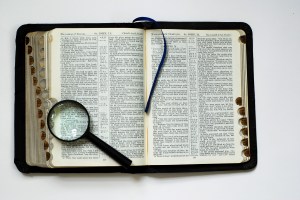
Study to shew thyself approved unto God, a workman that needeth not to be ashamed, rightly dividing the word of truth. ~2 Timothy 2:15

  1. Incomplete reading
  2. Incomplete context

1. Read Completely

As mentioned earlier, for the Matthew 7:1-5 passage, too many of us stop at verse 1, instead of reading all the way to verse 5. In verse 5, Jesus clearly states (in the analogy) that we should take the mote out of our brother’s eye, i.e., judge our brother. Jesus is saying that we should get right with God before we help our brother, because the state of our relationship with God hinders our ability to provide assistance. Indeed, as Jesus makes even clearer in John 7:24, the foundation for correct judgment is “righteousness”.

In addition, we frequently get lost in the size comparison between the log and the mote. Jesus, I believe, was emphasizing the disabling presence of the log in one brother’s eye BUT not diminishing the irritation caused by the mote. Do you remember how irritating it can be when a hair or even a speck of sand, gets in your eye and how it can cause you to lose focus on everything else? The brother with the mote needed assistance, but only someone who could see properly could help. When sin invades our lives we need help too. We need a good judge. So Paul does agree with Jesus after all. In fact, Paul writes elsewhere:

Brethren, if a man be overtaken in a fault, ye which are spiritual, restore such an one in the spirit of meekness; considering thyself, lest thou also be tempted. Bear ye one another’s burdens, and so fulfil the law of Christ. ~ Galatians 6:1-2

In other words, those that have had the stump removed (by God) from their eye (i.e., the spiritual) should help (i.e., restore) those with mote in their eye (i.e., those overtaken in a fault).

2. Read Carefully

The original Greek word for “judge”,Krino (kriðnw), has multiple meanings. Hence, the understanding of the word must be done contextually. I believe that God, in His perfect Wisdom, did this to ensure that study the scripture carefully (2 Timothy 2:15–Study to shew thyself approved unto God, a workman that needeth not to be ashamed, rightly dividing the word of truth). We will revisit this point later.

What to Judge: Fruit Inspection NOT Branch Destruction

If we now agree that its okay to judge, the next crucial issue is what to judge. Jesus provides the answer for us a few verses after showing us how to get rid of motes:

I am the vine, ye are the branches: He that abideth in me, and I in him, the same bringeth forth much fruit: for without me ye can do nothing. ~John 15:5

Beware of false prophets, which come to you in sheep’s clothing, but inwardly they are ravening wolves. Ye shall know them by their fruits. Do men gather grapes of thorns, or figs of thistles? Even so every good tree bringeth forth good fruit; but a corrupt tree bringeth forth evil fruit. A good tree cannot bring forth evil fruit, neither can a corrupt tree bring forth good fruit. Every tree that bringeth not forth good fruit is hewn down, and cast into the fire.Wherefore by their fruits ye shall know them. ~ Matthew 7:15-20

Abide in me, and I in you. As the branch cannot bear fruit of itself, except it abide in the vine; no more can ye, except ye abide in me. I am the vine, ye are the branches: He that abideth in me, and I in him, the same bringeth forth much fruit: for without me ye can do nothing. ~ John 15:4-5

But the fruit of the Spirit is love, joy, peace, longsuffering, gentleness, goodness, faith, Meekness, temperance: against such there is no law. ~ Galatians 5:22-23

Fruit type and quantity comprise a window into the spiritual state of a believer. Thus any behavior that is inconsistent with the fruit of the Spirit, or even a dearth of fruit, signifies the presence of (at least) a mote—i.e., points to weaknesses/hindrances that a christian brother/sister needs help with.

Equally important, Jesus also shows us what not to judge.

I am the true vine, and my Father is the husbandman. Every branch in me that beareth not fruit he taketh away: and every branch that beareth fruit, he purgeth it, that it may bring forth more fruit… If a man abide not in me, he is cast forth as a branch, and is withered; and men gather them, and cast them into the fire, and they are burned. ~John 15:1-2, 6

Only God (the husbandman/gardener) judges people (the branches): that is NEVER our place/job. Only God knows the state of the relationship between a believer and Christ. Fruit inspection reveals the weaknesses in a brother’s life but it never reveals his standing with God. We can declare deeds as sinful (bad fruit), but we cannot declare any person unrighteous.

Who to Judge: An Inside Job

“For what have I to do to judge them also that are without? do not ye judge them that are within? But them that are without God judgeth. Therefore put away from among yourselves that wicked person.” ~1 Corinthians 5:12-13

Now let us consider who to judge. Our answer is provided (above) in 1 Corinthians 5:12-13, where Paul instructs us to only judge our christian brothers. Stating specifically, that God alone judges those outside of the Body of Christ. The reason for this of course is that those outside of the Body of Christ do not and cannot bear fruit!

For they that are after the flesh do mind the things of the flesh; but they that are after the Spirit the things of the Spirit. For to be carnally minded is death; but to be spiritually minded is life and peace. Because the carnal mind is enmity against God: for it is not subject to the law of God, neither indeed can be. So then they that are in the flesh cannot please God. But ye are not in the flesh, but in the Spirit, if so be that the Spirit of God dwell in you. Now if any man have not the Spirit of Christ, he is none of his. ~Romans 8:5-9

Consequently, the interaction between believer and non-believer should always be limited to salvation. Without salvation, neither moral nor immoral behavior pleases God because no one can work-for/earn righteousness.

How to Judge: Use the Right Scales

In Matthew 7:2 (above), Jesus shows us both how to judge and how not to judge: Don’t use your scales. If we use our (human-nature-brand) scales, we will be judged on them. And that is not good because we are inherently unmerciful and unfair, biased and myopic. instead we should use God’s scales which are found in the entirety of His Word. We must use the clear and unbiased Word to guide our judgement, applying the Word with the fairness and mercy of God, Himself working through us.

For with what judgment ye judge, ye shall be judged: and with what measure ye mete, it shall be measured to you again. ~Matthew 7:2

But thou, O Lord, art a God full of compassion, and gracious, long suffering, and plenteous in mercy and truth. ~Psalm 86:15

Who is a God like unto thee, that pardoneth iniquity, and passeth by the transgression of the remnant of his heritage? he retaineth not his anger for ever, because he delighteth in mercy. ~Micah 7:18

Why to Judge: Watch for Wolves

There are two reasons scripture gives us for judging. The first is to protect. Jesus (and Peter and Jude) warns us, in Matthew 7:15, to beware of false prophets who seek to destroy the sheep/church. Fruit inspection he instructs is the key to discerning the false from the true.

The second reason for judging is found in Matthew 7:5, Galatians 6:1-2 and James 5:20. Therein God shows us that proper fruit inspection affords us the ability to help a brother in need; to save him.

Taken together, we should judge (inspect fruit) to preserve and protect the church. This is of crucial importance today, because of the plethora of the false. We must equip ourselves through study of the Word of God to discern the truth so that we ourselves are not lead astray AND so that we can help others to stay in line with God. We judge(inspect fruit) therefore, not out of self-righteousness, but out of humility (by using God’s scales not ours) and love (we bear each other’s burdens).

Bookmark and Share

Reflections in Nehemiah: Weak Strength & Blessed Oppression

Bookmark and Share

Nehemiah 2:10
When Sanballat the Horonite, and Tobiah the servant, the Ammonite, heard of it, it grieved them exceedingly that there was come a man to seek the welfare of the children of Israel.

______________________________

Having obtained the king’s permission and protection, Nehemiah continued his mission for the KING, Jehovah. As soon as Nehemiah entered Judea, he received opposition in the form of Sanballat the Horonite, and Tobiah the servant, the Ammonite. (Tobiah, it seems, was a servant of Sanballat, who was the governor of Samaria, and was helping him to oppress the Jews.) Both these men had been able to exert their power over the affairs of the Jews and immediately realized that Nehemiah’s arrival would change that. And they were not happy about it.

The Strong are God-Filled; The Weak are Just Hollow

“Thus saith the LORD, Let not the wise man glory in his wisdom, neither let the mighty man glory in his might, let not the rich man glory in his riches: But let him that glorieth glory in this, that he understandeth and knoweth me…” ~Jeremiah 9:23-24a

God provides us with insight into the nature of the opposition that His servants face when doing His will. The name Sanballat means “strength” and Horon means “hollowness”. So the opposition Nehemiah faced (Sanballat of Horon) was the strength of hollowness or hollow strength. In other words, the servant of God walking in the will of God faces opposition that has no substance, no real power. This is not to say, however, that the battle is not real. The battles that believer’s face while serving God can be painfully real, just ask Paul who was imprisoned and beaten even almost to death (2 Corinthians 11:23-27). But despite the opposition, the victory is assured.

Sanballat had no chance of stopping Nehemiah from accomplishing God’s will; any strength he appeared to have was just a façade. Every time the name Sanballat the Horonite was mentioned Nehemiah would hear “hollow strength”. Similarly, despite the numerous beatings and imprisonments he endured, Paul still accomplished his mission

“I have fought a good fight, I have finished my course, I have kept the faith” ~ 2 Timothy 4:7

Just like Nehemiah and Paul, we can also be sure of accomplishing God’s will for us if we remain faithful to Him. Indeed, we are the only ones that can ‘stop’ God’s plan from being accomplished in our lives.

Lemons make Lemonade; Trials make Triumphant

We can also gain insight from the name Tobiah, which means “Jehovah is good” and Ammonite (Ben-Ammi) means “children of my people”. So the unwitting message in Tobiah’s name is that God is good, [to the] children of my people: God is good to His children.

“…We glory in tribulations also: knowing that tribulation worketh patience; And patience, experience; and experience, hope: And hope maketh not ashamed; because the love of God is shed abroad in our hearts by the Holy Ghost which is given unto us.” ~Romans 5:3b-5

Many years earlier, when the Israelites were journeying from Egypt to take possession of the Promised Land, Balaam was hired to curse the Israelites but instead ended up blessing them whenever he opened his mouth (Numbers 22-24). Now that the Israelites were repossessing the home God had given them, it is Tobiah who is seeking to oppress the Jews. But, similar to Balaam before him, Tobiah, every time his name was mentioned, constantly reminded the Jews of God’s goodness.

Likewise, when the servants of God, walking in the will of God, face opposition it is good. Scripture reminds us of this fact in many places:

“And we know that all things work together for good to them that love God, to them who are the called according to his purpose.” ~ Romans 8:28

“My brethren, count it all joy when ye fall into divers temptations; Knowing this, that the trying of your faith worketh patience. But let patience have her perfect work, that ye may be perfect and entire, wanting nothing.” ~ James 1:2-4

When God allows opposition to face us, even as we are doing His will, it is for GOOD! Therefore, those who oppose servants of God are unwittingly helping them, instead of hurting them. Paul was sent to prison in Rome to stop him from spreading the Gospel. But instead of stopping him, God wrote many of the epistles in the New Testament through Paul while he was in prison.

Therefore, servants of God who are walking in the will of God as they accomplish the plans of God have no reason to fear. No one can stop them from doing God’s work and those who try are only blessing them; making them stronger.

Bookmark and Share

Reflections in Nehemiah: Feeling The Good Hand of God

Bookmark and Share

Nehemiah 2:7-8
Moreover I said unto the king, If it please the king, let letters be given me to the governors beyond the river, that they may convey me over till I come into Judah; And a letter unto Asaph the keeper of the king’s forest, that he may give me timber to make beams for the gates of the palace which appertained to the house, and for the wall of the city, and for the house that I shall enter into.
And the king granted me, according to the good hand of my God upon me.

“Thou wilt shew me the path of life: in thy presence is fulness of joy; at thy right hand there are pleasures for evermore.” ~Psalm 16:11

The king granted everything Nehemiah needed for his mission to rebuild the walls of Jerusalem, ACCORDING TO “the good hand of my God upon me”. Nehemiah recognized the Good Hand of God working things out and making his way smooth, because Nehemiah was walking in God’s will, accomplishing His plan.

Like Nehemiah, God has a plan for every one of us. And as long as we yield to His will, nothing can prevent that plan from being executed. Therefore, the key to experiencing the Good Hand of God upon me is to discover His will for me and to walk in it.

“For I know the thoughts that I think toward you, saith the LORD, thoughts of peace, and not of evil, to give you an expected end.” ~ Jeremiah 29:11

“For we are his workmanship, created in Christ Jesus unto good works, which God hath before ordained that we should walk in them.” ~ Ephesians 2:10

Bookmark and Share

Reflections in Nehemiah: The Right Words to Say


Bookmark and Share


Nehemiah 2:4
Then the king said unto me, “For what dost thou make request?”, So I prayed to the God of heaven.

Nehemiah had just gotten the opening he was looking for and now he intended to ask the King for permission to rebuild the walls of Jerusalem.  The safety and well-being of the Jews that had returned home from captivity was in constant jeopardy because the broken-down walls of Jerusalem had not yet been rebuilt.  There was a LOT at stake!  It was crucial that Nehemiah said the right words to the King.

"Let the words of my mouth, and the meditation of my heart, be acceptable in thy sight, O LORD, my strength, and my redeemer." ~Psalm 19:14

There are times when we find ourselves in situations similar to Nehemiah’s: where we need to find the right words to say.  It might be in an interview to get a job we desperately need.  It might be to guide/inspire our children to make right choices.  It might be to encourage someone who is depressed.  It might be to lead someone to accepting Jesus Christ as their Lord and Saviour.  At those times we discover the truth of the Proverb:

“A word fitly spoken is like apples of gold in pictures of silver.” ~Proverbs 25:11

In such times, we must follow Nehemiah’s example and say a word of prayer (even a quick silent prayer), looking to God to supply the right words that we need for our circumstance.  But, it doesn’t stop there.  Notice that Nehemiah prayed and then (in the next verse) he spoke.  That is, Nehemiah stepped out in faith that the Lord would answer his prayer and give him precisely the right words to say.

Moreover, let us notice that Nehemiah could have this confidence in God, because he was seeking to do the work of God, while walking in the will of God.  Nehemiah was not on a mission to serve his own agenda or fulfill his human desires.  Nehemiah was on a mission to serve God, so he was confident that God would give him the right words to say, when he asked.  Like Moses, when God sends us, when we are walking in His will, He will give us the words we need to say

“Now therefore go, and I will be with thy mouth, and teach thee what thou shalt say.” ~ Exodus 4:12


Bookmark and Share


Pain and Prayer

Bookmark and Share

Nehemiah 1:4
And it came to pass, when I heard these words, that I sat down and wept, and mourned certain days, and fasted, and prayed before the God of heaven

Nehemiah had just received some bad news. His fellow Jews who had returned home after the Babylonian captivity were still struggling. They were under threat from hostile neighboring nations and they were vulnerable because the walls of their main city, Jerusalem, had not been rebuilt.

And I said, My strength and my hope is perished from the LORD: Remembering mine affliction and my misery, the wormwood and the gall. My soul hath them still in remembrance, and is humbled in me. ~ Lamentations 3:18-20

The key point of this verse, however, is Nehemiah’s reaction to the news. The verse tells us that he

  1. wept and mourned
  2. fasted and prayed.

That is, Nehemiah’s response to the painful news was both emotional and spiritual/devotional.

When dealing with grief we often fail to realize the importance of affording ourselves and others the room to be both emotional and spiritual. It is okay to weep and mourn as long as we also remember to fast and pray to God. Likewise, as we seek God in difficult times let us not forget our humanity, because He doesn’t.

Painful experiences, like the loss of a loved one, or coping with an illness that ravages our bodies or even facing financial ruin that threatens our families, can tear our hearts open. But it is while our hearts are ripped open and raw that God can finally reach past the barriers to touch the core of our being. It is in these moments that that the façade is ripped away and we can only be who we really are, unvarnished, before Him.

This I recall to my mind, therefore have I hope. It is of the LORD’s mercies that we are not consumed, because his compassions fail not. They are new every morning: great is thy faithfulness. ~ Lamentations 3:21-23

Indeed, in the midst of our sorrow, when we are sick with grief, the Holy Spirit cries out to God for us:

“Likewise the Spirit also helpeth our infirmities: for we know not what we should pray for as we ought: but the Spirit itself maketh intercession for us with groanings which cannot be uttered. ~Romans 8:26

Because God has compassion; He feels our distress; He knows our pain:

“For we have not an high priest [Jesus] which cannot be touched with the feeling of our infirmities…” ~Hebrews 4:15a

As we deal with the hurt that we sometimes experience, let us allow our emotions to flow out and God’s tender mercies to flow in.

Bookmark and Share

Reflections in Nehemiah: Finding Comfort in Crisis


Bookmark and Share


Nehemiah 1:1-3
1 The words of Nehemiah the son of Hachaliah. And it came to pass in the month Chisleu, in the twentieth year, as I was in Shushan the palace,  2 That Hanani, one of my brethren, came, he and certain men of Judah; and I asked them concerning the Jews that had escaped, which were left of the captivity, and concerning Jerusalem.  3 And they said unto me, The remnant that are left of the captivity there in the province are in great affliction and reproach: the wall of Jerusalem also is broken down, and the gates thereof are burned with fire.

Finding Comfort in Crisis

The main message of the book of Nehemiah is contained in the first sentence. The name Nehemiah means “Jehovah comforts” and the name Hachaliah means “whom God enlightens”. In Scripture God often uses the names of people to convey a message Abraham, Isaac, Jacob/Israel, to name just a few, each have specific meanings to remind us of God’s purpose or judgment in specific situations.

“I am come a light into the world, that whosoever believeth on me should not abide in darkness.” ~John 12:46

This is also true for the book of Nehemiah, which details how Nehemiah went about rebuilding the walls of Jerusalem. The walls of Jerusalem had been destroyed earlier by the Babylonians and now that the Hebrews had returned home there was no wall. In this period of history, unwalled cities were vulnerable: they lacked both physical and economic security. As a result, the Hebrew nation was being oppressed by hostile clans around them. How could they cope?

God’s answer came in the form of Nehemiah son of Hachaliah: God comforts whom God enlightens. The secret to coping in situations where one is vulnerable and/or being taken advantage of, is to have our understanding illuminated by God.

At the beginning of Psalm 73, the Psalmist expresses despair at the seeming success of the unjust compared to the suffering of the just:

“But as for me, my feet were almost gone; my steps had well nigh slipped. For I was envious at the foolish, when I saw the prosperity of the wicked… Behold, these are the ungodly, who prosper in the world; they increase in riches. Verily I have cleansed my heart in vain, and washed my hands in innocency. For all the day long have I been plagued, and chastened every morning.” ~Ps. 73: 2-3, 12-14

But then the psalmist is enlightened:

“When I thought to know this, it was too painful for me; Until I went into the sanctuary of God; then understood I their end.” ~Psalm 73:16-17

And by that enlightenment he finds comfort:

“Thou shalt guide me with thy counsel, and afterward receive me to glory. Whom have I in heaven but thee? and there is none upon earth that I desire beside thee. My flesh and my heart faileth: but God is the strength of my heart, and my portion for ever.” ~Psalm 73:24-26

“Then spake Jesus again unto them, saying, I am the light of the world: he that followeth me shall not walk in darkness, but shall have the light of life.” ~John 8:12

Likewise, when the Syrian army surrounded Elisha, Elisha’s servant was terrified. But when God “opened” the eyes of Elisha’s servant so he could see the Army of Angels encamped around them (“the mountain was full of horses and chariots of fire”), then he was comforted (2 Kings 6:14-18).

The message for us is the same. As we face the various crises that come into our lives—whether it is job-loss, sickness, death or even depression—we can only receive God’s comfort when we accept His enlightenment. It is only as we grow in our knowledge and understanding of His Word, through the work of the Holy Spirit, as we read the scripture and commune with God in prayer, that we will gain the “the peace of God, which passeth all understanding” (Phil. 4:7).

“Jehovah comforts whom Jehovah enlightens”


Bookmark and Share


Redemption (Part 4): Knowledge [of God] is Power

Bookmark and Share

Genesis 3:6, 9-13
6And when the woman saw that the tree was good for food, and that it was pleasant to the eyes, and a tree to be desired to make one wise, she took of the fruit thereof, and did eat, and gave also unto her husband with her; and he did eat…

The law of his God is in his heart; none of his steps shall slide. (Psalm 37:31)

9And the LORD God called unto Adam, and said unto him, Where art thou? 10And he said, I heard thy voice in the garden, and I was afraid, because I was naked; and I hid myself. 11And he said, Who told thee that thou wast naked? Hast thou eaten of the tree, whereof I commanded thee that thou shouldest not eat? 12And the man said, The woman whom thou gavest to be with me, she gave me of the tree, and I did eat. 13And the LORD God said unto the woman, What is this that thou hast done? And the woman said, The serpent beguiled me, and I did eat.

WHY DID/DO YOU SIN?
Mankind has sinned and in need of Redemption from the curse of sin. To help man understand His pre-ordained redemption plan, God asked Adam three key questions.

The first question (vs. 9) establishes the first consequence of sin: Estrangement. Sin separates man from God and the first work of God’s redemption plan is to bridge that gap.

The second question (vs. 11a) reveals the second crucial consequence of sin: Confusion. In a sinful state, men elevate their thinking above God’s, trusting their own perspective and reasoning. The second work of God’s redemption plan is to replace mankind’s worldview with His Word.

The third question (vs. 11a) shows the true definition/nature of sin: Disobedience. The third work of God’s redemption plan is to define unequivocally that (any and all) sin is disobedience to God’s Word, which is perfectly expressed in the Bible, but also revealed in nature (Romans 1:18-20) “so that they are without excuse”.

Now we come to the fourth and final question (vs. 13) where God is asks (in paraphrase) “Why did/do you sin?” God wants us to evaluate, to understand why we sin, because knowledge will give us power over sin. In other words, if we know why we sin then we will know how to defeat sin. The Bible tells us:

But every man is tempted, when he is drawn away of his own lust, and enticed. Then when lust hath conceived, it bringeth forth sin: and sin, when it is finished, bringeth forth death. ~James 1:14-15

Explicitly, we sin because our desires/wants combine with our will. Earlier in the chapter (Genesis 3:1-5) it is apparent that there is a separation between Eve’s will and her craving for the fruit. Even if the fruit looked good, God had said not to eat it. And so she did not eat it, since she had submitted her will to God’s command/authority, i.e., God’s Word. What the devil did was to give Eve and Adam, reasons (“Ye shall not surely die: For God doth know that in the day ye eat thereof, then your eyes shall be opened, and ye shall be as gods, knowing good and evil.” ~ Genesis 3:4b-5) to replace God’s command/authority with their will. Once this happened, the joining of man’s will to man’s desires/wants produced sin.

Therefore, the fourth work of God’s redemption plan is, by the ongoing work of the indwelling Holy Spirit, to prevent the joining of a man’s will to his desires. This is done by:

  • Placing our will (back) into submission to God’s will/authority

and

  • Transforming our desires.

The Bible expresses it this way:

But put ye on the Lord Jesus Christ, and make not [an act of the will] provision for the flesh [the source of our desires], to fulfill the lusts thereof [i.e., to sin]. ~Romans 13:14

Subjugating our will under God’s Word is our choice; a choice we must make daily.

Submit yourselves therefore to God. Resist the devil, and he will flee from you. ~James 4:7

Humble yourselves therefore under the mighty hand of God… ~1 Peter 5:6a

Conversely, our human desires are changed by God through the working of the Holy Spirit and His word in us.

Order my steps in thy word: and let not any iniquity have dominion over me. (Psalm 119:133)

Thy word have I hid in mine heart, that I might not sin against thee. ~Psalm 119:11

And be not conformed to this world: but be ye transformed by the renewing of your mind, that ye may prove what is that good, and acceptable, and perfect, will of God. ~Romans 12:2

Therefore, now that we know why we sin, the question we must ask ourselves is “Do we want to overcome sin?” To be clear, it is a difficult battle to overcome sin in any believer’s life, as it was even for a stalwart like Paul (Romans 7). Our will rages against God’s authority and our desires demand fulfillment (especially those desires we have unwisely nurtured over the years). However, the key point is that it CAN be done (1 Corinthians 9:27). We CAN overcome sin by continually submitting our will to God’s authority, by studying, memorizing and frequently contemplating God’s Word, so that it can transform us by replacing our human desires with Godly desires. Then God’s will and God’s plan will consummate in us to produce righteousness to the Glory of God.

Bookmark and Share

——————————————————————————————————————-
**This is the fourth and final installment in a series on the Origins of Redemption as given in Genesis 3**