Latest Posts

Encounters with Jesus: The Widow’s Mite… “Only Faith will enable us to give until we have nothing left.”

Bookmark and Share

Mark 12:41-44
41And Jesus sat over against the treasury, and beheld how the people cast money into the treasury: and many that were rich cast in much. 42And there came a certain poor widow, and she threw in two mites, which make a farthing. 43And he called unto him his disciples, and saith unto them, Verily I say unto you, That this poor widow hath cast more in, than all they which have cast into the treasury: 44For all they did cast in of their abundance; but she of her want did cast in all that she had, even all her living.

NOTES

  1. It’s not the size of our gift; it’s the size of our faith.
  2. It’s not how much we GIVE; it’s how much we KEEP

CHORDS

Jesus observes a poor widow putting money into the temple treasury and uses the opportunity to teach his disciples, and us, God’s perspective on giving. Jesus shows us that instead of how much we give, God looks at (a) the circumstances in which we give and (b) how much we keep for ourselves.

Riches profit not in the day of wrath: but righteousness delivereth from death. (Proverbs 11:4)

In teaching His disciples, Jesus first focused on the person giving, rather than the gift given (vs. 43). The gift giver was a poor widow. The significance of this would not be lost on the disciples, because most widows in those days were greatly disadvantaged.

“Under the Mosaic dispensation no legal provision was made for the maintenance of widows. They were left dependent partly on the affection of relations, more especially of the eldest son, whose birthright, or extra share of the property, imposed such a duty upon him…” (Smiths Bible Dictionary)

“…The loss of a husband in ancient Israel was normally a social and economic tragedy. In a generally patriarchal culture, the death of a husband usually meant a type of cultural death as well… Her crisis was aggravated if she had no able-bodied children to help her work the land of her dead spouse. To provide for her children, to maintain the estate, and to continue payments on debts accrued by her husband imposed severe burdens. Since she was in an extremely vulnerable economic position, she became the prime target of exploitation. The fact that she was classed with the landless stranger and Levite indicates that she was often unable to keep her husband’s land.” (Baker’s Evangelical Dictionary)

Jesus wanted them to realize was that the poor widow’s gift was a great value, because she gave even though she was in need herself. Paul echoes this principle in when he praised the generosity of the Macedonian churches, which though poor gave liberally.

“Moreover, brethren, we do you to wit of the grace of God bestowed on the churches of Macedonia; How that in a great trial of affliction the abundance of their joy and their deep poverty abounded unto the riches of their liberality. For to their power, I bear record, yea, and beyond their power they were willing of themselves; Praying us with much intreaty that we would receive the gift, and take upon us the fellowship of the ministering to the saints.” ~ 2 Corinthians 8:1-4
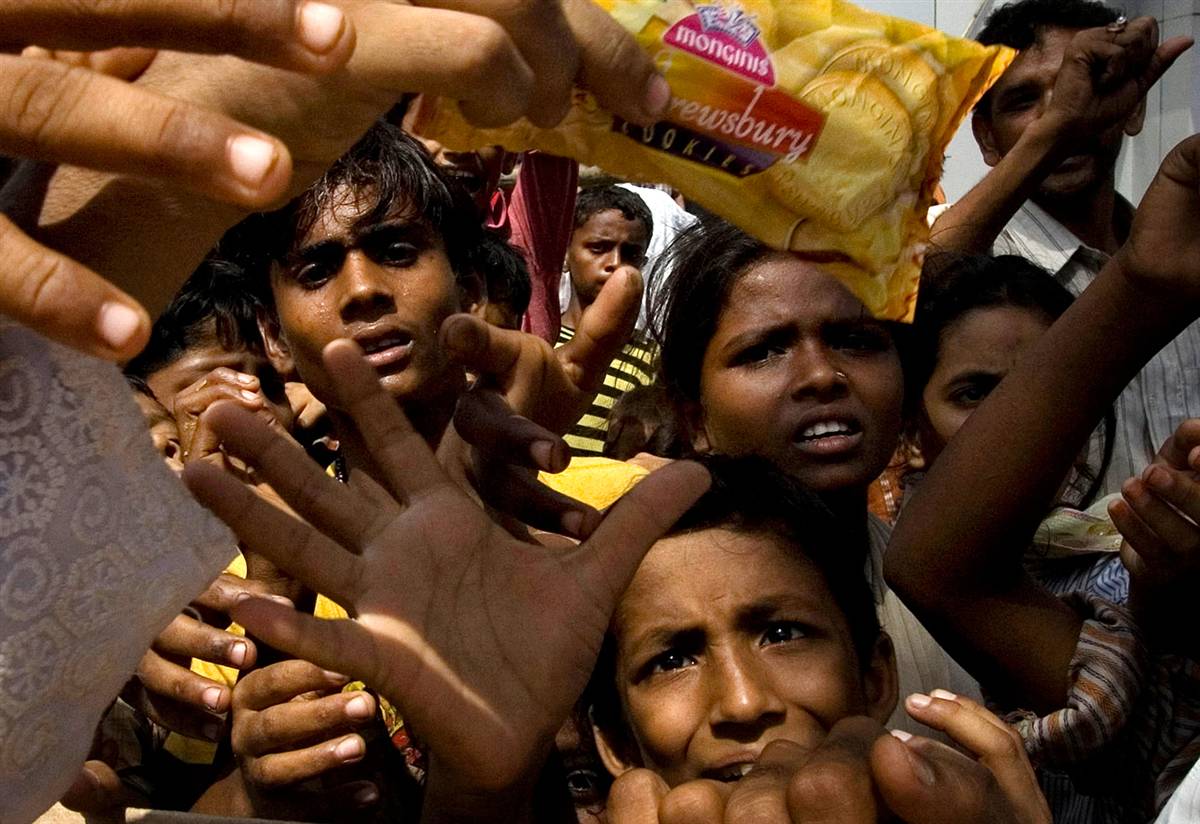
Give to every man that asketh of thee; and of him that taketh away thy goods ask them not again. (Luke 6:30)

The message to us is that we are never too poor to give. We are never too impoverished to help someone else. Even if, like another famous widow (1 Kings 17: 9-16), we have one morsel of food left to eat, we still can share.

The truth is that most of us will never face such dire need, though many of us do face financial difficulties of varying degree. But, the challenge is: Do we look at our circumstances and think we should give more or give less? When economic pressures threaten to smother us, do we close the purses/wallets tighter or do we open them wider?

Jesus, through the example of the poor widow, dares us to give. Give even when it hurts. It’s when we can least “afford” to give that God values our gift the most.

Everyone else (rich, poor and in-between), Jesus tells us, gave out of “their abundance” (vs. 44). And such gifts, no matter how much, had less value to God.

God is not concerned about the size of our gifts. God cares about the “size” of our faith.

Next, Jesus focuses on the poor widow’s gift. But notice His words (vs. 44b), “…she of her want did cast in all that she had, even all her living”. Of necessity, the Scripture tells us that the widow gave 2 mites (less than two-percent of a day’s wage). But pointedly Jesus addresses the fact that she had nothing left. God determines the value of a gift by what the giver keeps, not what the giver gives. This is counter-intuitive.

…I live by the faith of the Son of God, who loved me, and gave himself for me. (Galatians 2:20b;)

Most Christians consider tithing, giving ten-percent of one’s income, to be a virtue. However, it is clear that ten-percent is a bigger sacrifice for the person earning ten dollars a day, than the person earning one thousand dollars a day. It’s takes more faith to live on nine dollars a day, than on nine hundred dollars a day.

Jesus asserts that the widow’s gift was of greater value, not because of the amount she gave, but because of the amount she kept for herself, which was zero. Likewise, to understand how much we are really giving to God we must consider how much we keep for ourselves.

Finally, one theme that arises from this encounter with Jesus is the triumph of faith over rationality/logic/reason. The actions of the widow could not be supported by a rational argument. Indeed, if we knew her, many of us would have advised her to keep what she had for she didn’t have enough to give; “God would understand”.

Two mites were too small for her to give a tenth; they didn’t make any smaller money. Yet, she could have given one mite and kept the other. Instead the widow gave it all.

Her act could only have come from her faith in God to supply her needs. She believed that the same God that allowed her husband to die, the same God that watched as she became destitute, was still merciful. That same God would supply her needs; that same God was worthy of praise; that same God loved her and had a purpose for her life.

In the midst of difficulties, trials, tribulations and all types of storms, faith is what allows the believer to keep going. Faith, NOT logic, NOT reason, NOT rationality, Faith will sustain believers to the end.

And I said, My strength and my hope is perished from the LORD:
Remembering mine affliction and my misery, the wormwood and the gall.
My soul hath them still in remembrance, and is humbled in me.
This I recall to my mind, therefore have I hope.
It is of the LORD’s mercies that we are not consumed, because his compassions fail not.
They are new every morning: great is thy faithfulness.

~ Lamentations 3:18-26

Only Faith will enable us to give when we have almost nothing left, and give until we have nothing left.

CODA

  • How much of God’s provision are you keeping for yourself?
  • As the economy gets harder, are you becoming more generous?
  • Is your faith as big as a poor widow’s?

Bookmark and Share

The Parable of the Two Sons: “It’s not how you start… It’s how you finish!”


Bookmark and Share


Even so faith, if it hath not works, is dead, being alone. (James 2:17)

Matthew 21:28-32
28 But what think ye? A certain man had two sons; and he came to the first, and said, Son, go work to day in my vineyard. 29 He answered and said, I will not: but afterward he repented, and went. 30 And he came to the second, and said likewise. And he answered and said, I go, sir: and went not. 31 Whether of them twain did the will of his father? They say unto him, The first. Jesus saith unto them, Verily I say unto you, That the publicans and the harlots go into the kingdom of God before you. 32 For John came unto you in the way of righteousness, and ye believed him not: but the publicans and the harlots believed him: and ye, when ye had seen it, repented not afterward, that ye might believe him.

NOTES

  1. It’s not what you SAY, It’s what you DO
  2. It’s not how you START, It’s how you FINISH
  3. It’s not who you ARE, It’s who you can BECOME
  4. It’s not yet too late (for anyone) to CHANGE

CHORDS

In this short parable Jesus shows us God’s emphasis on deeds over words, accomplishments over intentions and growth over standing. The first son said he would not obey, but then he did (faithfulness). While the second son said he would do his father’s wishes, but then didn’t (believism). By application, God is far less interested in what we say and more interested in what we do. It is easy to say we believe/trust in God, it is much harder to actually demonstrate that belief/trust in our lives. If the extent of our faith lies in the words we say or principles we profess, then that is no faith at all.

But be ye doers of the word, and not hearers only, deceiving your own selves. ~James 1:22

What doth it profit, my brethren, though a man say he hath faith, and have not works? can faith save him?  If a brother or sister be naked, and destitute of daily food, And one of you say unto them, Depart in peace, be ye warmed and filled; notwithstanding ye give them not those things which are needful to the body; what doth it profit? Even so faith, if it hath not works, is dead, being alone. Yea, a man may say, Thou hast faith, and I have works: shew me thy faith without thy works, and I will shew thee my faith by my works. ~James 2:14-18

“…Choose you this day whom ye will serve… but as for me and my house, we will serve the LORD.” ~Joshua 24:15

It’s not what we say that matters; it’s what we do. The starkness of the parable on this matter is arresting. Absolutely NO credit is given to the son who initially gave the right (verbal) answer. Instead, the son who initially gave the wrong (verbal) answer gets ALL the credit. Clearly, their actions completely erased their original statements. In other words, it’s far less important to get the words right, than to get the deeds right. This notion is corroborated in the well-known Parable of the Talents (Matthew 25:14-30) where the servants were judged on what they did, and NOT what they said/professed. Immediately following that parable, Jesus describes for His disciples what the Final Judgment would be like. In His account, the Father separates the sheep (the saved) from the goats (the unsaved) and notably the sole dividing factor was their deeds:

Then shall the King say unto them on his right hand, Come, ye blessed of my Father, inherit the kingdom prepared for you from the foundation of the world: For I was an hungred, and ye gave me meat: I was thirsty, and ye gave me drink: I was a stranger, and ye took me in: Naked, and ye clothed me: I was sick, and ye visited me: I was in prison, and ye came unto me. ~Matthew 25:34-36

Notwithstanding, the Bible makes it clear that we are saved by grace though faith and “Not of works, lest any man should boast” (Ephesians 2:8-9). But we are saved UNTO works (Ephesians 2:10), so our deeds/actions reveal our heart condition in ways our words never can. As any science student can attest, only theories confirmed by experiment can be trusted. Likewise, the only way our faith can be verified is through our actions. Christians will never change the world with religious talk unless it is coupled with righteous walk.

...This one thing I do, forgetting those things which are behind, and reaching forth unto those things which are before, I press toward the mark for the prize of the high calling of God in Christ Jesus. (Philippians 3:13-14)

This parable also shows us that it’s not how we start that matters, it’s how we finish. The second son started off on the correct footing, he had the right answer, which might indicate that he had the right intentions. Perhaps he did mean to obey his father. The first son, it is clear, had the wrong intentions as well as the wrong answer. But, after he repented, the first son actually does his father’s bidding; while the second, despite his probable good intentions, doesn’t. As in the famous saying: “The road to hell is paved with good intentions”.

The application is that it’s not enough to start well; we must finish well too. No winners are declared at the start of a race; winners are decided only at the finish line. So regardless of our good intentions, if the faith we profess does not lead us into obedience then:

As the body without the spirit is dead, so [our] faith without deeds is dead ~James 2:26.

Similarly, it doesn’t matter where we started; the errors of our past are inconsequential. No matter how filthy I was before, and no matter how filthy I am now, its not too late to turn around if I realize my state before God and, like the second son, I repent and then obey:

…This one thing I do, forgetting those things which are behind, and reaching forth unto those things which are before, I press toward the mark for the prize of the high calling of God in Christ Jesus ~Philippians 3:13-14.

Thirdly, this parable of the two sons shows us the importance of transformation. The favorable outcome of the second son hinged on one thing: repentance. Repentance is the hinge on which transformation pivots. Only AFTER repentance did the change take place.

For our lives to be transformed by God we must repent; we must change our mindset from self-direction to God-direction, from rebellion to obedience. There is only one way: God’s way. But how do we get there? We get there by accepting the truth rather than avoiding it.

...Be not conformed to this world: but be ye transformed by the renewing of your mind... (Romans 12:2)

Jesus told the parable in response to the badgering of the Pharisees. They knew John the Baptist was a prophet and they knew John declared Jesus to be the Messiah and they knew from Jesus’ miracles that He was sent from God (John 3:2) but to accept the truth meant they would have to change their ways. In the end they decided that stagnation was preferable to transformation and so they killed Him.

The same choice is open to us. If we know the Bible is real, then we must accept its teaching and yield to God’s way, i.e., we must repent. Until we submit to God it is impossible to obey Him. And so we—like the second Son—rather than being doers, we become professors of the faith only:

Having a form of godliness, but denying the power thereof ~2 Timothy 3:5.

Finally, Jesus leaves hope for all regardless of where we stand: in Matt. 21: 31 (above) He uses the word “before” rather than “and not”. By so doing he was telling the Pharisees and all of the other “second sons” that they still had a chance. The opportunity to repent had not yet passed them by; make use of it.

CODA

  • What are you DOING about what you know?
  • How are you FINISHING the race you started?
  • Are you BECOMING more than you are?
  • Will you start the CHANGE today?


Bookmark and Share