Latest Posts

Faith Takes us where our Minds cannot Go


Facebook Twitter More...

“For my thoughts are not your thoughts, neither are your ways my ways, saith the Lord. For as the heavens are higher than the earth, so are my ways higher than your ways, and my thoughts than your thoughts.” ~ Isaiah 55:8-9

This verse explains for us why we are so often confused and/or surprised by how God resolves situations. Indeed, a reasonable conclusion is that we should not even bother to try to “understand” how God operates: As we call on God to resolve the various issues that confront us, our challenge is never to understand the things He does, our challenge is to have faith in Him.

Similarly, we aren’t called to explain God to anyone: we can’t: God cannot be explained: God cannot be contained in any humanly sourced rational framework: God cannot be formulated.

As the Bible tells us, we are called to share our FAITH, not our LOGIC. All through the book of Acts, whenever Paul shared his testimony, he never sought to explain the “why”, he only recounted the “what”.

We will never (fully) understand why God operates in the way that He does. And, if we try to, we will be left frustrated. But, we can trust in Him. We can accept His way to be perfect and trust that He will do what is best.

“Such knowledge is too wonderful for me; it is high, I cannot attain unto it.” ~ Psalm 139:6

In closing, consider this (somewhat silly) example:doggie cool

You can’t explain to your dog (if you have one) that s/he shouldn’t have chocolate because it will make him sick. Isn’t it great that your dog doesn’t get mad with you and go off to someone who will give her/him chocolate? Isn’t it wonderful that your dog is “dumb” enough to trust your decisions?

Likewise, let us commit to being “dumb” enough to trust God’s way, because we certainly won’t ever (fully) understand it.

Faith takes us where our minds cannot go
Faith shows us what our minds cannot know
Reason asks for an explanation
God’s ways are beyond contemplation
Faith accepts that God knows what is best
In God’s loving hands we can find rest

(For the philosophers: If we were ever to understand God (completely), we would become His equal: we would be God! When a doctoral student understands the research topic equally as well as his/her professor does, the student and the professor become academic equals. We will never understand God, because we will never be His equal. Therefore, faith is the only way we can respond to Him.)

Welcoming Worship with the Willing within the Wilderness & without Widgets


Facebook Twitter More...

I was glad when they said unto me, Let us go into the house of the Lord.
Our feet shall stand within thy gates, O Jerusalem.
Jerusalem is builded as a city that is compact together:
Whither the tribes go up, the tribes of the Lord, unto the testimony of Israel,
to GIVE THANKS unto the name of the Lord.
~ Psalm 122:1-4

In our passage, the psalm writer (David) is commenting on the worship of God in Jerusalem by the people of Israel.

Worship Attitude: Glad to Greet God

In verse 1, David expresses his own joy and eagerness to worship God. When he was summoned to worship he was glad to go. What a contrast to many a modern day Christian. So many of us can barely drag ourselves into church once a week, and we are often not glad to be there.

Notice that there is no commentary on whether the people were ‘nice’, or whether the music or worship style suited his taste or whether the sermons were good. (Indeed, descriptions of worship services in the books of Ezra and Nehemiah sometimes seem rather long and comparatively ‘un-entertaining’ by today’s standards.) He was just glad to get an opportunity to worship God. The focus was not on himself in any way, his focus was on God and so he was glad to go and worship Him.

Worship Unity: Blessed to Befriend my Brother

In verses 2-3, the psalm-writer takes the perspective of the people, and the focus turns to unity. The tribes of Israel were diverse and had grown more distinct over the years, they even had different dialects (e.g., see Judges 12:1-6). However, despite their differences they had a common history: God saved them from bondage in Egypt. And, because of this history, they would worship God together.

2981

Indeed, the psalm-writer tells us that Jerusalem was “compact together”, which in one sense speaks to its size. When the people of Israel came to worship, they would have to cram into the city, so much so that interaction with others was unavoidable. Jerusalem, then, was designed to create interaction that would promote fellowship which is the basis of unity.

Likewise, the church too is ‘designed’ to be like the Jerusalem described in our text: The church is the place where believers should ‘cram in’ and interact with each other: where believers get to know each other far beyond just superficially:

“Hello, how are you?” asks Believer #1.
“Oh, I am blessed!”, responds Believer #2.
[They then pass each other while exchanging perfunctory smiles, not bothering to invest the time needed to really get to know each other as real Brothers/Sisters in Christ must.]

The church is where we build relationships that carry on beyond the walls of the building. The church is where a diverse group of people come to worship God because of their shared history of salvation! And that love-infused fellowship declares the truth of Jesus’ message.

However, the psalm-writer was also speaking prophetically. Jerusalem, and the people of Israel, were not as united as God had intended. And scripture records a fair amount of disunity (in fact, the kingdom would split when David’s grandson became king and there were civil wars at the start and in the middle of David’s reign).

The people did not all share David’s love for God: many were caught up in idol worship. But by inspiration of The Holy Spirit, David knew that one day God would unify a people who loved Him to worship Him together, in unity, in The New Jerusalem:

“Sing and rejoice, O daughter of Zion: for, lo, I come, and I will dwell in the midst of thee, saith the Lord.  And many nations shall be joined to the Lord in that day, and shall be my people: and I will dwell in the midst of thee, and thou shalt know that the Lord of hosts hath sent me unto thee.
And the Lord… shall choose Jerusalem again.” ~ Zechariah 2:10-12

And I John saw the holy city, New Jerusalem, coming down from God out of heaven, prepared as a bride adorned for her husband.  And I heard a great voice out of heaven saying, Behold, the tabernacle of God is with men, and he will dwell with them, and they shall be his people, and God himself shall be with them, and be their God.” ~ Revelation 21:2-3

Worship Testimony: Eager to Evangelize my Enemies

In verse 4, the psalm writer continues to focus on unity of the people of God, but shifts the emphasis outward. The tribes of the Lord go up, in unity, to worship God “unto the testimony of Israel, to GIVE THANKS unto the name of the Lord”.

5722

The testimony of Israel is the reality of salvation because of God’s love and faithfulness. In short, God promised to bring the seed of Abraham to the Promised Land. And He did. He saved them from bondage in Egypt; and He unified and sanctified them in the desert/wilderness; and He brought them into the Promised Land: because He loved them and because He is faithful. AND everyone who saw it knew it: they knew Israel was special, because their God was special: their God was real.

For we have heard how the Lord dried up the water of the Red sea for you, when ye came out of Egypt; and what ye did unto the two kings of the Amorites, that were on the other side Jordan, Sihon and Og, whom ye utterly destroyed.
And as soon as we had heard these things, our hearts did melt, neither did there remain any more courage in any man, because of you: for the Lord your God, He is God in heaven above, and in earth beneath.” ~ Joshua 2:10-11

That was the testimony of Israel! What a great testimony!

And that is the testimony, to which we, Believers, still are called today. We go up to worship God, we GIVE THANKS, because of what God has done and is doing in our lives: because of His work of salvation in us.

And as the world sees God’s transformative work in our lives, as the world sees a diverse group of Believers unite, not because of convenience, but because of the common, shared Joy of Salvation, the world will believe! They will see God at work in us mightily as we bring His light to this dark world and as we share His love in a world full of hate; as we lift up those who are trodden down; yes, the world will see God at work in us and their hearts will melt.

Oh let us GIVE THANKS to God for salvation and for the unity of the brethren and for the testimony to which we are called. AMEN!


There is NO Other Way, NO Other Truth, NO Other Life


Facebook Twitter More...

“…for there is none other name under heaven given among men, whereby we must be saved.” ~ Acts 4:12b

When it comes to The Gospel, I don’t mind being called narrow-minded, dogmatic, old-fashioned, unenlightened or even just plain stupid. But it is, disturbing, offensive and quite “hard to swallow” when people, calling themselves Believers in Christ, claim there are other ways to God, the God of the Bible.

There might be many ways to get to, to be saved by or to know, other gods; but there is ONLY one way to the salvation that Jehovah provides: and that is through Jesus Christ: There is NO other way.

So many people calling themselves Christians, claim to know God, claim to be Believers, but then give equal standing to the world’s religions: that is WRONG.

“And in all things that I have said unto you be circumspect: and make no mention of the name of other gods, neither let it be heard out of thy mouth.” ~ Exodus 23:13

“For thou shalt worship no other god: for the Lord, whose name is Jealous, is a jealous God” ~ Exodus 34:14

God, Jehovah, The God of the Bible, will NOT share the “spotlight”: If we have salvation by Him, then we have salvation by Him ONLY; if we worship Him, then we worship Him ONLY, if we serve Him, then we serve Him ONLY.

There is is neither moral equivalence nor spiritual equivalence: islam is not the equal of Christianity, neither is hinduism or any other religion; mohammed might get you to his god, but mohammed cannot get you to Jehovah; only Jesus can do that. If we see other gods as equal to Jehovah, then Jehovah is NOT our God. The God you find outside of Jesus, is not the God of the Bible.

"Because strait is the gate, and narrow is the way, which leadeth unto life, and few there be that find it." ~ Matthew 7:14

“Because strait is the gate, and narrow is the way, which leadeth unto life, and few there be that find it.” ~ Matthew 7:14

And, if that offends anyone, that’s okay.

We are free to find our own gods, BUT we are not free to call any one of those gods, Jehovah, The God of The Bible.

“Jesus saith unto him, I am the way, the truth, and the life: no man cometh unto the Father, but by me.” ~ John 14:6

AMEN!

“…for there is none other name under heaven given among men, whereby we must be saved.” ~ Acts 4:12b

And if that offends anyone, that’s okay.

Loving Our Enemies is More Important than Defeating Them


Facebook Twitter More...

“For when we were yet without strength, in due time Christ died for the ungodly. For scarcely for a righteous man will one die: yet peradventure for a good man some would even dare to die. But God commendeth his love toward us, in that, while we were yet sinners, Christ died for us.” ~ Romans 5:6-8

This passage of Scripture is a favorite of many because it reminds us of God’s love for us. God loves us so much that while we were still His enemies, He rescued us from a certain death by letting Jesus die for our sins instead. In the words of a beautiful hymn:

“Love was when God became a Man,
Down where I could see Love that reached to me;
Love was God dying for my sin
And so trapped was I my whole world caved in.”

However, this passage is much more than a reminder of God’s love for us: The passage is also a challenge.

God demonstrates His love for us even when we oppose Him, even when every fiber of our being resists Him, even when we have rejected Him; even then God still shows His love for us. The challenge is, “Believers, how are we showing God’s love to those that oppose us?”

It is easy to reflect on God’s love for us, but God challenges us to do more than just think about how much He loves us. He wants us to do more than simply accept that love. He wants us to LIVE that love, to commend His love to others in the way we treat them, especially those who oppose us at every turn.

“But I say unto you, Love your enemies, bless them that curse you, do good to them that hate you, and pray for them which despitefully use you, and persecute you; That ye may be the children of your Father which is in heaven: for He maketh His sun to rise on the evil and on the good, and sendeth rain on the just and on the unjust.” ~ Matthew 5:44-45

Yes God wants us to love those who hate us, just as He has always loved us even when we hated Him.

But in the battles of the day (pro-life vs. pro-choice, pro-gun vs. anti-gun, pro-gay vs. anti-gay, pro-immigration vs. anti-immigration, pro-tax vs. anti-tax, pro-austerity vs. pro-stimulus, left vs. right) it can be easy to forget God’s unfailing love and the importance of demonstrating that love, even to those with whom we vehemently disagree. Yes, loving our enemies is more important than defeating them.

Consider this truth: While we ourselves were God’s enemies, we were saved and transformed by God’s love, not God’s judgment (though the time of God’s judgment will definitely come). Therefore, only way to reach our enemies is to demonstrate a love that they cannot show/give. The same love God showed us while we were His enemies.

What makes the Believer different, is the love of God that flows from God through the Believer to the people (both friends AND enemies) God puts in that Believer’s life.

Consider this truth: Salvation is more important than politics. It is more important that my enemy comes to God than to my point of view (even if I am right!). If I win the fight but my enemy is still unsaved, then I have not won anything. If I lose the fight, but win my enemy for Christ, then I have won everything.

Brothers and Sisters in Christ, we have been instructed to love our enemies, not to win arguments with them. Let us commend to them the love we ourselves have received from God. Yes, let us love our enemies even as they oppose us.

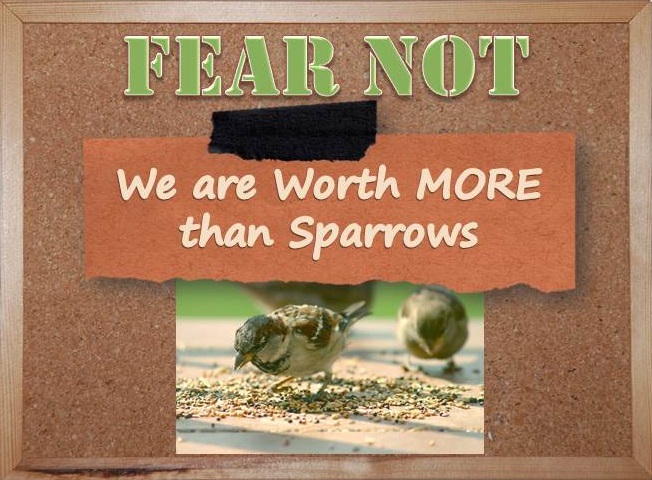
FEAR NOT: We are Worth More than Sparrows


Facebook Twitter More...

“Are not five sparrows sold for two farthings, and not one of them is forgotten before God? But even the very hairs of your head are all numbered. FEAR NOT therefore: ye are of more value than many sparrows.” ~ Luke 12:6-8

FEAR NOT: We are Worth More than Sparrows

Jesus’ reference to sparrows is interesting. Sparrows are very common birds and unlike majestic birds like eagles or exotic birds like parrots they are quite unremarkable; even their ‘songs’/vocalizations are comparatively boring.  They are eaten by most birds of prey (owls eagles, etc.), and by many mammals (cats, squirrels, etc.) as well as by man. They carry a large number of parasites and diseases. And large numbers of sparrows occasionally die off as a result of related epidemics.

Yet, Jesus tells us that God ‘remembers’, keeps track of, each one. In Matthew 10:29, we are told that not even one of them falls to the ground without God’s knowledge and permission.

We should note, therefore, that God’s care for the sparrows does not prevent them from experiencing the normal struggles and challenges and difficulties of life: they are eaten, they have diseases, they lose their ‘loved ones’ (jays/magpies love to eat their eggs).

There are times in our lives that we feel as boring, unremarkable and just plain un-special as sparrows.  And there are times when our lives feel overwhelmed by hardships/trials: sometimes it’s the loss of a loved one; sometimes it’s struggling with illness; sometimes it feels like life is about to eat us whole!  In those down times, we often feel like God has forgotten us: it is easy to feel abandoned when we go through difficulties. But, clearly, that is not the case: God remembers sparrows despite their challenges and God remembers us when we are troubled too. Indeed, we are much, much more precious to God than any sparrow: we are special to Him, and He doesn’t find us boring!

FEAR NOT, God cares for us; FEAR NOT God will never forget us. He watches over the sparrows and He watches over us. Troubles will come, hardships are common to mankind (1 Corinthians 10:13), but God never stops loving us.  If God remembers each sparrow, we can be sure He remembers each of us too: FEAR NOT!

This post is a part of a series on several of the “FEAR NOT” sayings in the Bible. 

How do you Slice your Prayer Pie?

Thought provoking article… read and reconsider

Judy's avatarConnecting Dots...to God

At the risk of irreverent over-analysis, I created a pie chart out of the Lord’s Prayer.   I find the visual representation of the prayer that Jesus taught us helpful as I consider the slices of my prayer pie.  Maybe you will too.

Jesus said, “This, then , is how you should pray:

‘Our Father in heaven,
hallowed be your name,
your kingdom come,
your will be done on earth as it is in heaven.
Give us today our daily bread.
Forgive us our debts, as we also have forgiven our debtors.
And lead us not into temptation,
but deliver us from the evil one.'”  Matthew 6:9-13
 

The first four phrases of the Lord’s Prayer are fully focused on God and His kingdom.  (The shades of blue in the prayer pie below.)  The final three give attention to our need for spiritual forgiveness and protection. (Red slices below.)  In between is

View original post 71 more words

The Thorn

“And lest I should be exalted above measure through the abundance of the revelations, there was given to me a thorn in the flesh, the messenger of Satan to buffet me, lest I should be exalted above measure.  For this thing I besought the Lord thrice, that it might depart from me. And He said unto me, ‘My grace is sufficient for thee: for my strength is made perfect in weakness.‘ ” ~ 2 Corinthians 12:7-9a

                     The Thorn

thorn-2I stood a mendicant of God before His royal throne
And begged him for one priceless gift, which I could call my own.
I took the gift from out His hand, but as I would depart
I cried, “But Lord this is a thorn and it has pierced my heart.
This is a strange, a hurtful gift, which Thou hast given me.”
He said, “My child, I give good gifts and gave My best to thee.”
I took it home and though at first the cruel thorn hurt sore,
As long years passed I learned at last to love it more and more.
I learned He never gives a thorn without this added grace,
He takes the thorn to pin aside the veil which hides His face.
by Martha Snell Nicholson

“And He said unto me, ‘My grace is sufficient for thee: for my strength is made perfect in weakness.’ Most gladly therefore will I rather glory in my infirmities, that the power of Christ may rest upon me.  Therefore I take pleasure in infirmities, in reproaches, in necessities, in persecutions, in distresses for Christ’s sake: for when I am weak, then am I strong.” ~ 2 Corinthians 12:9-10

FEAR NOT: You Shall Be Made Whole


Facebook Twitter More...

“But when Jesus heard it, he answered him, saying, FEAR NOT: believe only, and she shall be made whole.” ~ Luke 8:50

FEAR NOT: You Shall Be Made Whole

Jesus said the words in our text to Jairus, after they had learned his daughter had died before Jesus could get to Jairus’ home. Jairus had come to Jesus pleading for Him to heal his critically ill daughter, and Jesus had consented.   But while on the way, Jesus was delayed (perhaps for a few minutes?) while healing a desperately ill woman (Luke 8:40-54).

Scripture does not tell us whether this delay was the reason Jesus got to Jairus’ home “too late”. However, what is clear is that Jesus intended to heal her: He was on the way. Indeed, this is perhaps the key to understanding the message of this verse.

What happens when we cry out to Jesus for help, but before any discernable answer to our prayers things get tragically worse?

Jairus had already believed in Jesus; that is why he had asked Him to come. Jairus already had faith that Jesus could heal… The question was, whether Jairus had faith that Jesus could do more.

Many of us have faith that God can work in our lives up to a point. And, we even exercise that faith. But, what happens when things fall apart? What happens when things get worse than we ever expected? Do we, will we, have faith in God then?

To illustrate the point, consider the story of Jim Elliot the famous missionary. In 1956, Jim and his fellow missionaries were in Ecuador to bring the Gospel to the Waodani/Auca native peoples. Every sign suggested they were making progress in their effort to reach out to them. Then, on the day they were to meet with the tribe, the Aucas attacked them, killing all five missionary men in the group.

PAUSE: Jim Elliot and the other missionaries had believed God had lead them to take the Gospel to the Waodani/Aucas; everything seemed to have been ‘falling into place’. Jesus was on His way.

Then calamity struck.

Had Jesus misled them? How could Jesus be glorified by their deaths? How could any good come out of this terrible tragedy??

Jim’s wife, Elisabeth and other female members of the remaining missionary team (wives and sisters of the slain men). Decided to continue the mission to the Aucas: Yes, despite the tragedy, despite their grief, they continued. Indeed, within a year they were living with the Auca tribe, deep in the jungles of Ecuador.

And they succeeded: They brought the Gospel to the Aucas and the Auca tribes accepted the gospel and were converted… even those who had participated in the murder of Jim and his friends.

broken watch

They might not have understood His way, but Jesus had not misled them. Unexpectedly, Jesus used the death of Jim Elliot and his friends, to get to the Aucas. Jesus was glorified, and great good did come out of the tragedy: the Waodani/Aucas believed.

Moreover, many people across the world heard of the great missionary work in the face of tragedy and countless Believers were inspired and challenged to grow in their own faith and to participate in missionary work.

This is the context in which Jesus’ words were spoken… Jairus had believed Jesus could make his daughter well… but, the worst had happened, she had died… Could Jairus continue having faith in Jesus?

Eventually, the story ends with Jairus’ daughter being brought back to life. But the challenge for us remains the same: when we take that ‘leap of faith’ and then somehow find ourselves sinking, can we still trust in Jesus?

“FEAR NOT” Jesus says, “believe only”, and whatever trial is facing us, even when it seems everything has been shattered to pieces, it “shall be made whole.”

FEAR NOT, friends, keep believing, keep trusting, keep holding on, Jesus will see us through, even when the darkness gets darker and the bleak grows bleaker: FEAR NOT, everything “shall be made whole”; FEAR NOT, you “shall be made whole.”

This post is a part of a series on several of the “FEAR NOT” sayings in the Bible. 

Tribulation Forges Peace


Facebook Twitter More...

“These things I have spoken unto you, that in me ye might have peace. In the world ye shall have tribulation: but be of good cheer; I have overcome the world.” ~ John 16:33

This is one of Jesus’ many curious passages that can seem quite contradictory. In the verse, Jesus promises us peace (“These things I have spoken unto you, that in me ye might have peace”). But, He also (in the “same breath”!) promises us unavoidable, inevitable tribulation (“In the world ye shall have tribulation”).

How can this be so?? How can we have both? (Especially since most of us only want one of them, namely peace)

To grasp what Jesus is saying, we must examine the Biblical definitions of both peace and tribulation.

TRIBULATION

Tribulations may be defined as:

Difficulties in the physical realm due to battles in the spiritual realm:

“For we wrestle not against flesh and blood, but against principalities, against powers, against the rulers of the darkness of this world, against spiritual wickedness in high places.” ~ Ephesians 6:12

AND

Difficulties resulting from the creation being in a fallen state due to the consequences of the first sin and its perpetuation/propagation:

Kaktusblüten

“Unto the woman He said, I will greatly multiply thy sorrow and thy conception; in sorrow thou shalt bring forth children; and thy desire shall be to thy husband, and he shall rule over thee.
And unto Adam He said… cursed is the ground for thy sake; in sorrow shalt thou eat of it all the days of thy lifeThorns also and thistles shall it bring forth to thee… In the sweat of thy face shalt thou eat bread, till thou return unto the ground…” ~ Genesis 3:16-19a

“For we know that the whole creation groaneth and travaileth in pain together until now. And not only they, but ourselves also, which have the firstfruits of the Spirit, even we ourselves groan within ourselves, waiting for the adoption, to wit, the redemption of our body.” ~ Romans 8:22-23

Given these truths, it is easy to grasp that tribulation is inevitable while we live here on Earth as physical beings. There will be cancer, there will be murder, there will be crashes, there will be losses and struggles of every kind, even if we ourselves live “perfect” lives.

Jesus also tells us:

“And ye shall be hated of all men for my name’s sake…” ~ Matthew 10:22

Even if we are the best disciples we could ever be, tribulation will come our way because we serve Jesus Christ.

With this perspective, it is prudent that we change our attitudes from tribulation avoidance to tribulation expectation/preparation, because we know it is coming, no matter what we do.

PEACE

Peace, as defined in the Bible, is not the absence of trials/tribulations (if it were, then Jesus would have contradicted Himself in our text). Rather, peace is living in harmony with God. Consider the following:

“But the Comforter, which is the Holy Ghost, whom the Father will send in My Name, He shall teach you all things, and bring all things to your remembrance, whatsoever I have said unto you.  Peace I leave with you, My Peace I give unto you: not as the world giveth, give I unto you. Let not your heart be troubled, neither let it be afraid.” ~ John 14:26-28

As those verses indicate, the Peace of which Jesus speaks is the harmonious relationship between God and an individual that the indwelling presence of the Comforter enables. The Comforter uses the WORD of God to teach us who God is and how to obey Him, which thereby enables us to experience peace. (So we MUST read/study The Bible if we want to ever experience real peace!)

PEACE AND TRIBULATION: A “Symbiotic” Synthesis

827034_33199112

Jesus speaks to us through Scripture—we have His Words and He is THE WORD (John 1:1-3)—so that we can have peace, i.e., live in harmony, live in obedience, to God in a world that is replete with unavoidable tribulations; like the ones we face every day.

But there is more. God knowing that we will face troubles in this world, wisely “leverages” tribulations to our benefit:

“And not only so, but we glory in tribulations also: knowing that tribulation worketh patience; And patience, experience; and experience, hope: And hope maketh not ashamed; because the love of God is shed abroad in our hearts by the Holy Ghost which is given unto us.” ~ Romans 5:3-5

We not only have Jesus words to give us peace in the midst of tribulations, we ALSO benefit from tribulations because in enduring them, we are drawn even closer to God, i.e., we have even MORE PEACE!!! Hallelujah!!!

And if drawing ever nearer God is our desire in life (and it should be), we can rejoice in the tribulations that face us because they help us to accomplish our goal!

As we face the tribulations that come our way, let us cling ever closer to our Lord and Saviour and in Him find perfect peace.

“Thou wilt keep him in perfect peace, whose mind is stayed on thee: because he trusteth in thee.” ~ Isaiah 26:3

We Don’t Live Here


Facebook Twitter More...

“Let not your heart be troubled: ye believe in God, believe also in me. In my Father’s house are many mansions: if it were not so, I would have told you. I go to prepare a place for you. And if I go and prepare a place for you, I will come again, and receive you unto myself; that where I am, there ye may be also.” ~ John 14:1-3

Most often when reading/hearing this verse, we focus on the mansions Jesus is preparing for Believers for when the get to heaven. However, there is another message in the verse that we should pay close attention to: This Earth is NOT our home.

This concept is crucial if we are going to get the correct perspective needed to live victorious, abundant, fruitful lives while we sojourn on Earth. To illustrate this, let me share a personal story.

hot-air balloons-1b

Many years ago, I worked as a social worker for about a year for a church located in a “ghetto”. The area was rife with violent crime. (I remember seeing one young man stab another in the street below my office window.)

One day there was a frightening gunfight between the local police and some well armed thugs less than a hundred yards from our office on the church grounds. We all cowered under our desks while the gun-battle raged. We were waiting for a breather, so that we could jump into the cars and escape to our homes in other parts of the city far away from the ongoing gunfight. Well… most of us were. There was one older lady that actually lived in the area and she had nowhere to ‘escape’ to.

You see, that’s the point. When you know have a home far away from the battlefield, it gives you hope. As bad as the gunfight was, most of the social workers at that church had hope of escaping to somewhere safe. But the social worker that lived there didn’t.

Believers, we must live our lives here on earth knowing that we don’t belong here. We will escape the battles and the struggles one day.

One day we will leave this world with all its diseases, all its oppression, all its unfairness, all its perplexities; one day we will be headed home.

Now, to be clear, while we are here we do have a job (just like the social workers in the story) to do: we are called to minister to mankind: we are called to spread the Gospel, to let everyone know about Jesus and salvation through Him. But when we have completed our work, we will be headed home: we don’t live here.