“And these words, which I command thee this day, shall be in thine heart:
And thou shalt teach them diligently unto thy children, and shalt talk of them when thou sittest in thine house, and when thou walkest by the way, and when thou liest down, and when thou risest up.
And thou shalt bind them for a sign upon thine hand, and they shall be as frontlets between thine eyes.
And thou shalt write them upon the posts of thy house, and on thy gates.”~ Deuteronomy 6:6-9
When I was growing up, my parents and sisters and I talked much about the Lord Jesus in our home. As a child I was not as grateful for this training as I was when I became an adult. Mom and dad knew the importance of making sure their children read God’s Word the bible, and then discussed what we read with them.
Some of my fondest memories of my dad, who has been with the Lord for seven years now, are when we discussed different Scriptures. Even in my adult years I still talked a great deal about Jesus with my parents, their guidance was priceless!
My husband and I discussed the Bible with our son as he was being raised and now with our two little grandchildren! And we know it is important to God that we do this from our verses today.
Even the world acknowledges that what we learn as children sticks in our minds for life, so what is more important that making sure that little ones learn God’s Word and that it is in their hearts? Psalm 119:11 says,
“Thy word have I hid in mine heart, that I might not sin against thee.”
God desires our hearts! When we talk about Him and to Him many times throughout our day, we are pondering Him in our hearts and this will help us to live our lives more closely in line with His Word. According to (Malachi 3:16) it is recorded in heaven every time we honor and talk about God.
It is all too easy to get caught up in the things of this life, get captured by the unimportant, and forget about God. That is precisely why He reminds us many times throughout His Word to keep our focus on Him. He is to be at the center of our lives, not on the sidelines! He is to be asked and obeyed about important decisions that we make, to be gone to when we need help, and to be praised often for all that He has done for us thus far.
No one will ever love us as much as God, so we know that He always has our best interests at heart. He deserves our time, attention, and love! O that we would talk about and live for Him at home, in public, when we rise up, and when we lie down! All the while loving Him, for He first loved us (1 John 4:19).
Thank You Father God for loving me, for sending Jesus to shed His blood for my sins, and for always being with me. I love You so and give You all honor and praise this day, Amen!
”But FEAR NOT thou, O my servant Jacob, and be not dismayed, O Israel: for, behold, I will save thee from afar off, and thy seed from the land of their captivity; and Jacob shall return, and be in rest and at ease, and none shall make him afraid.
FEAR thou NOT, O Jacob my servant, saith the Lord: for I am with thee; for I will make a full end of all the nations whither I have driven thee: but I will not make a full end of thee, but correct thee in measure; yet will I not leave thee wholly unpunished.” ~ Jeremiah 46:27-28
FEAR NOT: God’s Children are Corrected; God’s Enemies are Annihilated
Notice, in our text, the phrase, “for I will make a full end of all the nations whither I have driven thee: but I will not make a full end of thee”.
God destroyed the nations that held Israel captive, but He never destroyed Israel. The Babylonians were completely wiped out as a people: Babylon existed where there is modern-day Iraq. However, the people of Iraq are not descendants of the Babylonians, they are all gone.
The message for us is straightforward: God disciplines/corrects His children: “I will… correct thee in measure; yet will I not leave thee wholly unpunished”. BUT, He removes/annihilates His enemies. Where do you stand?
Children of God: FEAR thou NOT!
Enemies of God: FEAR a LOT!”
This post is a part of a series on several of the “FEAR NOT” sayings in the Bible.
“Have not I commanded thee? Be strong and of a good courage; be not afraid, neither be thou dismayed: for the Lord thy God is with thee whithersoever thou goest.” ~ Joshua 1:9
In this passage, God is instructing Joshua to be strong and courageous as he now leads the obstinate Israelites to the Promised Land. His spiritual mentor Moses has died, so the task probably looked a little daunting to him. But God is reassuring Joshua that He is with him and will protect him.
The Lord would not call him to the task without enabling him to complete it, he had God’s promise of a sure victory (Joshua 1:5-6), God’s Word as a safe guide (Joshua 1:7-8), and God’s presence as a sustaining power (Joshua 1:9, above).
In short, Joshua had all he could ever need for the journey!
And so do we!
God has equipped us with His Word and His indwelling Holy Spirit to go through this journey of life with His power. We can be strong and courageous in Him for He is with us wherever we go.
“The real battle of faith is joined here. Not what we are, but what He is! Not what we feel, but His facts.”
I love that quote! We may feel afraid and discouraged at times in this life, like the battles are too big to overcome. But we are to stick to God’s facts and not our feelings.
God has promised us victory through Him and we must cling to that when we feel defeated in this world. Jesus has already defeated sin, death, and hell at the cross, our part is to trust Him with our lives and obey His Word and ways. God has great plans for His children (Jeremiah 29:11), and has enabled us very nicely to bring those plans of His to fruition.
So what have we really to fear? Nothing! The God of the universe is our Father. He created all that exists, and His love for us is immeasurable. He is our Protector and Defender, our Sustainer and Provider. We have much to rejoice in don’t we? How can we not open our mouths in praise to Him for all that He has done for us!
Thank You Father God for sending Jesus to this earth to shed His blood for the forgiveness of my sins. Thank You for loving me and for all Your care and keeping. I love You so and give You all praise this day, Amen!
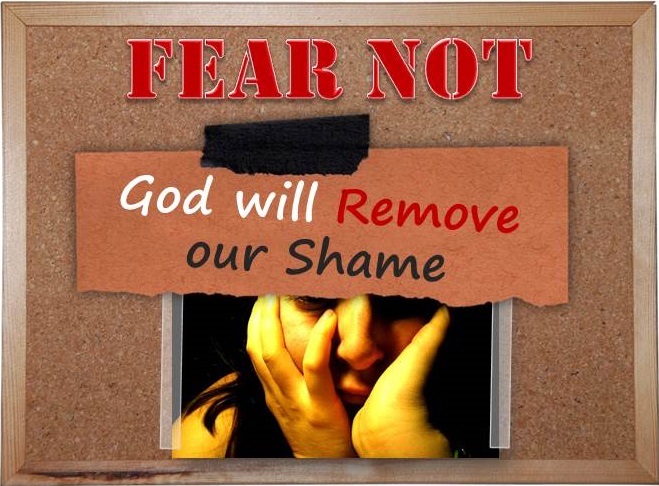
“FEAR NOT; for thou shalt not be ashamed: neither be thou confounded; for thou shalt not be put to shame: for thou shalt forget the shame of thy youth, and shalt not remember the reproach of thy widowhood any more.” ~ Isaiah 54:4
FEAR NOT: Jesus will Wash Our Filthy Garments: Jesus will Remove Our Shame
In Isaiah 54, God speaks of Judah as His wife and likens the captivity the nation would experience as widowhood–i.e., Judah was taken captive, as many widows were in those days, because ‘she’ had no ‘husband’ to defend ‘her’ honor.
BUT God, yet again reassures Judah that He will restore them.
Yet again, we are also reminded of God’s restorative work in our own lives. The people of God through faith, the spiritual descendants of Abraham, the fellowship of Believers, we are again encouraged that God’s will restore us.
If we will wait on Him and walk with Him, God will take away the shame of our sin and the embarrassment of our iniquity. The consequences of sin are often unavoidable. But, if we will repent, if we will wait on Him and walk with Him, God will lead us out of shame and into His glory.
“And he shewed me Joshua the high priest standing before the angel of the Lord, and satan standing at his right hand to resist him. And the Lord said unto Satan, The Lord rebuke thee, O satan; even the Lord that hath chosen Jerusalem rebuke thee: is not this a brand plucked out of the fire?
Now Joshua was clothed with filthy garments, and stood before the angel. And he answered and spake unto those that stood before him, saying, Take away the filthy garments from him. And unto him he said, Behold, I have caused thine iniquity to pass from thee, and I will clothe thee with change of raiment.” ~ Zechariah 3:1-4
FEAR NOT, Believers; FEAR NOT, Brothers and Sisters in Christ: The Lord will not leave us in shame, He is preparing us making us spotless as the Bride of His wedding feast.
“…Christ also loved the church, and gave himself for it; That He might sanctify and cleanse it with the washing of water by the word, That He might present it to Himself a glorious church, not having spot, or wrinkle, or any such thing; but that it should be holy and without blemish.” Ephesians 5:25b-27
This post is a part of a series on several of the “FEAR NOT” sayings in the Bible.
“Let your light so shine before men, that they may see your good works, and glorify your Father which is in heaven.” ~ Matthew 5:16
“If any man speak, let him speak as the oracles of God; if any man minister, let him do it as of the ability which God giveth: that God in all things may be glorified through Jesus Christ, to whom be praise and dominion for ever and ever. Amen.” ~ 1 Peter 4:11
In recent times, many Believers have been praying for great national economic recovery. Is that the will of God? Think about it: Why do we want our nation’s economy to prosper?
“O ye sons of men, how long will ye turn my glory into shame? how long will ye love vanity, and seek after leasing? Selah.” ~ Psalm 4:2
Do we honestly think that prosperity would bring God glory? And shouldn’t we be predominantly praying for God’s glory? Show me a rich nation or person that is godlier because of their riches.
Conversely, am I saying that poverty brings godliness? NO!! Neither poverty nor riches will, in themselves, bring God glory.
Scripture tells us to “Seek first the kingdom of God” (Matthew 6:33): God’s highest priority is His glory and that must also be ours:
“…that God in all things may be glorified through Jesus Christ” ~ 1 Peter 4:11
Many of us in the evangelical Church today have convinced ourselves that our agenda is also God’s. However, our agenda MUST be informed by The Scriptures, not our feelings. And The Scriptures tell us that God’s glory tops His agenda.
Accordingly, God is not primarily speaking to nations now. Today, God is speaking to The Church: Christ’s bride (Ephesians 5:25-29); His called out ones (1 Peter 2:9): Who are strangers to this world (1 Peter 2:11) and whose affections are set above, not on earthly prosperity (Colossians 3:1-3).
“If ye then be risen with Christ, seek those things which are above, where Christ sitteth on the right hand of God. Set your affection on things above, not on things on the earth. For ye are dead, and your life is hid with Christ in God.” ~ Colossians 3:1-3
And sadly that message is all but absent from many of our churches.
“And Gedaliah the son of Ahikam the son of Shaphan sware unto them and to their men, saying, FEAR NOT to serve the Chaldeans: dwell in the land, and serve the king of Babylon, and it shall be well with you.” ~ Jeremiah 40:9
FEAR NOT: Be Obedient Instead
There is nothing to FEAR in obedience to God. But there is everything to FEAR in disobedience to God.
The Babylonians had already captured and taken into captivity many of their leaders, merchants and craftsmen. They left behind a small number of Judah’s populace to remain there as a vassal state. God, through Jeremiah, had instructed this remnant to serve the Babylonians: it was part of God’s plan.
However, though the Israelites, who remained in the land, had seen Jeremiah’s prophecies come true, rather than obey God, they assassinated the governor Gedaliah (a godly man), kidnapped Jeremiah and fled to Egypt. Because of their disobedience, God cut them off forever. There are real consequences to for our actions.
There was nothing for them to FEAR if they obeyed God: He would have protected them. But when they disobeyed God, they lost that protection.
Let us learn from their experience, when God rebukes us, it is wise for us to accept His rebuke with humility: let us not add more disobedience to that that already got us in trouble. There is nothing to FEAR when our Father, God, corrects/chastises/disciplines us. But trouble comes when we reject His correction/chastisement/discipline.
FEAR NOT, Believer, there is joy and peace in God’s discipline: let us humbly be corrected thereby.
“Wherefore doth a living man complain, a man for the punishment of his sins?
Let us search and try our ways, and turn again to the Lord.
Let us lift up our heart with our hands unto God in the heavens.” ~ Lamentations 3:39-41
This post is a part of a series on several of the “FEAR NOT” sayings in the Bible.
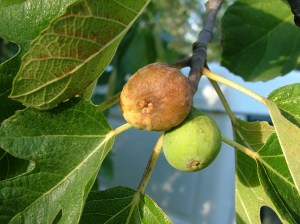
“And on the morrow, when they were come from Bethany, he was hungry: And seeing a fig tree afar off having leaves, he came, if haply he might find any thing thereon: and when he came to it, he found nothing but leaves; for the time of figs was not yet. And Jesus answered and said unto it, No man eat fruit of thee hereafter for ever. And his disciples heard it…
…And in the morning, as they passed by, they saw the fig tree dried up from the roots. And Peter calling to remembrance saith unto him, Master, behold, the fig tree which thou cursedst is withered away.
And Jesus answering saith unto them, Have faith in God. For verily I say unto you, That whosoever shall say unto this mountain, Be thou removed, and be thou cast into the sea; and shall not doubt in his heart, but shall believe that those things which he saith shall come to pass; he shall have whatsoever he saith. Therefore I say unto you, What things soever ye desire, when ye pray, believe that ye receive them, and ye shall have them.” ~ Mark 11:12-14 & 20-24
Why would Jesus curse a fig tree for not having fruit (for Him to eat) when it was not even time for the fig tree to bear fruit? Jesus created the fig tree. Jesus created the seasons. Jesus designed fig trees to bear fruit seasonally and cyclically. Why would Jesus curse the fig tree for doing what he designed fig trees to do?
To understand this passage, we must first realize that Jesus was not angry and He did not have a particular dislike for fig trees. Moreover, as part of Scripture, Jesus’ action was not insignificant: it had meaning. Indeed, the cursing of the fig tree was a dramatic object lesson for His disciples then and for Believers thereafter: Jesus was powerfully demonstrating the radically new reference frame in which His disciples must operate.
The conventional human practice of benevolence has always been that if we are going to help someone, then we give from what we have at that time, in that season. In other words, we meet the needs of others with what we presently have available to us. Especially, we give from our surplus: what we have extra.
However, Jesus discarded that concept and replaced it with a new one. When someone was in need, it would be His disciples’ responsibility to help them; no caveats, no qualifications, no provisos, no conditionalities, no “ifs, ands or buts”. When someone came to them for fruit, they would not be allowed the excuse of not being in season.
This was not the first time that Jesus taught His disciples this lesson. Jesus had already demonstrated this principle with His own life: He met the needs of all who came to him in need, never turning anyone away because he was “out of season”.
Even at the wedding feast in Cana, when it was not yet His time (John 2:4), He still met the needs of the hosts (John 2:1-11).
Further, Jesus challenged His disciples to feed the multitude that had followed Him into the wilderness to hear Him teach (Matthew 14:15-16, John 6:5-7). The disciples had what seemed to be reasonable excuses:
there were too many to feed,
they did not have the money to buy enough food for everyone,
let them be responsible for their own food.
But, Jesus fed them anyway; He accepted no excuses and He made no excuses.
In the object lesson, when Jesus was hungry it was the fig tree’s job to provide fruit; no excuses. When the fig tree provided no fruit it was cursed and it dried up from the roots: it was now only suitable to be cast into the fire. When there is a need, we, the disciples of Jesus, must meet that need; no excuses.
Consider the following passage:
“I am the true vine, and my Father is the husbandman. Every branch in me that beareth not fruit he taketh away: and every branch that beareth fruit, he purgeth it, that it may bring forth more fruit…
…I am the vine, ye are the branches: He that abideth in me, and I in him, the same bringeth forth much fruit: for without me ye can do nothing. If a man abide not in me, he is cast forth as a branch, and is withered; and men gather them, and cast them into the fire, and they are burned.” ~ John 15:1-2 and 5-6
Those that abide in Jesus and in whom Jesus abides will always bring forth MUCH fruit. And, just as Jesus did, they will ALWAYS, under every circumstance and in every instance, meet the needs of those in need; no excuses. Conversely, those who do not abide in Jesus, will never produce fruit, they will never be “in season”. Therefore, they will wither… just like the fig tree did.
If we have Jesus in us what excuse is there to produce fruit? What excuse can we give for not meeting the needs of those we encounter? Is Jesus seasonal? Is His power cyclical? Certainly not! The problem is that WE are seasonal, situational, cyclical and conditional. We vary, Jesus does not.
The Christian is always able to meet the needs of those around him/her, because there are no limits on Jesus’ power to use him/her. The problem is that the Christian is not always willing or prepared to draw on the power Jesus provides.
Jesus’ disciples were unable to heal a boy possessed with a demon. And, after Jesus healed the child, they asked Him why they had been unable to (Mark 9:14-29). Jesus answered them saying, “This kind can come forth by nothing, but by prayer and fasting”.
Notice that Jesus never said they did not have access to the power to heal Him. Rather, Jesus suggested they had not used the correct approach. They already had all the power they needed to bear the fruit for the season that confronted them. What they lacked was the right preparation.
Today, too many Believers limp around as if they are unable to exercise the power of God made available to them by the Holy Spirit indwelling their lives. We seem to forget that “I am crucified with Christ: nevertheless I live; yet not I, but Christ liveth in me…” (Galatians 2:20). And the Christ that lives in us is not impotent: He is not powerless!
Are we prepared for Christ’s power to work through us?
The Christ that lives in us intends to meet the needs of all that we encounter. He intends to produce the fruit for which our fellowman yearns. And the Christ that lives in us is NOT seasonal! When the Christ that lives in us meets someone He is always ready to meet their needs. The question is whether we will allow the Christ that lives in us to bear fruit through our lives; or whether we will just content ourselves with producing leaves.
The fig tree was full of leaves but void of fruit… fig leaves are pretty (some actually grow fig trees ornamentally to enjoy their foliage) but fig tree leaves cannot satisfy. Believers can sing and celebrate all day if we like, but our society needs fruit, not pretty leaves.
As Christians focus increasingly on receiving a blessing instead of being a blessing, the church is withering. Our influence is waning fast. For many onlookers, we have become anachronistic avatars with quaint, but irrelevant, beliefs. We have great buildings, great music, and nice programs: we have beautiful leaves. But too often we provide no salt for a decaying society. Too often we provide no light for a society stumbling around in darkness.
►What do you have for the coworker who feels depressed and needs good counsel?
►What do you have for the single mother who is struggling to raise her children and pay the bills?
►What do you have for the abused child in the apartment down the hall?
►What do you have for the young man addicted to pornography?
►What do you have for the lonely old people at the nursing home (the one you pass on your way to church every Sunday)?
►What do you have for the beggar on the corner?
►What do you have for the Muslim girl at school?
To be clear, not everyone came to Jesus looking for fruit. Indeed some, like the Pharisees, came to chop Jesus down. And they even thought they had. Moreover, many did not take the fruit Jesus had to offer. Some, like the rich young ruler (Mark 10:17-22, Luke 18:18-23), walked away. But, that’s not the point. The point is that Jesus always had something to offer. And, if He lives in us, so do we… IF we will let Him work through us.
Not everyone is interested in the fruit Christians must bear; not everyone will accept that fruit Jesus wants to produce through us. But we must bear the fruit anyway. When someone in need crosses the path of a Believer, there must be fruit available for their hunger; we must be wells of living water to quench their thirst (John 4:14). We must be the fig trees that bear in season and out of season.
“Preach the word; be instant in season, out of season; reprove, rebuke, exhort with all long suffering and doctrine.” ~ 2 Timothy 4:2
In closing, it is worthwhile addressing the question “How can I produce fruit?”
Indeed, that was the very question Jesus addressed when He later spoke to His disciples about the now withered fig tree (Mark 11:20-24). When Peter pointed out the next day that the fig tree had withered, Jesus gave an unexpected answer, rather than addressing the withering of the fig tree, Jesus replied “Have faith in God” and then He proceeded to teach them about faith.
Clearly, Jesus was not suggesting that His disciples go around cursing fruit trees. Rather, Jesus was zeroing in on the second point of the object lesson: To produce fruit in season and out of season requires faith.
∆ If we are going to feed five thousand hungry men, we must have faith in God.
∆ If we are going to heal the sick, we will need faith.
∆ To give Biblical counsel to a co-worker requires faith.
∆ To help a single mom in need requires faith.
∆ To rescue an abused child requires faith.
∆ To help someone out of the trap of pornography needs faith.
∆ To minister to the lonely and neglected needs faith.
∆ To reach out to the homeless requires faith.
∆ To share the gospel with an unbeliever we must have faith.
In Jesus, Believers have the potential to produce fruit; BUT we need to exercise faith to turn that potential into reality. Without faith we will just be leafy, unfruitful fig trees, regardless of the season.
And the disciples went, and did as Jesus commanded them, And brought the ass, and the colt, and put on them their clothes, and they set Him thereon.
And a very great multitude spread their garments in the way; others cut down branches from the trees, and strawed them in the way. And the multitudes that went before, and that followed, cried, saying,
“Hosanna to the son of David: Blessed is he that cometh in the name of the Lord; Hosanna in the highest.”
And when He was come into Jerusalem, all the city was moved, saying, “Who is this?”
And the multitude said, “This is Jesus the prophet of Nazareth of Galilee.” (Matthew 21:6-11)
Holy Week, as it is traditionally called, begins with Palm Sunday, the penultimate Sunday of Lent, the last Sunday before Easter Sunday. Palm Sunday commemorates Jesus’ triumphal entry into Jerusalem, just before His final celebration of the Passover.
In His “Triumphal Entry”, Jesus rode into Jerusalem on a donkey, fulfilling Zechariah’s prophecy, made more than five hundred years earlier (Zechariah 9:9) and signifying, according to the tradition of the time, that He was coming in peace, not in war: He was delivering mercy, not judgment.
As Jesus rode into Jerusalem, a large crowd gathered singing “Hosanna to the son of David: Blessed is he that cometh in the name of the Lord; Hosanna in the highest” (Matthew 21:9). The word “Hosanna” means “Oh save” or “Save now”, therefore, the shouts from the crowd were as much a plea as a celebration: They were celebrating Jesus’ arrival and they were looking to Him to save them.
The question is, “Save how?”
Just a few days later, crowds would again assemble, but then they would look to Barabbas (a Zionist rebel) for salvation and reject Jesus completely.
What could have brought about such a dramatic change of heart for the multitudes?
How did Jesus go from savior to schmuck?
Our text suggests that the answer lies in mistaken identity. In vv. 10-11, the crowds are asked the simple question: “Who is this?” And they replied, “This is Jesus the prophet of Nazareth of Galilee.” This however was the wrong answer. To understand why, we must turn to an earlier exchange between Jesus and His disciples, given below:
“When Jesus came into the coasts of Caesarea Philippi, he asked his disciples, saying, “Whom do men say that I the Son of man am?” And they said, “Some say that thou art John the Baptist: some, Elias; and others, Jeremias, or one of the prophets.” He saith unto them, “But whom say ye that I am?” And Simon Peter answered and said, “Thou art the Christ, the Son of the living God.” And Jesus answered and said unto him, “Blessed art thou, Simon Barjona: for flesh and blood hath not revealed it unto thee, but my Father which is in heaven.” ~ Matthew 16:13-17
Even then the crowds saw Jesus as a prophet, potentially, even a great prophet; but ONLY a prophet. Jesus, however, rejects this identification and accepts ONLY His correct title: The Christ (The Anointed One), The [only begotten] Son of the living God, The Messiah.
The crowds missed this truth: they had only ever seen Jesus as a prophet: a great prophet who could help them, but ONLY a prophet. They never recognized Jesus as The Messiah, their Messiah: they had mistaken His identity.
To not recognize Jesus as Messiah meant they could never be part of His Kingdom, they could never receive the grace needed for the Salvation that God offered. To not recognize Jesus as Messiah meant that they would always look for a Saviour, but they would never be saved. The multitude wanted to make Jesus, “the prophet”, king of their kingdom. But Jesus, The King, came so that the multitude could become part of His Kingdom.
And when Jesus declined to rule over their kingdom, and invited them into His Kingdom instead, they rejected Him. And in His place they chose Barabbas to be their champion. The multitude wanted their nation, Israel, to return to its glory as in the days of David and Solomon: they wanted to attain glory on earth. So they sought someone who would promise to give them the glory they sought; someone who would lead them where they wanted to go and tell them what they wanted to hear.
Today, many of us also fail to recognize Jesus as Messiah. We too see Him as just a prophet, or even a good man who did some good things a good time ago. Therefore, we look to other means, methods and messiahs for Salvation. Some seek a Messiah from another religion, some seek a messiah in their own achievements/works, and for others the messiah’s name is Science/Philosophy.
Like the multitude, we often seek a messiah who will lead us in the way we want to be lead, a messiah who will conform to our own vision of life. We even ask Jesus to be this messiah for us: we want to make Him king over the kingdoms we desire to live in.
And, just like the multitude, when Jesus rejects our request to rule in our personal kingdoms, we are tempted to find someone/something that will champion the lives we desire to live. Someone who will tell us what we want to hear and who will lead us where we want to go. We are tempted to trade Jesus for Barabbas.
However, to recognize Jesus as The Messiah, as The Christ, The Anointed One, we must see Him as more, much more than a prophet. A prophet brings words of life, but Jesus is life itself. As Scripture tells us:
“For in Him [Jesus] we live, and move, and have our being…” ~ Acts 17:28a
Moreover, to recognize Jesus as The Messiah, as The Christ, The Anointed One, we must see Him as King of His Kingdom. Jesus will not accept our invitation to be king over a kingdom we give to Him. We do not get to decide what aspects of our lives Jesus will rule. Instead, Jesus invites is into His Kingdom.
He sets the boundaries; He makes the rules; He sets the goals.
Jesus is the Way to His Kingdom, Jesus is the life we live in His Kingdom and Jesus is the ONLY Truth to be known in His Kingdom (John 14:6).
Jesus leads us where He wants us to go and He tells us what He wants us to hear. And our glory is neither sought nor found in the things of this earth: we seek and we find glory in Him, ONLY in Him.
This is Jesus’ identity: He is not just a prophet: Jesus is the Son of the living God, our Saviour and the one who holds together the very universe we live in.
“For by Him were all things created, that are in heaven, and that are in earth, visible and invisible, whether they be thrones, or dominions, or principalities, or powers: all things were created by Him, and for him: And He is before all things, and by Him all things consist. And He is the head of the body, the church: Who is the beginning, The Firstborn from the dead; that in all things He might have the preeminence.” ~ Colossians 1:16-18
Jesus is King of His Kingdom.
In our text, though they praised Him, the multitude did not recognize Jesus’ identity and when He was crucified their praises disappeared. They did not want to live in that Kingdom; for the multitude, there was no glory in the Cross.
But that was a long time ago. The challenge for each one of us now, in this moment in time, is,
It’s 5:00 AM, and I’m wide awake. The darkness is soft and inviting, but sleep doesn’t come with it, I can feel the wakefulness behind my eyes, so I get up.
Early-morning insomnia used to be my enemy, a cruel tormentor robbing me of my precious hours of sleep. Even as child I hated and dreaded the long hour nights alone, the struggle through the ensuing day to stay awake on little rest.
It took many years, but eventually my Lord taught me that all my hours are His, and that He is well able to sustain me, and that the hours spent with Him are never wasted, regardless of what time of day they occur. So now, in my thirties, there is no fear of the morning hours; this time is my time with Him, with the God who loves me so much that He can’t wait to start His day with me.
Who can resist an invitation like that?
I love the gentle mornings.
This particular morning, I know why I am awake. Only a few hundred miles away, a very beloved person to me is struggling with consuming darkness. I have been to see her, have stepped into the maelstrom that is trying to drown her soul, and the hunger to help her is very acute. It was on my mind when I went to sleep, it was on my mind as I tossed and turned, and now that my day has begun it is first in my thoughts.
I wonder what she’s doing right now, what she’s thinking, how badly is the Enemy tormenting her body and soul. I think of things I’d like to say, to do, wonder if they would help in the slightest. I wonder if I am praying for her the right way, if she cares that I’m praying, if she wants to be helped or if she’d rather I just leave her to die on her own terms. I wonder.
But I don’t wonder alone. God’s presence is with me, has been with me all the night. He did not sleep; and He does not wonder. He sees and knows, and cares more than even I do.
It was assurance in that reality that let me sleep at all last night; it’s assurance in that reality that comforts me this morning. I am filled with His peace, even as my mind and heart heave in disarray. I cannot have answers right now; but I have The God who has all those answers, and it is enough that He carries them within His heart; that great, loving, merciful heart that He shares so freely with His beloved.
And because He shares, I share. I write my thoughts in a journal, knowing full well He already knows what I’m thinking, knowing He could say it far better than I could, but that’s not the point. I read His thoughts in His book, ancient words written for me for just exactly this morning, speaking in ways that tell me He loves me in the precise way I need to hear it right now. Telling me too that He loves also her who is so near and yet so very far from me.
He knows.
I get no answers from Him other than that; and yet, there is so much for me in that answer.
God knows.
It is enough.
The sun is coming up now, grey light brightening the windows. Day is coming, and with it all the doings of life that must be done. I cannot stay in this cradle of quiet for long; but I am so thankful for the time before day. Come sunny skies or consuming darkness, I know the One that goes with me; and He knows me, and He knows those I love and long for. Simple answers there are none, but there is always this answer: Be still, and know that I am God.
“Yet now hear, O Jacob my servant; and Israel, whom I have chosen: Thus saith the Lord that made thee, and formed thee from the womb, which will help thee; FEAR NOT, O Jacob, my servant; and thou, Jesurun, whom I have chosen. For I will pour water upon him that is thirsty, and floods upon the dry ground: I will pour my spirit upon thy seed, and my blessing upon thine offspring” ~ Isaiah 44:1-3
FEAR NOT: In Jesus We are Righteous: We are Jesurun!
In this beautiful passage of Scripture, God (through Isaiah) gives us a wonderful message of encouragement.
First, the message is addressed to “Jacob my servant” and “Israel, whom I have chosen”. In referring to The Hebrews by these two names God is sending a message. Jacob means ‘supplanter’: one who gains advantage through treachery (Merriam-Webster), or more simply, one does things his/her own way instead of God’s way. Conversely, Israel means ‘God prevails’: God wins out in the end.
Jacob used any means he could find to “get ahead”. He lived ‘by his wits’. However, at Peniel (Genesis 32:22-32), Jacob finally realized that he could not “get ahead”, he could not succeed, without God’s blessing.
Thus, when God addressed The Hebrews by both names, He was referring to two aspects of their character: they had the tendency to go their own way, but they also knew that God would prevail in the end. So too with us Believers: though we know God’s Will will be done, we often yield to the temptation of going our own way, of exercising our own wills.
NOTICE, however, that it is exactly to such a conflicted people that the message of God’s blessing comes. God promises to bless the those who are becoming ‘Israel’ but still have a lot of ‘Jacob’ in them. In other words, God blesses us, where we are! Hallelujah!
If God were to wait until all the ‘Jacob’ was gone from our character, none would be blessed; no one would survive: our lives would be miserable and meaningless. But God recognizes BOTH the Jacob in us (like him we were born that way, born grasping the heel of our brethren, trying to get ahead in our own strength) and the Israel that God Himself has imparted to us through faith when we looked to Him for His blessing of salvation. And despite our conflicted-ness God still determines to bless us! Oh what a merciful Father.
WHY? Why would God promise to bless those whom He knows still have given themselves completely to Him? Why would God bless those who still have the tendency to rely on their own strengths instead of on Him?
These questions are answered, when God (in our text above) next addresses The Hebrews. First, He called them Jacob and Israel (Isaiah 44:1). Second, He called them “Jacob, my servant” and “thou, Jesurun, whom I have chosen” (Isaiah 44:1). God uses the name “Jesurun” as an endearment in Scripture and it means “upright one”.
Much of Isaiah rebukes the sins of The Hebrews and predicts the coming punishment they would receive in the future as a result. Clearly, the people were not upright. Nevertheless, God calls them that name because, uprightness (i.e., righteousness) does not come from man, righteousness comes from God. God imputes His righteousness to us, Believers, because we can never attain righteousness on our own. In short, God could call them “Jesurun”, upright ones, because He could make them so: He would impart His righteousness!
When God looks on a Believer, saved by grace, He sees His only begotten Son, Jesus. And because of Jesus, He calls out “Jesurun”: My beloved upright one!
Yes, there is still some ‘Jacob’ left in us… but that “Jacob” (self-will) is dying daily while “Israel” (God prevails) is gaining strength and the sins of that “Jacob” are covered by the Blood of Jesus!
FEAR NOT, Believer, God knows exactly “where” we are: He knows there is still some Jacob left in us. FEAR NOT, God does not reject us because we are yet imperfect.
FEAR NOT, God will bless us: He will help us, He will restore us, He will replenish us; He will lift us out of the pit; he will sustain us, BECAUSE when God looks at us He sees His Son, He sees “Jesurun”. Hallelujah!
This post is a part of a series on several of the “FEAR NOT” sayings in the Bible.
















 Reflections in The WORD