Latest Posts

The Confrontation Conundrum


4Answer not a fool according to his folly, lest thou also be like unto him.

5Answer a fool according to his folly, lest he be wise in his own conceit.” ~ Proverbs 26:4-5


At first glance, these two verses from The Book of Proverbs appear to be contradicting each other. However, closer examination shows that is not actually the case.

To understand the teaching contained in this couplet, we first need to see how the Bible defines the primary terms used in the passage, then we can examine them separately before finally putting them back together to see God’s message to us.

Who is a Fool?

The Bible defines a fool as one who rejects God, and so hates the teachings of God (i.e., God’s Word: The Bible).

“The fool hath said in his heart, ‘There is no God’.” ~ Psalm 14:1a

“The fear of the Lord is the beginning of knowledge: but fools despise wisdom and instruction.” ~ Proverbs 1:7

Therefore, in our text, to “Answer a fool” (v. 5) means replying/responding, as in a discussion/debate, to one who (by words or deeds) denies the authority of God over his/her life.

Conversely, to “Answer not a fool” means NOT replying/responding to one who denies the authority of God over his/her life.

What is the Fool’s Folly?

Again the Bible gives us a clear definition: the fools’ folly is deceit.
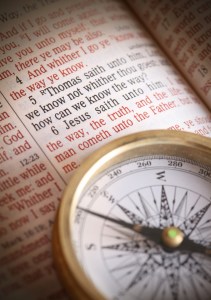
Compass and bible depicting popular bible verse John 14:5-6 How do we know the way. I am the way the truth and the life....etc. Focus to bible text

“The wisdom of the prudent is to understand his way: but the folly of fools is deceit.” ~ Proverbs 14:8

The rejection of God is the rejection of truth. Romans 1 explains the fool’s folly this way:

“For the wrath of God is revealed from heaven against all ungodliness and unrighteousness of men, who hold the truth in unrighteousness
Because that, when they knew God, they glorified him not as God, neither were thankful; but became vain in their imaginations, and their foolish heart was darkened. Professing themselves to be wise, they became fools,” ~ Romans 1:18, 21-22

The phrase “hold the truth in unrighteousness”, in Romans 1:18, means to reject the truth.  That is, to reject God’s existence and authority, to consider/treat it as false. In other words, fools deliberately deceive themselves and others about God.

The fool rejects God and therefore must deny the truth of God to himself and all who would hear him.

Answer Not a Fool…

Now that we have seen the Biblical definitions of a fool (one who rejects God) and his folly (deception), the first verse of the couplet (i.e., v. 4) becomes clearer. Believers are warned that there is a danger in debating with those who reject God; because our faith in God can be greatly shaken by their deceptions. For example, when speaking about the end times, Jesus said:

“For there shall arise false Christs, and false prophets, and shall shew great signs and wonders; insomuch that, if it were possible, they shall deceive the very elect.” ~ Matthew 24:24

The “false Christs, and false prophets” are those who reject God and, therefore, are fools by definition. And their intent is to “deceive the very elect”, to deceive Believers.

Jesus does indicate that, ultimately, Believers are not deceived: that is, they don’t stay deceived. But, as Galatians 2:11-21 reveals, even a stalwart like Peter was deceived for a period of time.

Apply great caution when debating fools ensnared by deceptions, for you might also become trapped by those same deceptions.

stay-or-go-2

Answer a Fool…

In the second verse of the couplet (v.5), we are encouraged to challenge the deceptions spewed out by those who reject God. However, now the focus shifts from the Believer to the fool. If the fool is not challenged, he might think he is right, i.e., “be wise in his own conceit.”

The idea here is that God still loves the fool. Even though the fool has rejected God, God desires to rescue the fool from His folly, so that he can know the Truth and be saved.

“For God sent not his Son into the world to condemn the world; but that the world through him might be saved.” ~ John 3:17

“And the servant of the Lord must not strive; but be gentle unto all men, apt to teach, patient, in meekness instructing those that oppose themselves; if God peradventure will give them repentance to the acknowledging of the truth; And that they may recover themselves out of the snare of the devil, who are taken captive by him at his will.” ~ 2 Timothy 2:24-26

Retaining Faith while Rescuing Fools

Rather than being contradictory, our couplet outlines the tension that exists for Christians interfacing with the world. On one hand, a Believer can  have his/her faith challenged, even to the point of becoming (though not permanently) deceived. On the other hand, the imperative of God’s love for mankind (even for those who reject Him) means that we must engage even those who have rejected God and are ensnared by deceptions of their own making.

lifeguard-338192_1920

In some ways, it is like rescuing a drowning man. If the drowning man, in his panic, fights the rescuer, he can cause them both to drown. Nevertheless, even with that risk in mind, the rescuer tries to help because he wants to save the drowning man’s life.

Indeed, in Galatians 6:1 we see a similar tension:

“Brethren, if a man be overtaken in a fault, ye which are spiritual, restore such an one in the spirit of meekness; considering thyself, lest thou also be tempted.“ ~ Galatians 6:1

Here, mature Believers are both challenged to restore the fallen brother and warned of the dangers of engaging with a brother trapped in sin.

In our text, God wants us to be fully aware of both the challenges and opportunities that can arise when sharing the Gospel, His truth, with those who have rejected Him.

No Will but Thine

‘Tis my aim Jesus divine,
Hence to have no will but thine,
Let me covenant with thee,
Thine for evermore to be:
This my prayer, and this alone,
Saviour, let Thy will be done!

Thee to love, to live to Thee,
This my daily portion be,
Nothing to my Lord I give,
But from him I first receive:
Lord, for me thy blood was spilt,
Lead me, guide me, as Thou wilt.

All that is opposed to Thee,
Howsoever dear it be,
From my heart the idol tear,
Thou shalt have no rival there,
Only Thou shalt fill the throne:
Saviour, let Thy will be done.

Wilt Thou, Lord, in me fulfil
All the pleasure of Thy will;
Thine in life, and Thine in death,
Thine in every fleeting breath,
Thou my hope and joy alone:
Saviour, let Thy will be done.

Octavius Winslow

Me, A Betrayer

How oft have I betrayed my Lord
with feigns of love in deed and word
While in my cold and calloused heart
I held myself from Him apart

How sore I tread upon His grace
And played the part with double face
And every gracious call I spurned
As He did bid me to return

‘Twas His sweet love broke through my shell
And saved me from eternal hell
And rescued me from death’s dark door
And gave me life and peace and more

I’m amazed when looking back I see
How great the Savior’s love for me
It’s beyond my understanding why
He cared for such a wretch as I

May all of my remaining days
Be spent in humble, thankful praise
To Christ my Savior, God and Friend
Who loves His own unto the end

by Vicki Baird

Love’s Inscription

Behold, I have graven thee upon the palms of My hands.” ~ Isaiah 49:16

No doubt a part of the wonder which is concentrated in the word “Behold,” is excited by the unbelieving lamentation of the preceding sentence. Zion said, “The Lord hath forsaken me, and my God hath forgotten me.”

How amazed The Divine Mind seems to be at this wicked unbelief! What can be more astounding than the unfounded doubts and fears of God’s favoured people? The Lord’s loving word of rebuke should make us blush; He cries, “How can I have forgotten thee, when I have graven thee upon the palms of my hands? How darest thou doubt my constant remembrance, when the memorial is set upon my very flesh?”

O unbelief, how strange a marvel thou art! We know not which most to wonder at, the faithfulness of God or the unbelief of His people. He keeps His promise a thousand times, and yet the next trial makes us doubt Him. He never faileth; He is never a dry well; He is never as a setting sun, a passing meteor, or a melting vapour; and yet we are as continually vexed with anxieties, molested with suspicions, and disturbed with fears, as if our God were the mirage of the desert.

“Behold,” is a word intended to excite admiration. Here, indeed, we have a theme for marvelling. Heaven and earth may well be astonished that rebels should obtain so great a nearness to the heart of infinite love as to be written upon the palms of His hands.

“I have graven thee.” It does not say, “Thy name. ” The name is there, but that is not all: “I have graven thee. ” See the fulness of this! I have graven thy person, thine image, thy case, thy circumstances, thy sins, thy temptations, thy weaknesses, thy wants, thy works; I have graven thee, everything about thee, all that concerns thee; I have put thee altogether there.

Wilt thou ever say again that thy God hath forsaken thee when He has graven thee upon His own palms?

From Spurgeon’s Morning & Evening for February 24 Morning

A Stew, a Stew! My Kingdom for a Stew!

And Jacob [cooked stew]: and Esau came from the field, and he was faint: and Esau said to Jacob, “Feed me, I pray thee, with that same red [stew]; for I am faint”…
And Jacob said, “Sell me this day thy birthright.”
And Esau said, “Behold, I am at the point to die: and what profit shall this birthright do to me?”
And Jacob said, “Swear to me this day”; and he [swore] unto him: and he sold his birthright unto Jacob. Then Jacob gave Esau bread and [stew] of lentils; and he did eat and drink, and rose up, and went his way: thus Esau despised his birthright.”
~ Genesis 25:29-34

BIBLICAL BACKGROUND

The Birthright was the privilege to be the one through which God would enact/deliver the promise He had made to Abraham to establish a holy nation/people. As the firstborn son, Esau was to inherit The Birthright when his father died. In selling his Birthright, he relinquished that privilege to Jacob.

Believers also have a Birthright: God has promised to establish His kingdom through us: He has made us heirs of His kingdom (James 2:5) and He has commanded us to teach others the truth so that they can become heirs too (Matthew 28:18-20). Our Birthright is God working through us to do His will and accomplish His purposes. Our Birthright becomes available when we first accept/confess the death and resurrection of Christ Jesus as the way to our salvation.

POINTS TO PONDER

  1. For Esau, The Birthright (the privilege of God working through him to establish a holy nation) was not priceless. There was a situation in which he would be willing to sell his Birthright.
  2. For Esau, present physical need was more important than future spiritual gain.jacob-esau-stew
  3. Esau was unwilling to die for The Birthright.
  4. For Jacob, Love/Loyalty was not priceless. He traded his relationship with Esau to get his way. Jacob valued and wanted The Birthright, and was willing to exploit his brother’s weakness to get it.
  5. Jacob lacked faith and patience. God had already set the Birthright aside for Jacob (Genesis 25:23), He just had to wait on God’s timing and God’s way. But Jacob chose to do things in his time and in his way.
  6. For Jacob, future gain was more important than present loyalties.
  7. Both Esau and Jacob behaved badly, but Jacob was right about the (value of the) Birthright: Jacob chose God, Esau rejected God.

QUESTIONS to QUARRY

What could make you sell your birthright? What could make you trade God’s will to satisfy a hunger?

When a believer sells his birthright, can he/she get it back? (See 1 John 1:9 for the answer.)

How important is your Birthright in Jesus to you? Are you willing to suffer hunger for it? Are you willing to faint to keep it? Are you willing to die for it?

Are you willing to wait on God? Are you willing to do things God’s way and in God’s time? Does God move too slowly? Is God ever late?

Who are you willing to hurt to get your way? Who are you willing to hurt to get what you want, when you want it?

http://menonamission.org/

I Prayed for Thee Today

I prayed for thee today,
To the God Who has all power
That He would keep thee close to Him
And strengthen Thee this hour,
And that thou be conformed to Christ
In Whom thy life is hid
And reflect to all the Father’s love
As Christ our Savior did.

I prayed that thou might know Him well
And delight thyself in Him
Who sacrificed Himself for thee
And cleansed thee of thy sin
I prayed thy eyes be lifted high
To Him enthroned above
Until He brings us home to Him
Upon His beams of love.

by Vicki Baird

The First Step to Salvation

A pre-requisite for salvation is believing in the Bible as the true Word of God unto us and, therefore, an accurate, untarnished revelation of God’s character and will. Otherwise, the god we choose to believe in would not be the God of the Bible, but the god of our own construct, as we piece together the parts of the Bible we like and discard the parts we do not like.  Similarly, salvation by our self-constructed god would bear no resemblance to salvation defined in the Bible.

“Let Thy mercies come also unto me, O Lord, even Thy salvation, according to Thy word.” ~ Psalm 119:41

Consequently, the act of faith in accepting the prescription for salvation articulated by God in His Word, must also mean full acceptance of ALL other prescriptions in His Word: Full acceptance of even those truths that we find uncomfortable.

cognitive dissonance

In other words, if I yield my will to God for salvation, then I must also yield my will to Him for everything else. God, by definition, cannot be right about one thing and wrong about another.  Acknowledgment of God’s authority as Deity, cannot be compartmentalized.

Hence, my very cognition is, and must always be, open and subservient to God’s truth and dismissive of any other “truth”, including “truth” of my own invention.

Anything else is both cognitively and spiritually dissonant.

Christians and Politics: A Few Questions to Consider

Given how much governmental/legislative politics influences the lives of people, including Believers, there is often tremendous pressure on getting involved in partisan politics and picking sides. However, in surveying the political scene, a few questions come to mind regarding just how best Christians should navigate the political seas.

1. Planks, Platforms, and Policies

Political parties offer secular solutions for society’s struggles. However, God makes it quite clear in His Word that it is impossible for humans to find the solutions for life’s problems without Him.

“Enter ye in at the strait gate: for wide is the gate, and broad is the way, that leadeth to destruction, and many there be which go in thereat: Because strait is the gate, and narrow is the way, which leadeth unto life, and few there be that find it.” ~ Matthew 7:13-14

The strait gate is Jesus Christ.  The narrow way is God’s way, God’s solutions and God’s prescriptions for life. And that way leads to good results. The broad way is man’s way: man’s solutions and man’s prescriptions for life and it eventually results in destruction.

Highway Exit - Matthew 7:13Moreover, we humans are not equipped to function independently of God: We can’t love without God, for God is love; we can’t do right without God, because righteousness comes from God, we can’t be wise without God, because wisdom only begins when we walk with God in humble reverence.

“O Lord, I know that the way of man is not in himself: it is not in man that walketh to direct his steps.” ~ Jeremiah 10:23

Consequently, in supporting any political party, a Christian is also giving support to a set of manmade policies that are doomed to fail.

QUESTION 1: “Should Christians support any secular political party, which by definition seeks to implement manmade, ungodly, policies leading to the ultimate demise of the society they seek to govern?”


2. Peace, Prosperity, and Panaceas

Perhaps more dangerous than obviously unsuccessful manmade policies, are apparently successful manmade policies. Apparently, successful human solutions give the illusion that mankind has the answers to life: that we can provide our own salvation: that we do not need God.cross 1

In other words, the danger for Believers is that in supporting a particular political party, we (unintentionally?) send the message that success, happiness, even salvation can be found in manmade ideas.  In Scripture we see this warning:

“Woe to them that are at ease in Zion, and trust in the mountain of Samaria, which are named chief of the nations, to whom the house of Israel came!
…Ye that put far away the evil day, and cause the seat of violence to come near; that lie upon beds of ivory, and stretch themselves upon their couches, and eat the lambs out of the flock, and the calves out of the midst of the stall;” Amos 6:1, 3-4

The people in Zion (in Judah, the southern kingdom), had come to trust in the governing practices of Israel (the mount of Samaria) because of their economic success (as described in the books of Hosea and Amos).

In other words, they looked away from mount Zion where The Temple (and God’s mercy seat) was, and looked instead towards mount Samaria, the seat of government, which had instructed its people to worship idols it created for their salvation (1 Kings 12). God’s solutions in His Word was usurped by manmade solutions because of the apparent economic success and security of Israel.

QUESTION 2: “By supporting a political party, do Christians risk diminishing the message of (true) salvation in Jesus Christ alone?”

3. Perception, Perplexity, and Pontification

No political party has a monopoly on virtue; no political party has a monopoly sin. Consequently, it is typical that each political party, either in policy or practice, supports something clearly wrong or ignores something clearly right. (Note, this is not to say all political parties are necessarily “equally” evil.) Often Christians are called on to choose between the evils in one party versus the evils in another. However, the Bible teaches clearly that ALL evils/sins are the same. Consider the following teaching of Jesus:

“There were present at that season some that told him of the Galilaeans, whose blood Pilate had mingled with their sacrifices. And Jesus answering said unto them, “Suppose ye that these Galilaeans were sinners above all the Galilaeans, because they suffered such things?
“I tell you, Nay: but, except ye repent, ye shall all likewise perish.
“Or those eighteen, upon whom the tower in Siloam fell, and slew them, think ye that they were sinners above all men that dwelt in Jerusalem?
“I tell you, Nay: but, except ye repent, ye shall all likewise perish.” ~ Luke 13:1-5

choosing lesser of two evilsJesus makes it clear that the size or the egregiousness of the sin is not the issue. Rather the only thing that matters is repentance. Therefore, it is inconsistent with Jesus’ teaching to choose any political party based on the relative size of its sins versus another political party. It matters not whether a political party is on the right side of any issue. Rather the issue, the ONLY issue, that matters is whether the political party adopts and advocates repentance. But this is not usually a policy of any (modern?) political party.

It is possible to repent, to receive God’s salvation in Jesus Christ, and still be wrong on any number of issues. While Jesus works in our hearts to sanctify/perfect us, washing us with the Word of Truth, we still make mistakes and hold misconceptions: e.g., Paul was wrong about John Mark (Acts 15:36-39 and 2 Timothy 4:11), Peter was wrong about the Mosaic Law (Galatians 2:11-21).

It is possible to be saved and be on the wrong side of many issues, BUT remain saved.

It is also possible to be unsaved and be on the right side of many issues, BUT remain condemned.

Salvation is infinitely more important than political/ideological orthodoxy.

QUESTION 3a: “In supporting one political party over another because of its stance on a favorite issue, are we effectively saying one sin matters more than another?”
QUESTION 3b: “Is right thinking on an issue is more important than repentance for a life?”
QUESTION 3c: “If repentance/salvation is infinitely more important than orthodoxy, shouldn’t we spend infinitely more time preaching repentance/salvation than preaching orthodoxy?”

4. Putrefaction, Petrifaction, and Purulence

God does not change (James 1:17). However, man and manmade institutions change quite a bit. Those who are saved are being changed into the very image of Christ Jesus (1 Corinthians 15:49, 2 Corinthians 3:18). And those who are not saved are deteriorating, degrading into the image of satan (Revelation 19:20).flower-1042490_1920

Man does not stand still.

Accordingly, unconverted men and their secular institutions, without the sustaining power of Christ, degrade and fail.

“It is better to trust in the Lord than to put confidence in man.
It is better to trust in the Lord than to put confidence in princes.” ~ Psalm 118:8-9

Eventually, the political party one supports will degrade. Eventually, it will become more and more difficult to find sufficient rationale to support it, beyond tradition or that it appears the least of the available evils (i.e., “at least it’s better than _____”).

But [Jesus] answered and said, “Every plant, which my heavenly Father hath not planted, shall be rooted up.” ~ Matthew 15:13

Perhaps, like Daniel, if only evil choices are available one should refrain from choosing at all (see Daniel 1). Daniel and his friends rejected ALL of the food offered; requesting vegetables (pulse) instead.

Let us be clear, there is NO Biblical imperative for direct (partisan) political involvement of any kind. Rather, the Bible encourages us to PRAY (to God) for leaders in government (1 Timothy 2:1-6). That is, the Bible directs us to exclusively put our trust in The One Who cannot change: The One Who will never fail us: The One Who is good and is good ALL the time.

QUESTION 4: “Why should a Believer invest any hope in a political party that will eventually degrade and fail?”

Phinally, Phinale, and Phinish

If political parties were full of Godly men, we would have prayer meetings rather than elections. Candidates would be seeking to serve rather than to rule. Solutions would come from Bible studies rather than think-tanks.

"Thy kingdom come, Thy will be done in earth, as it is in heaven." ~Matthew 6:10

“Thy kingdom come, Thy will be done in earth, as it is in heaven.” ~Matthew 6:10

Any political party devoted to God rather than men would spend much more effort campaigning for God’s power than earthly power.

Perhaps Christians should spend more time and effort setting just that example.  This is more than just choosing to vote or not to vote; it is more that choosing who to vote for:  as Believers we must carefully consider our allegiances and our mindset towards political parties/issues.

We must realize that our lives and our well-being do not depend on political parties and/or political figures.  We must look to Christ for everything and nothing matters without Christ.  God alone is good.  Therefore, there is no good without God.  Let us put our trust, our hope, in Him alone.

“Some trust in chariots, and some in horses: but we will remember The Name of the Lord our God.” ~ Psalm 20:7