Latest Posts

The Conquerors

Jesus and Alexander died at thirty-three.
One lived and died for self; one died for you and me;
The Greek died on a throne; the Jew died on a cross;
One’s life a triumph seemed; the other but a loss.
One led vast armies forth; the other walked alone.
One shed a whole world’s blood; the other gave His own.
One won the world in life and lost it all in death;
The other lost His life to win the whole world’s faith.

Jesus and Alexander died at thirty-three.
One died in Babylon, and one on Calvary.
One gained all for himself; and one Himself He gave,
One conquered every throne; the other every grave.
The one made himself God, the God made Himself less,
The one lived but to blast, the other but to bless.
When died the Greek, forever fell his throne of swords;
But Jesus died to live forever Lord of lords.

Jesus and Alexander died at thirty-three.
The Greek made all men slaves; the Jew made all men free.
One built a throne on blood; the other built on love.
The one was born of earth; the other from above.
One won all this earth, to lose all earth and heaven.
The other gave up all, that all to Him be given.
The Greek forever died; the Jew forever lives.
He loses all who gets, and wins all things who gives.

by Charles Ross Weede

“Rejoice greatly, O daughter of Zion; shout, O daughter of Jerusalem: behold, thy King cometh unto thee: he is just, and having salvation; lowly, and riding upon an ass, and upon a colt the foal of an ass.” ~ Zechariah 9:9

“That crowd that followed Him, that said, ‘Hosanna,’ they never thought of Him as the Son of God, the Saviour of the world. But that same crowd that said, ‘Hosanna,’ one day, said ‘Crucify Him’ the next day.” ~Bishop Rule
A Royal Air Force search and rescue Sea King helicopter comes to the aid of the French Fishing vessel Alf (LS683637) during a storm in the Irish Sea. The helicopter crew rushed to the aid of an injured fisherman trapped by bad weather on the Irish Sea. The Royal Navy Hydrographic survey vessel HMS Echo was carrying out maritime security operations when she received a request for assistance from Milford Haven Coastguard. The coastguard had already scrambled both an RAF search and rescue helicopter and an RNLI lifeboat to rescue the fisherman, but weather conditions were deteriorating fast. The 5 metre high swell meant it was not possible to lower a winchman safely onto the French vessel’s deck and assist the fisherman who was showing signs of hypothermia. Once Echo was called in, the 3,500 tonne ship attempted to provide some shelter for the RNLI lifeboat to get alongside the French fishing vessel, Alf, but once again the weather prevented a rescue. This left them with no choice but to escort the fishing vessel closer inland before the helicopter was able to winch the injured fisherman to safety.

Six Principles of Salvation

“No man can come to me, except the Father which hath sent me draw him: and I will raise him up at the last day.” ~ John 6:44

Our text is a magnificent verse of scripture.  Jesus spoke these words in response to some of His followers who doubted Him (John 6:37-40) after He had revealed that He was the Messiah, The Sent One from Heaven (John 6:41-42). In His answer, Jesus defines six (6) key principles of the Gospel message:

  1. Man’s Dilemma
    • Man’s Incapacity
    • Man’s Depravity
    • God’s Sovereignty
  2. God’s Love
  3. God’s Grace and Mercy
  4. Salvation in Jesus
  5. Urgency of Decision
  6. Salvation Culmination

1. Man’s Dilemma: “No man can come”

Jesus succinctly describes man’s problem as: “No man can come”. Our inborn tendency to sin, to rebel against God, means that we have no natural inclination to seek Him out. We have no inherent desire to reach out for Him. Our natural inclination is to seek our own way instead.

“There is none that understandeth, there is none that seeketh after God.” ~ Romans 3:11

flood roof hurricane-katrina

“I sink in deep mire, where there is no standing: I am come into deep waters, where the floods overflow me.” ~ Psalm 69:2

Rather than moving toward God, we move away from Him. Rather than serving Him, we determine to serve ourselves.

“No man can come”, because no man has an unprompted, self-originating, desire to seek God out.

Man has a second problem: God is holy. Our sinful state disqualifies us from entering into God’s presence. God cannot tolerate man’s sin. Unless our sin is removed, we cannot, safely, enter into God’s presence (Isaiah 6:1-7, Zechariah 3:1-5).

“No man can come”, because no man is sinless, no man is holy.

Man has a third problem: God is sovereign. Man cannot come to God, man cannot “show up on God’s doorstep”, uninvited. We see practical examples of this in Scripture:

  • Like the rest of his subjects, Queen Esther knew that she was forbidden to approach (her husband) King Ahasuerus uninvited; if she did, she could lose her life (Esther 4:10-17).
  • God invited Moses to come up to meet with Him on Mt. Sinai, but warned that if anyone else even touched the mountain they would be executed (Exodus 19:10-25).

“No man can come”, because no man has the authority to approach The Holy and Sovereign God.

2. God’s Love: “except”

rescue-1

“He sent from above, he took me, he drew me out of many waters.” ~ Psalm 18:16

Man had no means to come to God, no means to reconcile with God, no means to escape God’s judgment. Therefore, God’s love had to make “a way out of no way”. God’s love is expressed in the simple word “except”. The exception God made for mankind was established BECAUSE of His love for us:

“For God so LOVED the world, that He gave His only begotten Son, that whosoever believeth in Him should not perish, but have everlasting life.” ~ John 3:16

Except for God’s love, man has no hope.

3. God’s Grace and Mercy: “the Father which hath sent me draw[s] him”

The penalty for our sin is eternal torment. However, God has chosen to show us mercy. Rather than give us the punishment we deserve, God offers us forgiveness and reconciliation.

helicopter-615168_1280

“Save me, O God; for the waters are come in unto my soul.” ~ Psalm 69:1

However, since we are unable to come to God, God draws us, God invites us: This is God’s grace. To overcome our incapacity, our depravity and our impotence, God must use His infinite capacity, His singular purity and His almighty power to draw us to Himself.

“The Lord hath appeared of old unto me, saying, Yea, I have loved thee with an everlasting love: therefore with lovingkindness have I drawn thee.” ~ Jeremiah 31:3

4. Salvation in Jesus: “to me [Jesus]”

Note here that the Father is drawing men to Jesus. The reconciliation between God and man must come through Jesus. There is no other way:

“Jesus saith… I am the way, the truth, and the life: no man cometh unto the Father, but by me.” ~ John 14:6

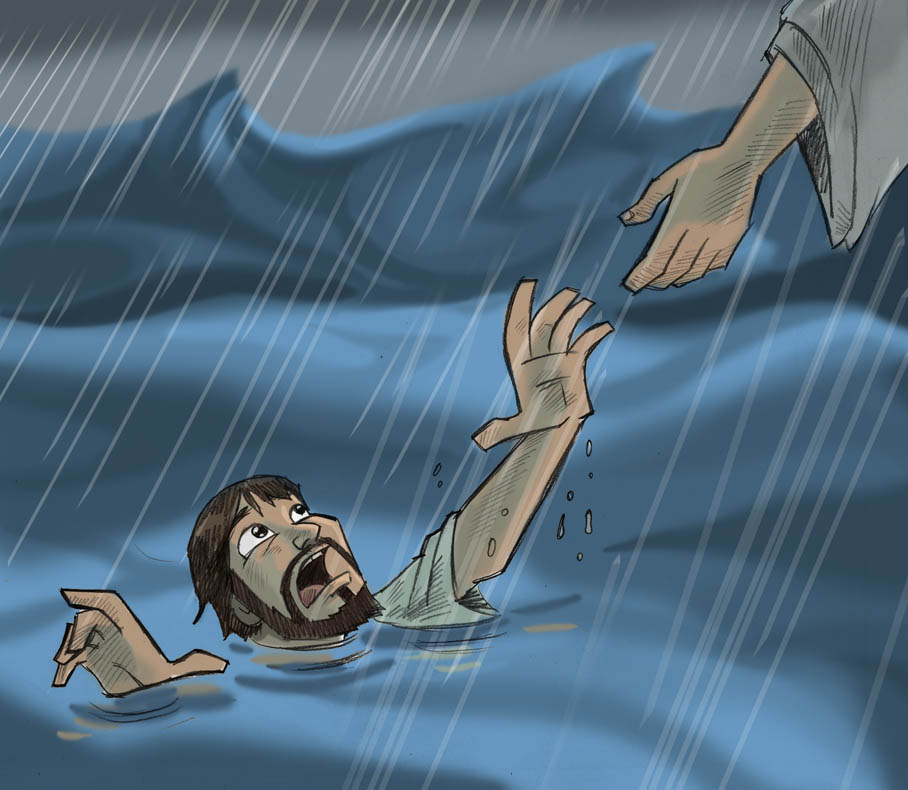
Peter sinking in the sea

In John 1:1-3 we learn that Jesus is The Word. Specifically, Jesus is how God expresses Himself. God expresses Himself to the universe in Jesus.

When God expressed His creativity (“And God said…”), Jesus created the universe (John 1:1-3).

When God expressed His love for man, Jesus took on the form of a man, and was crucified for the sins of man (Philippians 2:5-11).

And when God is ready to judge the world and satan and his hosts, Jesus will lead an righteous army to exact vengeance, Revelation 19:11-21.

Hence, there is no way into God’s presence, there is no way into a right relationship with God, except through The Expression of God’s love: Jesus.

5. Urgency of Decision: “the Father… draw[s]”

Since it is God, The Almighty, that draws us, it makes sense that we answer His call: that we respond positively to His pull on our hearts.

When a parent calls a child, the child that honors his/her parent answers the parent’s call and goes to his/her parent. Similarly, when a king/leader summons a citizen, it is expected that the citizen answers that call.

"He that covereth his sins shall not prosper: but whoso confesseth and forsaketh them shall have mercy." ~Proverbs 28:13

“He that covereth his sins shall not prosper: but whoso confesseth and forsaketh them shall have mercy.” ~Proverbs 28:13

Sadly, is far too easy for us to forget/ignore God’s sovereignty. If for no other reason, we should respond positively to God, because He is our creator and Lord of the universe.

Accordingly, there is a related reason we must respond to God’s gentle pull: God will not draw us forever. God is merciful and patient, longsuffering; but He will not call us forever.

“And the Lord said, My spirit shall not always strive with man, for that he also is flesh…” ~ Genesis 6:3a

“Because that, when they knew God, they glorified him not as God, neither were thankful; but became vain in their imaginations, and their foolish heart was darkened… Wherefore God also gave them up to uncleanness through the lusts of their own hearts…” ~ Romans 1:21, 24a

If we refuse to come to God, then God will stop drawing us to Himself. He will let us go our own way, which is the way to perdition.

Each man has but a window of opportunity to heed God’s call. And when that window closes, there is no longer a way in. When God stops drawing us to Jesus, we have no way of “drawing” ourselves to Him. Only the souls on the “ark of salvation” will be spared God’s wrath.

“…behold, now is the accepted time; behold, now is the day of salvation.” ~ 2 Corinthians 6:2b

6. Salvation Culmination: “I will raise him up at the last day.”

bonding

“For the Lord himself shall descend from heaven with a shout, with the voice of the archangel, and with the trump of God: and the dead in Christ shall rise first: Then we which are alive and remain shall be caught up together with them in the clouds, to meet the Lord in the air: and so shall we ever be with the Lord.” ~ 1 Thessalonians 4:16-17

The world is moving inexorably to the final day of God’s judgment. A penalty must be paid for sin. Those who have rejected Jesus’ offer of salvation will have to pay the penalty for sin themselves. Stained with sin, they will be cast out of God’s presence.

However, those who have accepted Jesus offer of salvation will be “raised up”, taken out of the masses bowed before God’s throne. Jesus raises up those who are marked by His blood, those who belong to Him and He presents them holy and approved before God the Father.

Then shall the King say unto them on his right hand, “Come, ye blessed of my Father, inherit the kingdom prepared for you from the foundation of the world” ~ Matthew 25:34

The Hath and the Hath Nots

And the disciples came, and said unto him, “Why speakest thou unto them in parables?”
He answered and said unto them, “Because it is given unto you to know the mysteries of the kingdom of heaven, but to them it is not given. For whosoever hath, to him shall be given, and he shall have more abundance: but whosoever hath not, from him shall be taken away even that he hath. Therefore speak I to them in parables: because they seeing see not; and hearing they hear not, neither do they understand.” ~ Matthew 13:10-13

After Jesus told the crowds that followed him the parable of the sower, His disciples asked Him why He spoke to the people in parables (as seen above in our text, Matthew 13:10-13). Jesus answered them, saying that (1) His disciples had been afforded special insight that wasn’t bestowed on everyone and (2) those that “have (hath)” would gain more, but those that didn’t have (hath not) would be left without a trace. At first glance, Jesus’ answer can appear somewhat troubling: it seems completely unfair.

Why would only some get a blessing, why not everybody?

AND

Why did those that have, get more and those that didn’t have be left with nothing?

Perhaps the key to unraveling this conundrum is to first discover what is this thing that some have, but others don’t have.

For the answer, Matthew 25:14-30 (the Parable of the Talents) provides us with a useful starting point. In particular, let’s examine vv. 25-30

“And I was afraid, and went and hid thy talent in the earth: lo, there thou hast that is thine.
His lord answered and said unto him, ‘Thou wicked and slothful servant… Take therefore the talent from him, and give it unto him which hath ten talents. For unto every one that hath shall be given, and he shall have abundance: but from him that hath not shall be taken away even that which he hath.
And cast ye the unprofitable servant into outer darkness: there shall be weeping and gnashing of teeth.’” ~ Matthew 25: 25, 26a, 28-30

glass water fill-1

The basic difference between the one that hid the talent and the other servants (who used their talents to gain more) was their ATTITUDE toward their master. And that distinction is so important that it was the deciding factor between salvation and damnation (v. 30). The master had placed each one of them in charge of some of his money, albeit of varying amounts. But, it was their attitude, their disposition, towards their master that determined how they used the money they were allotted.

The servant that refused to try to increase his master’s wealth had be given the least money and, therefore, he had the least risk. With the least to lose, he was best poised to invest the talent. But his bad attitude toward his master blinded him: he could not see/perceive his advantage. Likewise, a bad attitude toward God, prevents us from seeing His grace and mercy.

The servant that hid the talent/money saw his master as unjust (v. 25), he therefore had no faith in his master’s goodness. From his viewpoint, the talent/money his master invested in him was a liability, a burden.

To better understand why attitude is so important, let’s examine Romans 1:18-21:

“For the wrath of God is revealed from heaven against all ungodliness and unrighteousness of men, who hold the truth in unrighteousness; Because that which may be known of God is manifest in them; for God hath shewed it unto them.
For the invisible things of him from the creation of the world are clearly seen, being understood by the things that are made, even his eternal power and Godhead; so that they are without excuse: Because that, when they knew God, they glorified him not as God, neither were thankful; but became vain in their imaginations, and their foolish heart was darkened.” ~ Romans 1:18-21

extinguished candle-lower res

Everyone receives a “natural”/innate revelation of God (v. 19-20). But some (v. 21) reject/hide/deny that revelation. And those who do so, lose the (“natural”/innate) revelation they had in the first place. They veer off the strait of salvation into the darkness of damnation (their foolish heart was darkened).

However, those who respond correctly to the (“natural”/innate) revelation of God by seeking a greater (i.e., ordained, Biblical) revelation; they gain salvation.  The ones who respond correctly do so because they have the right attitude to God: they want to serve Him, they want to please their master.

The servants knew who their master was; they knew his character. The real problem for the servant that hid the talent was that he did not want to work for his master. Our problem with God, is not that God is unknowable, unfair, mysterious, etc. Rather, our problem with God is that serving Him takes us away from our own agenda. If God is my master, then I can’t be my master. If I can’t be my master, if I can’t get my way, then I would rather not do anything. And certainly, I don’t want to do anything to expand His kingdom: to confirm His power over me.

That brings us back to Matthew 13:12.

The people who followed Jesus were mixed in their intentions. Some were seeking God and some were not, e.g., most of the Pharisees had already rejected God. Some had the right attitude, while some wanted to be their own god.

The truth of Jesus’ teaching was meant for and ONLY accessible to those who were seeking God, those who had/hath the right attitude: those who “hath” the desire to serve their Master.

Conversely, the ones who rejected God, the ones that “hath not” the right attitude, were unable to understand Jesus’s teaching. Their minds were darkened (Romans 1:21).

To those who sought God, He gave them understanding (vs. 11). And, as their faith grew, they had even more faith. As they understood Jesus’ Word, they could understand even more. As the served God, their service grew.

For those who had no faith in God, those who were unwilling to serve Him, they lost everything, “their foolish hearts were darkened” and they lost their way.

Grappling with Grace

“Beloved, when I gave all diligence to write unto you of the common salvation, it was needful for me to write unto you, and exhort you that ye should earnestly contend for the faith which was once delivered unto the saints. For there are certain men crept in unawares, who were before of old ordained to this condemnation, ungodly men, turning the grace of our God into lasciviousness, and denying the only Lord God, and our Lord Jesus Christ.” ~ Jude 1:3-4


As we discussed earlier, the premise of the Epistle of Jude has already been outlined in the salutation (Jude 1:1-2), where holiness is established as the ongoing work of God in the life of a Believer (i.e., one who has been saved, one who is “born again” John 3:1-21, esp. vv. 3-7).

Now, as the body of Jude’s Epistle begins, in vv. 3-4, Jude explains the reason for the emphasis on holiness (set apart for the service of God). Specifically, Jude is concerned that false teachers have infiltrated the church and are leading Believers into sin in two distinct but closely related ways outlined in v. 4:

  1. “turning the grace of our God into lasciviousness”
  2. “denying the only Lord God, and our Lord Jesus Christ.”

To understand Jude’s distress, it is helpful to first explore the significance of grace and its role in the life of a Believer.

1. GLORIOUS GRACE

1.1 GROUNDS for GRACE

In the early church, grace was a wholly-new, groundbreaking concept. Every other religion had rules/laws that had to be observed for one to be considered a faithful follower (e.g., Judaism had the Mosaic Law). Christianity is different. Christianity says, man cannot be saved by faithfully observing a moral code.

Firstly, a suitable moral code by which to serve God, must come from God Himself. Therefore, all man-made moral codes are disqualified. Secondly, when God provided His moral code (the Mosaic Law) man was unable to observe it faithfully (Romans 3:20, 28; Galatians 2:16, 3:11, Hebrews 7:9). And thirdly, man cannot of himself attain righteousness sufficient to appease God, even if he could follow God’s moral code faithfully (Isaiah 64:6).

Consequently, man can only be saved by grace (Ephesians 2:8-9) through faith. Specifically, grace means that (when one professes faith in Jesus Christ for salvation) God places His own righteousness on helpless man to save man from God’s impending judgment of man’s sin. Grace, then, enables man to achieve what he could not attain by himself. Thereby, grace supersedes ALL moral codes as the way to obtain salvation (or sanctification).

1.2 GUIDED by GRACE

Now that we have established a working definition of grace, let us explore its impact on the life of a Believer.

spring-276014

The removal of the Law as the way to salvation creates a challenge for Believers, which can be expressed in the form of a question:

“What is required of me if there are no laws to follow?”

This issue was addressed very soon after the fall of man. Adam and Eve were not given any rules to follow after they were expelled from the Garden of Eden, and mankind quickly sank into a sinful state (Genesis 3-6).

One man, however, got it right: Enoch. Enoch walked with God. Without a moral code (i.e., without The Law), Enoch found the key to righteousness: Enoch had a relationship with God (Genesis 5:24). And that, indeed, is what God has always desired (Micah 6:6-8).

Moral codes do not place man’s focus on God, they oblige men to focus on their sins (Romans 3:20, 5:13, 7:5-9). Grace liberates us from a focus on our sins and prompts us to focus on God: to develop a relationship with God in the absence of laws, as Enoch did.

This new emphasis on relationship over rules is illustrated in the passages below:

All things are lawful for me, but all things are not expedient: all things are lawful for me, but all things edify not. Let no man seek his own, but every man another’s wealth.” ~ 1 Corinthians 10:23-24

“Know ye not that the unrighteous shall not inherit the kingdom of God? Be not deceived: neither fornicators, nor idolaters, nor adulterers, nor effeminate, nor abusers of themselves with mankind, nor thieves, nor covetous, nor drunkards, nor revilers, nor extortioners, shall inherit the kingdom of God.

And such were some of you: but ye are washed, but ye are sanctified, but ye are justified in the name of the Lord Jesus, and by the Spirit of our God.
All things are lawful unto me, but all things are not expedient: all things are lawful for me, but I will not be brought under the power of any.

…Know ye not that your bodies are the members of Christ? …What? Know ye not that your body is the temple of the Holy Ghost which is in you, which ye have of God, and ye are not your own? ~ 1 Corinthians 6:9-12, 15a, 19

white wildflowers

The key point in both passages is “All things are lawful for me, but all things are not expedient”. The Christian navigates life by expedience, not by law. What is expedient for a Believer is whatever the will of God in the circumstance is. A Believer must be guided by a desire to glorify God and to edify his brother.

It is important to note, however, that the verses also make it clear that some things are never expedient, e.g., thievery, adultery, drunkenness, homosexuality, extortion.

How can a Believer distinguish between those things that are expedient and those that are not? The answer lies in studying Scripture (2 Timothy 2:15, 3:16-17) under the tutelage of The Holy Spirit (John 14:26).

Scripture summarizes the points made in this section as follows,

“Likewise reckon ye also yourselves to be dead indeed unto sin, but alive unto God through Jesus Christ our Lord. Let not sin therefore reign in your mortal body, that ye should obey it in the lusts thereof. Neither yield ye your members as instruments of unrighteousness unto sin: but yield yourselves unto God, as those that are alive from the dead, and your members as instruments of righteousness unto God. For sin shall not have dominion over you: for ye are not under the law, but under grace.

What then? shall we sin, because we are not under the law, but under grace? God forbid.

…for as ye have yielded your members servants to uncleanness and to iniquity unto iniquity; even so now [that you are saved by grace through faith] yield your members servants to righteousness unto holiness.” ~ Romans 6:11-15, 19b

2. GARBLED GRACE

Thus far we have established a working definition for grace (God enabling man to live in righteousness) and we have examined the impact of grace in the life of a Believer (Believers live by their relationship with God, not by the law; Believers seek to Glorify God and edify their brethren). However, the transition from law to grace is a stumbling block for many and thus provides an opportunity for false teachers. This is the issue that concerns Jude.

white spring flower-trapped

Those who stumble on the foundation of grace, do so in one of two ways. Firstly, some revert to the imagined comforts of legalism: they re-create/re-introduce laws to govern themselves and others. This problem was dealt with extensively in the Epistle to the Galatians, which revealed that even the apostle, Peter, stumbled in this area (Galatians 2:11-21).

Jude, however, is concerned with the other way in which people stumble when dealing with grace, namely, “turning the grace of our God into lasciviousness”; and its consequence, “denying the only Lord God, and our Lord Jesus Christ”. Having examined some of the key aspects of grace in the life of a Believer, we can now explore the implications of Jude’s warnings.

2.1 GUTTED GRACE

It is tempting to interpret the replacement of the Law with grace as occasion for a “free-for all”. In other words, some wrongly interpret grace to mean they can do whatever they want to do: they focus solely on “All things are lawful unto me…” and ignore “…but all things are not expedient”. Accordingly, since “all things are lawful” they assume that it is acceptable to indulge in their lusts/passions without restraint. Moreover, they teach others to do likewise (2 Timothy 3, 2 Peter 2).

This had devastating effects on early church, as many were led back into the bondage of iniquity from which salvation had freed them in the first place. It made the conduct of Christians indistinguishable from the society around them. And totally distorted the message of the Gospel of Jesus Christ.

Jude therefore, implored Believers to contend, to fight, for the truth of the Gospel message. Otherwise, churches would fail, as they collapsed under the weight of their own immorality. The well-being of the newly emergent church was at stake.

Today, we face a similar challenge. False teachers in the modern church are generally not as blatant as in Jude’s time. However, they are more cunning and, potentially, even more destructive.

Dry-Wild-Flowers-Beautiful-Flowers-in-Autumn-Dry-and-Fading

One way that the modern form of this teaching takes shape is in the removal/absence of church discipline. Congregations are taught to tolerate serious and often repeated transgressions by both their leaders and fellow congregants/members. The lie taught is that discipline is not necessary since we are “under grace”.

As a result, many church members and church leaders live worldly lives everywhere except, supposedly, for a few hours in church each week, where forgiveness is claimed under grace and discipline is (wrongly) withheld because of grace. And, because of this duplicity/hypocrisy, the Gospel appears ineffectual, ephemeral and impotent.

Grace is not a loophole for immorality: Grace is given to lift us out of immorality, not to enable it. God is gracious and gives grace to His children; but God is also holy will judge unrighteousness.

“Be not deceived; God is not mocked: for whatsoever a man soweth, that shall he also reap. For he that soweth to his flesh shall of the flesh reap corruption; but he that soweth to the Spirit shall of the Spirit reap life everlasting.” ~ Galatians 6:7-8

To wed grace to immorality is to rob grace of its power to uplift and transform us.

“Therefore being justified by faith, we have peace with God through our Lord Jesus Christ: By whom also we have access by faith into this grace wherein we stand, and rejoice in hope of the glory of God.” ~ Romans 5:1-3

God gives us grace to stand in righteousness, not to wallow in immorality.

Rather than turn a “blind eye”, churches must discipline both their leaders and their congregants when they are living openly in sin. And this discipline includes removal from offices held in the church and even removal from fellowship (1 Corinthians 5) until it is clear that the sin is put away (2 Corinthians 2:4-11).

fadedflowers

For the church to be strong witness, salt and light in the broader community, the church must also be holy. When the holiness of the church is compromised, the effectiveness of the church is diminished.

More broadly, being under grace does not excuse our laziness for serving God. Being under grace does not excuse our love of money, or our gluttony, or our lack of generosity, or our pride, or our materialism, etc. Rather, Scripture instructs us:

“…not using your liberty [i.e., grace] for a cloak of maliciousness, but as the servants of God.” ~ 1 Peter 2:16

Being under grace does not mean we can live as we please. It is the unsaved, the un-regenerated, the rebellious man that lives as he pleases; not the born-again, child of God.

We must contend for our faith, by fighting for holiness, standing against false teaching and demonstrating, by the lives we live, the truth of the Gospel: that it is possible for a man to live for God, it is possible to be holy.

2.2 GROTESQUE GRACE

Jude’s second concern was that false teachers were “denying the only Lord God, and our Lord Jesus Christ.” This problem is a natural consequence of “turning the grace of our God into lasciviousness”. Since grace disqualifies the law, some argue, wrongly, that the lawmaker is likewise disqualified. The false teaching would then be “Since there are no rules, there is no Rule-Maker (i.e., God); so I will be the rule-maker (i.e., god)”. This was satan’s ploy from the beginning:

“For God doth know that in the day ye eat thereof, then your eyes shall be opened, and ye shall be as gods…” ~ Genesis 3:5

In arguing that grace meant they could make their own rules, false teachers in Jude’s day were effectively, making themselves equal to God. They were denying the unique authority of God as Creator and of Jesus Christ as Saviour.  This is idolatry.

dead flowers-3

Sadly, just as in Jude’s time, it is common today for both church leaders and laity, to make up their own rules, independently of the teachings of the Bible, God’s Word. This denies the authority and thereby the deity of God and the Lordship of Jesus Christ.

For example, many churches are becoming increasingly accepting of practicing homosexuals as brothers/sisters in good-standing, even though Scripture explicitly declares it abominable to God (e.g., Romans 1:18-30). Similarly, many churches/church-leaders have accepted pre-marital sex as a norm, rather than rejecting it as sin. Again, many modern churches have long gone silent on biblical teaching about materialism; and the oppression of the poor by the wealthy. Thereby, the church tacitly denies God’s authority in these issues. This is idolatry.

The modern church rarely reminds Believers of our obligation to care for the widows and orphans: single-mothers and their fatherless children. Few churches talk about immodesty, gluttony or pride, effectively confirming them as acceptable norms for Believers. Scripture describes it this way:

“For men shall be lovers of their own selves, covetous, boasters, proud, blasphemers, disobedient to parents, unthankful, unholy, without natural affection, trucebreakers, false accusers, incontinent, fierce, despisers of those that are good, traitors, heady, highminded, lovers of pleasures more than lovers of God; Having a form of godliness, but denying the power thereof: from such turn away.” ~ 2 Timothy 3:2-5

To turn ourselves into rule-makers, to deny/ignore the truths in God’s Word, is to deny the deity and authority and power of God the Father, and Jesus Christ the Son.  This is idolatry.

We must contend for our faith, by fighting for holiness, standing against false teaching and demonstrating, by the obedient lives we live, the truth of the Gospel: that it is possible for a man to live for God, it is possible to be holy.

There is hope for holiness, fight for it.

wildflowers_white-1

Say Hello to Holiness

“Jude, the servant of Jesus Christ, and brother of James, to them that are sanctified by God the Father, and preserved in Jesus Christ, and called: Mercy unto you, and peace, and love, be multiplied.” ~ Jude 1:1-2

In the opening salutation (verses 1-2) of Jude, the target audience is clearly defined: those who are sanctified AND preserved AND called. In doing so, the salutation also reveals that there are three ways in which God works in the life of a Believer. And, thereby, it provides the basis for the remainder of the letter.

SANCTIFIED

Sanctification is the act of being made clean: being made holy. Man cannot make himself holy, only God the Father can do so. There is a role for us to keep ourselves pure (2 Timothy 2:21), but holiness is imparted by God.

“Now Joshua was clothed with filthy garments, and stood before the angel. And [God the Father] answered and spoke unto those that stood before Him, saying, ‘Take away the filthy garments from [Joshua].’ And unto [Joshua] He said, ‘Behold, I have caused thine iniquity to pass from thee, and I will clothe thee with change of raiment.’” ~ Zechariah 3:3-4

God the Father makes us holy.

PRESERVED

Preservation means keeping something from decay or deterioration. Jude reveals that preservation of Believers is the job of Jesus Christ. This is perhaps best demonstrated when Jesus washed His disciples feet (John 13:5-10). As Jesus told Simon Peter (verse 10), the washed (i.e., the saved) had no need to be washed (saved) again, except for their feet. The feet symbolizes the Believer’s interaction with the world: as believers go about their day, even as they serve God, we sin.

Bird_in_bird_bath

Imperfection, deviation from God’s perfect will, is as pervasive as dust. So Jesus washes our feet he preserves us from deterioration. Without washing, our feet would quickly become so filthy that it would be difficult to walk on them, and they would be natural harbors for bacteria, leading to disease and infection. Likewise, without Jesus washing sin from our lives, our interactions with the world around us, our witness, becomes filthy and impeded, diseased and infected.

“…Christ also loved the church, and gave Himself for it; that He might sanctify and cleanse it with the washing of water by the word, that He might present it to himself a glorious church, not having spot, or wrinkle, or any such thing; but that it should be holy and without blemish.” ~ Ephesians 5:25b-27

God the Father makes us holy, Jesus keeps us holy.

CALLED

In this context, “called” means appointed to serve (1 Corinthians 1:1-2). Holiness in the life of a Believer is not an end in itself. We are made holy to be used by God. Indeed, that was the problem of asceticism and certain forms of monasticism practiced by the early church and still in evidence today.

lamp flame-1

Far too often, Believers are lulled to sleep or driven to distraction by the notion of attaining and maintaining purity/holiness. As Jesus taught in Matthew 5:15, a hidden light is useless: the point of lighting a candle is to use it for light.

The point of making a vessel holy is to use it in the worship of God, for the glorification of God (Numbers 7:1-3, 2 Timothy 2:21). A calling—i.e., a ministry/service—is an integral part of holiness. Without a calling, without a ministry, holiness becomes pointless and impotent. Jesus put it this way:

“Herein is my Father glorified, that ye bear much fruit; so shall ye be my disciples.” ~ John 15:8

God the Father makes us holy (sanctification), Jesus keeps us holy (preservation), so that we can serve properly.

MERCY, PEACE and LOVE

Jude completes the doctrinal architecture by coupling sanctification, preservation and calling with their enablers/facilitators.

God’s mercy makes it possible for us to receive sanctification. We do not deserve and cannot earn or manufacture our own holiness. Therefore we can only obtain it through mercy.

“Thou in thy mercy hast led forth the people which thou hast redeemed: thou hast guided them in thy strength unto thy holy habitation.” ~ Exodus 15:13

Water_Basin

Being at peace with Jesus, being on His team, being His disciple, makes it possible for Him to preserve us, to keep us clean. Jesus only washed His disciples’ feet. (And Judas’ foot-wash never mattered, see John 13:10-11, since Judas had never gotten a “bath”: Judas was not saved. Therefore, he could neither be sanctified nor preserved; and was not one of the called).

“Wherefore, beloved, seeing that ye look for such things, be diligent that ye may be found of him in peace, without spot, and blameless.” ~ 2 Peter 3:14

Love is the reason we are called and the reason we respond to God’s call. God wants to demonstrate His love to mankind, and He works through the lives of Believers to do it. We respond to God’s call because as children of God we also love our fellowmen.

“We love him, because he first loved us. If a man say, I love God, and hateth his brother, he is a liar: for he that loveth not his brother whom he hath seen, how can he love God whom he hath not seen? And this commandment have we from him, That he who loveth God love his brother also.” ~ 1 John 4:19-21

Mercy makes sanctification (holiness) possible, peace makes preservation possible, and love makes service/ministry (our calling) possible.

CLOSING REMARKS

The stage has now been set, the paradigm has now been constructed.  For the rest of the epistle, Jude is going to talk about holiness. Especially, Jude will emphasize the importance of preserving/maintaining holiness so that the church can be an effective witness for Christ in an immoral society.

Will you Pass on the Faith Baton?

“By faith Isaac blessed Jacob and Esau concerning things to come.” ~ Hebrews 11:20

Isaac’s special inheritance from his father, Abraham, was a “promissory note”: Abraham bequeathed to his son God’s promise that the land of Canaan would belong to his descendants some distant time in the future.

Isaac was then to stay in a land that was not yet his, living among people that hated him (Genesis 26:27).
(More on Isaac’s life can be found in Genesis 25-26)

POINTS to PONDER

  1. The test of Isaac’s faith was whether he would pass on the “promissory note” to his children. We ONLY pass on the things we truly believe in.
  2. Isaac spent his whole life among people that hated him, because they saw God’s blessing was upon him.
  3. Much of Isaac’s life was predetermined for him, from his birth: Isaac was born as the son of God’s promise to Abraham: he had obligations and expectations to live up to.
  4. Abraham was called to begin something new. Isaac was called to maintain what had already begun.

QUESTIONS to QUICKEN

Believer’s have also “inherited” a “promissory note”: The Promise of Jesus’ return, The Promise of inheriting His Kingdom. BXP135677 Like Isaac, the test of our faith is whether or not we will pass on Jesus’ Promise. Have you passed on The Promise to your children? Have you passed on The Promise to anyone? Are you actively trying to pass on The Promise? Do you really believe in The Promise?

Isaac’s neighbors knew who Isaac worshiped. Isaac’s neighbors could see in Isaac’s life, the evidence of Isaac’s faith. And they hated him for it. Jesus’ told his disciples that the world would hate them just as it hated Him. But they were to live in the world among “the haters” and be salt and light in their communities. Have your neighbors seen God at work in your life?? Can they see the difference in you? Are you willing to stand up for God in a sea of opposition? Are you willing to spend the rest of your life swimming against the tide?

Whose path are you walking on? Are you seeking out the path God has laid out for you (Ephesians 2:10)? Or, are you making your own path? Are you setting your children on God’s path? Or, are you letting them “choose for themselves”? ONLY one path leads to true and lasting happiness: ONLY one path has God on it. God expects His children to walk on the path He set for them.

Is your ministry one of creating or maintaining? God uses both pioneers and settlers, seed-planters and plant-waterers, in the work of His church. In the Bible, Paul was primarily a pioneer, an evangelist. But Timothy and Titus were given the tasks of being settlers, pastors. Paul planted the seeds, while Timothy and Titus watered and tended the plants that sprung up. God called Abraham to get the ball rolling and then God called Isaac to keep it going. What has God called you to do?

http://menonamission.org/

Obedience Fashions the Foundation for Fortitude

“And why call ye me, Lord, Lord, and do not the things which I say? Whosoever… heareth my sayings, and doeth them… is like a man which built a house, and dug deep, and laid the foundation on a rock…
But he that heareth, and doeth not, is like a man that without a foundation built an house upon the earth [sand]…” ~ Luke 6:46-49

POINTS to PONDER

  1. Jesus is our Lord ONLY to the extent that we obey Him. The person whose will we obey is our “Lord”.
  2. Obedience establishes a Believer: Obedience fashions the foundation for fortitude: a successful/victorious Christian life.
  3. Obedience is the POINT of Bible-studies/devotions/sermons/music/etc.: We study the Bible (God’s Word) to obey it.
  4. Without obedience, Bible-studies/devotions/sermons/music/etc. are useless.

Bible study (hearing God’s Word) is THE critical 1st step towards doing Gods will: fulfilling the purpose for which God made us. However, without the equally crucial 2nd step of obedience, Bible study, by itself, is impotent; making no lasting change in our lives.

QUESTIONS to QUICKEN

Who is Lord of your life? Whose will do you obey? Do you do things as you see fit? Or, do you do what the Bible says is right? Who is Lord of your life?

How much of what you have learned in church, Sunday school, personal devotions/Bible-study have you put into practice?

Do you need more Bible-study or more obedience? What will have the greater impact in your life now, more Bible-study or more Bible-obedience?

CLOSING COMMENTS

The modern church is awash with Biblical teaching. Despite the presence of many false teachers, the Believer who is truly seeking God can find many helpful resources online, in books or on the radio.lighthouse-168132_1920 God has preserved the works of many good Bible teachers/expositors over the past 200+ years. And there are a good number of excellent teachers still around today.

The modern church does not suffer, primarily, from a lack of teaching: the modern church suffers from a lack of obedience. The failure of the church today is that Believers refuse to practice the teachings of Scripture: we make every excuse to do the opposite of what the Bible teaches. We will only be able to stand up to the fierce storms of life if we have a foundation built on obedience to God’s Word.

But be ye doers of the word, and not hearers only, deceiving your own selves. For if any be a hearer of the word, and not a doer, he is like unto a man beholding his natural face in a glass: for he beholds himself, and goes his way, and straightway forgets what manner of man he was. But whoso looks into the perfect law of liberty, and continues therein, he being not a forgetful hearer, but a doer of the work, this man shall be blessed in his deed.” ~ James 1:22-25

http://menonamission.org/

Money can buy…

Money can buy:
Food, but not an appetite
A bed, but not sleep
Medicine, but not health
Books, but not brains
Acquaintances, but not friends
Finery, but not beauty
Pleasure, but not happiness
A house, but not a home
A church pew, but not heaven
A crucifix, but not a Saviour
Comfort, but not contentment

by Gertrude Heilemann

====

“Ho, every one that thirsteth, come ye to the waters,
And he that hath no money; come ye, buy, and eat;
Yea, come, buy wine and milk without money and without price.

Wherefore do ye spend money for that which is not bread?
And your labour for that which satisfieth not?

Hearken diligently unto me, and eat ye that which is good,
And let your soul delight itself in fatness.”

~ Isaiah 55:1-2

Faith: Obedience to Go, Where You do not Know (Because God told You So)

“So Abram departed, as the Lord had spoken unto him… and Abram was seventy and five years old when he departed out of Haran.” ~ Genesis 12:4

“By faith Abraham, when he was called to go out into a place which he should after receive for an inheritance, obeyed; and he went out, not knowing whither he went.” ~ Hebrews 11:8

POINTS to PONDER:

  1. Abram (later renamed Abraham) was called when he was (by the standards of the time) late middle age: seventy-five years old.
  2. Abram had a full-time job and responsibilities: he was a herdsman and he had a household (Sarai and Lot, and the live-in employees) to take care of.
  3. Abram DID NOT KNOW WHERE HE WAS GOING.
  4. It would take more than 500 years for Abram’s descendants to inherit the land God promised to Abram. Abram would not even be alive to see God fulfill His promise.

In summary, God called a middle-aged man in his late career and told him to leave where his business was well-established: to go to a place he had never seen or heard about that God would give to his children 500+ years later.

Now that takes FAITH!!!

QUESTIONS to ASK

Would you do what Abram did, if God called you? Are you “crazy” enough to say yes to God’s call?

Would you uproot your family and business/career to start over in a new place because God told you? Think carefully before answering. Many of us find it hard to change our routines just to visit someone who is sick. “I just couldn’t rearrange my schedule.” dive in lake-1Most church’s midweek Bible studies are attended by < 5% of the church members. Most churches struggle to find volunteers for… anything. We are all perpetually “too busy”.

Will you follow God, when you don’t know where He is leading you? Would you follow God when you can’t see the end, the goal, the target, the finish-line?

How many times have we quenched the Spirit with icy-cold waters of logic? How often have we felt God tug on our hearts… but calculated our way out of responding? “It doesn’t ‘add-up'”, we say. So we keep our feet firmly inside the boat, because we know no one can “walk on water”.

Will you follow God, knowing you may never see the full fruit of your labor?

Would you share the Gospel with a stranger? Would you plant the seed not knowing if it will grow or when it will be reaped?

Would you change career, to follow God’s call??

Would you risk your retirement plan? Would you risk your family? Suppose it’s not safe? Suppose you or a loved one dies?? Fellow missionaries, Jim Elliot, Nate Saint, Ed McCully, Peter Fleming, and Roger Youderian died trying to reach the Auca/Huaorani with the Gospel. Their wives and children had to face life without them. You have spent all your life trying to keep the family safe and secure… Can you bear to put all that you have achieved at risk now?

CLOSING THOUGHT

God is still calling us to follow Him, to do the work He has planned out for us from the beginning. The challenge, for you and for me, is to respond like Abram did: to trust God’s call over our calculation.