“Thou hast turned for me my mourning into dancing: thou hast put off my sackcloth, and girded me with gladness; To the end that my glory may sing praise to thee, and not be silent. O Lord my God, I will GIVE THANKS unto thee for ever.” ~ Psalm 30:11-12
Our text reveals two very important truths.
FIRST, the only correct response to God’s blessings is PRAISE and THANKSGIVING. Earlier in the Psalm, the psalmist (David) tells us that when God had blessed him previously, he had become haughty, confident in his own ability to sustain himself:
“And in my prosperity I said, ‘I shall never be moved’.” ~ Psalm 30:6
Then, when God “hid His face”, the psalmist was troubled (v.7) and in trouble (vv. 8-10): apparently, he was about to die.
Then, God saved him.
We are not given the details in the psalm. But, it is clear that the psalmist learned his lesson. Instead of responding to God’s blessings with pride, he declares “my glory may sing praise to thee” and “I will GIVE THANKS unto thee for ever.”
It is easy for us to think that the good things in our life come from our own efforts.
“I have a Ph.D. because I studied harder than…”
Do we realize that both the aptitude and the opportunity for study come from God? There are smarter students who never got the opportunities we did.
“I am wealthy because I worked harder than…”
Do we realize that both the strength and the opportunity for work come from God? There are harder workers who never got the opportunities we did.
When God blesses us, let us not praise ourselves or our strengths/abilities. Instead, let us PRAISE and GIVE THANKS to Him.
“Not unto us, O Lord, not unto us, but unto thy name give glory, for thy mercy, and for thy truth’s sake.” ~ Psalm 115:1
“…Yea, all of you be subject one to another, and be clothed with humility: for God resisteth the proud, and giveth grace to the humble.” ~ 1 Peter 5:5b
The SECOND truth revealed in our text is the importance of giving thanks regardless of our circumstances. To see this, let us note the tenses used in the verses:
The phrases: “hast turned”, “hast put off” and “[hast] girded” are all present perfect tense, which is used to “say that an action happened at an unspecified time before now”. Therefore, it was at some earlier time in the psalmist’s life that God had blessed him.
Therefore, the psalmist is saying: “God has blessed me in the past and for that I will GIVE THANKS to him forever.” Notice that the psalmist places no obligation on God to bless him in the present or in the future. The psalmist had experienced God’s blessing and so he will GIVE THANKS regardless of how things work out going forward.
Has God blessed you in the past? If He has, then you have enough reason for a lifetime of THANKSGIVING.
“It is a good thing to GIVE THANKS unto the Lord, and to sing praises unto thy name, O Most High: To shew forth thy lovingkindness in the morning, and thy faithfulness every night, Upon an instrument of ten strings, and upon the psaltery; upon the harp with a solemn sound.” ~ Psalm 92:1-3
The Bible often makes what seems hard very simple and straightforward. Would you like to do something good today? If the answer is “yes”, our verse tells us two good things to do:
GIVE THANKS unto the Lord
SING PRAISES unto thy name, O Most High
Our verse also tells us that we can, and should, do these two good things “in the morning” and “every night”. They should be the FIRST things we do when we rise, and the LAST things we do before going to sleep.
In other words, when we rise we “GIVE THANKS” and “SING PRAISES” for the day ahead that God has prepared for us. And when the day is spent we “GIVE THANKS” and “SING PRAISES” for the day God has given us.
When we rise from our beds in the morning, we look forward with hope, knowing that everything the day will bring is already in God’s hands: under His watchful care: That He has already made a way for us, not just to survive, but to thrive, to blossom, and to bear fruit.
Even when the day ahead means coping with a sick child, or paying bills, or sitting in traffic, or taking a tough test, or being diagnosed with cancer, or losing a job, or being betrayed by a friend; God has it covered and has already prescribed the perfect path for us to follow so that we can get through the fires and the floods that many a day can bring.
And so we “GIVE THANKS” and “SING PRAISES” to Him, to The Most High.
When we retire to bed at night, we look back on the day with gratitude, knowing that despite our mistakes, despite our missteps, God has taken us through the day. And though the day is finished, God isn’t finished with us yet. We don’t know if we will rise tomorrow, but we do know that we can turn to God in the closing moments of the day and ask for forgiveness for sin.
We can examine how the day went and we can see how our Father, God, guided us through. We know that the floods of the day did not overwhelm us and the fires of the day, though searingly hot, did not burn us up. God has been faithful.
And so we “GIVE THANKS” and “SING PRAISES” to Him, to our Lord and Saviour.
And we do so “with a solemn sound”, because we know that life is sometimes a challenge, sometimes hard and complex, difficult to understand or explain. “How does a mother bury her fourth child?” “How does a father go home without a job to return to and with bills to pay?” But we know God IS good. We know He has made a way for us. We know that even when we are faithless, He IS faithful.
And so we “GIVE THANKS” and “SING PRAISES” to Him, to our Strong Tower… we “GIVE THANKS” and “SING PRAISES” even “with a solemn sound”.
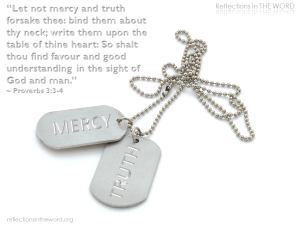
“By mercy and truth iniquity is purged: and by the fear of the Lord men depart from evil.” ~ Proverbs 16:6
This verse provides a prescription for Believers afflicted by a disease. The disease is iniquity and the prescription contains two medicines: mercy and truth. Although these terms are frequently used, it will be helpful for us to take a close look at their meaning and usage in this verse. Specifically, we would like to define the disease called iniquity and we want to know how the prescription works: “How do mercy and truth purge iniquity?”
THE DISEASE: Iniquity
The Bible often distinguishes iniquity from sin (and from transgression). For example:
“Keeping mercy for thousands, forgiving iniquity and transgression and sin…” ~ Exodus 34:7a
“…and pardon our iniquity and our sin, and take us for thine inheritance.” ~ Exodus 34:7b
“That thou enquirest after mine iniquity, and searchest after my sin?” ~ Job 10:6
“We have sinned, and have committed iniquity, and have done wickedly, and have rebelled, even by departing from thy precepts and from thy judgments:” ~ Daniel 9:5
Therefore, while it is clear iniquity and sin are related, it is also clear that there is enough consequential difference for God’s Word to make note of it.
One helpful definition of iniquity is given in Samuel’s rebuke of Saul for his disobedience:
“For rebellion is as the sin of witchcraft, and stubbornness is as iniquity and idolatry. Because thou hast rejected the word of the Lord, he hath also rejected thee from being king.” ~ 1 Samuel 15:23
Also helpful is this phrase:
“…When a righteous man doth turn from his righteousness, and commit iniquity…” ~ Ezekiel 3:20a
Taken together, we see that the disease of iniquity is an attitude, a mindset, to go one’s own way instead of God’s way in some areas of one’s life. When a Believer is infected with the disease of iniquity there are parts of his/her life that are un-yielded to God. In these areas the Believer is so entangled by the sin that it is difficult to escape even though it has been confessed to God.
Indeed, many of us at various times in our Christian journey have been trapped by a particular weakness, and struggle to break free from it because it became habitual: repeated over and over again. In Hebrews, it is referred to as “…the sin which doth so easily beset us…” (Hebrews 12:1). For some it might be pornography, for some gossiping, for some lying/deceitfulness/dishonesty, for some laziness, and so on: the list is long.
Yes, iniquity is a disease for which afflicted Believers desperately need a cure.
PRESCRIPTION: 1st Medication: Mercy
The first part of the two component remedy for the disease of iniquity is, mercy. The question is mercy from whom to whom? Is it mercy from God to the diseased Believer or from the diseased Believer to other Believers? Or both?
To help us understand, let us consider the following verses:
“Wherefore, O king, let my counsel be acceptable unto thee, and break off thy sins by righteousness, and thine iniquities by shewing mercy to the poor; if it may be a lengthening of thy tranquillity.” ~ Daniel 4:27
“He hath shewed thee, O man, what is good; and what doth the Lord require of thee, but to do justly, and to love mercy, and to walk humbly with thy God?” ~ Micah 6:8
“But go ye and learn what that meaneth, I will have mercy, and not sacrifice: for I am not come to call the righteous, but sinners to repentance.” ~ Matthew 9:13
In the passage from Daniel, showing mercy was the way in which the king could “break off” his “iniquities” and thereby could escape God’s impending judgment (Daniel 4).
In Micah we are instructed to “love mercy”. To be clear, the challenge here is not to love receiving mercy, which we all do. Rather, the challenge is to love giving mercy, which is by far a more difficult proposition.
Thirdly, when the Pharisees criticized Jesus for fraternizing with the “publicans and sinners”, He responded by quoting a fascinating verse from Hosea (Hosea 6:6). In the quote, Jesus reminds them that what God wanted as a sign of repentance from iniquity/sin/transgression was mercy, not sacrifice.
In other words, in God’s kingdom showing mercy to your fellowmen is a surer indication of a heart change than any sacrificial offering. Why? Because mercifullness means we recognize that we are no stronger than our brother/sister is. It means that we realize that we are just as weak and prone to iniquity/sin/transgression as they are. And that any ability to resist the trap of sin comes from God’s sustaining grace.
When Jesus challenged the man without sin to cast the first stone at the woman caught in adultery (John 8:1-11), He was really asking the men if they were without need of mercy. Clearly, when they considered their sins they recognized they were not any better than the adulterous woman because they all, “being convicted by their own conscience”, walked away (John 8:9).
That is exactly what the first of the medicines in the prescription for iniquity is: To begin the purge of iniquity from our own lives we must first recognize that we are no better than anyone else. Any advantage, any goodness in our lives is there because of God’s grace alone.
Just like the king, we won’t get anywhere without first showing mercy. Indeed we must love showing mercy, because we identify with our brother’s plight. We know that any pit he has fallen in would have gotten us too, but for the grace of God which sustains us.
To get rid of our own iniquity we must first see just how depraved in nature we really are: as depraved as the adulterer, as depraved as the thief, as depraved as the murderer. When we do, we will either show everyone mercy or we will show ourselves to be hypocrites; we will either take the medicine or remain diseased with iniquity. Furthermore, as Jesus reminds us:
“Blessed are the merciful: for they shall obtain mercy.” ~ Matthew 5:7
Showing mercy to our fellowmen puts us in the position to receive God’s mercy. Showing mercy to our fellowmen puts us in the position to start the purge of iniquity from our lives.
PRESCRIPTION: 2nd Medication: Truth
Truth in The Bible is synonymous with God’s Word, i.e., The Bible itself. The Bible defines Truth as Jesus, Himself (John 14:6), and it defines Jesus as The Word (John 1:1-3). And it is referred to as the Word of Truth (2 Timothy 2:15). Moreover, that is what Jesus called it:
“Sanctify them through thy truth: thy word is truth.” ~ John 17:17
As The Word washes us, our minds are transformed as we conform to the stature of Christ instead of the effigy of the world. And thereby our iniquity is removed.
Showing mercy to our fellowmen puts us in the position to start the purge of iniquity from our lives and The Truth, God’s Word, does the purging. It is by the humble study of God’s Word that we will be rid of iniquity.
Jesus put it this way:
“Then said Jesus… If ye continue in my word, then are ye my disciples indeed; and ye shall know the truth, and the truth shall make you free.” ~ John 8:31-32
MOTIVATION
“…by the fear of the Lord men depart from evil” ~ Proverbs 16:6b
Our verse closes by answering an underlying question: Why would anyone want to get better from the disease of iniquity (and its cousins sin and transgression)?
As doctors know too well, many people are not motivated to get better from their diseases. Many patients would rather live with (or die from) a disease rather than undergo grueling treatments or make uncomfortable lifestyle changes. They fear the cure more than they fear the disease.
Likewise, it is only when we fear the Lord that we will even have a desire to submit to His prescription for our iniquities: it is only when we fear the Lord that we will want to leave the evils with which we have become comfortable.
This leaves each of us in a quandary, because our challenge is not how to get out of iniquity, for God has told us how: he has given us his prescription. Instead, our quandary is whether we really want to “depart from evil”.
“Blessed are ye, when men shall revile you, and persecute you, and shall say all manner of evil against you falsely, for my sake. Rejoice, and be exceeding glad: for great is your reward in heaven: for so persecuted they the prophets which were before you.” ~ Matthew 5:11-12
Popular Judaism slew the prophets and crucified Christ. Popular Christianity killed the Reformers, jailed the Quakers and drove John Wesley into the streets. When it comes to religion, the crowds are always wrong. At any time there are a few who see, and the rest are blinded. To stand by the truth of God against the current religious vogue is always unpopular and may be downright dangerous…
Christianity’s scramble for popularity today is an unconscious acknowledgment of spiritual decline. Her eager fawning at the feet of the world’s great is a grief to the Holy Spirit and an embarrassment to the sons of God. The lick-spittle attitude of popular Christian leaders toward the world’s celebrities would make such men as Elijah or George Fox sick to the stomach….
Lot was a popular believer. He sat in the gates of Sodom. But when trouble struck, he had to send quick for Abraham to get him out of the jam. And where did they find Abraham? Out on the hillside, far away from the fashionable crowds. It has always been so. For every Elijah there have always been 400 popular prophets of Baal. For every Noah there is always a vast multitude who will not believe it is going to rain.
We are sent to bless the world, but never are we told to compromise with it.
“The evil bow before the good; and the wicked at the gates of the righteous.” ~ Proverbs 14:19
Perhaps the easiest way to see/grasp the truth of the statement is by considering how people behave during and immediately after major crises. It is remarkable how full churches get after a calamity (e.g., hurricanes, tornadoes, earthquakes, tsunamis, acts of terrorism, etc.), and how often righteous men and women are sought out when people are in need of comfort, or are struggling while coping with a tragedy.
Before Babylon invaded Judah, the prophet Jeremiah was publicly ridiculed by his countrymen: they scoffed at his warnings and belittled his preaching (e.g., Jeremiah 20:7-8). However, after Babylon had crushed them, the remaining Jews sought out his advice. Indeed, they even kidnapped him in an effort to ensure they could hear from God (Jeremiah 43).
It is especially in times of trouble that the righteous and the good, must seize the opportunity and use it to share the Gospel: to shed abroad the light that is Jesus. The “evil” and the “wicked” are waiting.
“Thou wilt keep him in perfect peace, whose mind is stayed on Thee: because he trusteth in Thee. Trust ye in the LORD for ever: for in the LORD JEHOVAH is everlasting strength:” ~ Isaiah 26:3-4
These verses contain fascinating and challenging truths; let’s examine two of them.
(1) Constant Communion Produces Perfect Peace
We often think that the absence of problems will give us peace:
“If only I had the right job…”, “If only I had a good husband/wife…”, “If only I had enough money…”, “If only I had my health…”.
However, our verses tell us that neither the presence nor the absence of problems matter at all. The only thing that brings us perfect peace is the constancy of our focus on God.
Even if everything in our lives are going haywire, we can have perfect peace if we look and keep looking to God.
To be clear, this does not mean that we become so “heavenly minded that we are no earthly good”. It does not mean that we lose touch with reality. Rather, it means that we are focused on what God is doing through the situations we find ourselves in, whether we are in a storm or in a calm. It means we trust in God rather than ourselves.
Here is a stark example: an infant child does not care whether mommy/daddy lost his/her job and was diagnosed with a terminal illness. In reality, that child’s way of life and wellbeing is under threat. But the child has implicit trust and complete dependence on his/her parents to provide food, shelter and all other needs. So that child can play contentedly, happily and perfectly peacefully in the midst of a tragedy.
That is what God is challenging us to do. He wants us to trust Him implicitly and completely, He wants us to focus completely on His strength and not on our weakness. Remember, it is only when Peter took his eyes off Jesus, that peace left him, and he began to sink (Matthew 14:28-31).
(2) God has the Strength we Need
We often look for strength in the wrong places. We look to ourselves, we look to our family/friends. We look to the so-called ‘experts’. We look to religions. We look to mind-power. etc.
But none of those alternatives have the strength we need to face the challenges of life; none of the them, not one.
It is amazing how many experts there are to tell us how to live our lives, how to find happiness. Yet the experts themselves haven’t found happiness and often live lives we would rather not imitate. Parenting experts do not have perfect children; money experts don’t have enough money (otherwise they would give away their books instead of selling them); health experts get diseases and die… and so on.
But most of all, no one can give us the strength to keep going when things fall apart. People can say soothing words, but the inner strength to get back up, where does that come from? Those that do not know/acknowledge God point to a variety of sources. But Believers know it is God who shields us and prevents our spirits from being crushed, that keeps the flame of hope alive in our hearts.
Does anyone think they are so strong that nothing can defeat them?
Think again!
We are but flesh, we are frail, as frail as grass (Isaiah 40:6-7). If God does not sustain us, we would all perish. But God, in whom there is everlasting strength reaches out and upholds us, even when we are too darkened to know it.
But those of us who do know God, let us find strength in Him and Him only; for He alone can lift us up, He alone can save, He alone is JEHOVAH.
“But they that wait upon the Lord shall renew their strength; they shall mount up with wings as eagles; they shall run, and not be weary; and they shall walk, and not faint.” ~ Isaiah 40:31
A selfish desire for happiness is as sinful as any other selfish desire. Its root is in the flesh which can never have any standing before God.
“Because the carnal mind is enmity against God: for it is not subject to the law of God, neither indeed can be.” ~ Romans 8:7
People are coming more and more to excuse every sort of wrongdoing on the grounds that they are ‘just trying to secure a little happiness.” Before she will give her consent to marriage the modern young lady may ask outright whether or not the man “can make me happy.” The lovelorn columns of the newspapers are wet with the self-pitying tears of persons who write to inquire how they can “preserve their happiness.” The psychiatrists of the land are getting fat off the increasing numbers who seek professional aid in their all-absorbing search for happiness. It is not uncommon for crimes to be committed against persons who do nothing worse than “jeopardize” someone’s happiness.
This is the hedonistic philosophy of old Grecian days misunderstood and applied to everyday living in the twentieth century. It destroys all nobility of character and makes milksops of all who consciously or unconsciously adopt it; but is quite the popular creed of the masses. That we are born to be happy is scarcely questioned by anyone. No one bothers to prove that fallen men have any moral right to happiness, or that they are in the long run any better off happy. The only question before the house is how to get the most happiness out of life. The thesis of almost all popular books and plays is that personal happiness is the legitimate end of the dramatic human struggle.
“But seek ye first the kingdom of God, and his righteousness; and all these things shall be added unto you.” ~ Matthew 6:33
Now, I submit that the whole hectic scramble after happiness is an evil as certainly as is the scramble after money or fame or success. It springs out of a vast misunderstanding of ourselves and of our true moral condition. No one who really knows himself can ever believe in his right to be happy. A little glimpse of his own heart will disillusion him instantly so that he is more likely to turn on himself and own God’s sentence against him to be just. The doctrine of man’s inalienable right to happiness is anti-God and anti-Christ, and its wide acceptance by society tells us a lot about that same society.
The effect of this modern hedonism is felt also among the people of God. The gospel is too often presented as a means toward happiness, to peace of mind or security. There are even those who use the Bible to “relax” them, as if it were a drug.
“Give unto the Lord the glory due unto his name; worship the Lord in the beauty of holiness.” ~ Psalm 29:2
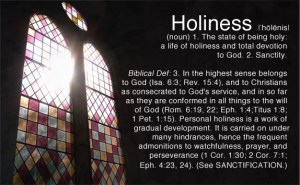
How far wrong all this is will be discovered easily by the simple act of reading the New Testament through once with meditation. There the emphasis is not upon happiness but upon holiness. God is more concerned with the state of people’s hearts than with the state of their feelings. Undoubtedly the will of God brings much final happiness to those who obey, but the most important matter is not how happy we are but how holy. The soldier does not seek to be happy; he seeks rather to get the fighting over with, to win the war and get back home to his loved ones. There he may enjoy himself to the full; but while the war is on his most pressing job is to be a good soldier, to acquit himself like a man, regardless of how he feels.
The childish clamor after happiness can become a real snare. One may easily deceive himself by cultivating a religious joy without a correspondingly righteous life. No man should desire to be happy who is not at the same time holy. He should spend his efforts in seeking to know and do the will of God, leaving to Christ the matter of how happy he shall be.
“But let him that glorieth glory in this, that he understandeth and knoweth me, that I am the Lord which exercise lovingkindness, judgment, and righteousness, in the earth: for in these things I delight, saith the Lord.” ~ Jeremiah 9:24
For those who take this whole thing seriously I have a suggestion. Go to God and have an understanding. Tell Him that it is your desire to be holy at any cost and then ask Him never to give you more happiness than holiness. When your holiness becomes tarnished, let you joy become dim. And ask Him to make you holy whether you are happy or not. Be assured that in the end you will be as happy as you are holy; but for the time being let your whole ambition be to serve God and be Christlike. If we are to take a stand like that we may expect to know a new degree of inward purification and, God being who He is, we are more than likely to know a new degree of happiness as well, but a happiness that springs out of a more intimate fellowship with God, a happiness that is elevated and unselfish and free from the carnal drawings of the flesh.
“Sanctify yourselves therefore, and be ye holy: for I am the Lord your God.” ~ Leviticus 20:7
Recently, (like so many other humanists have been opining) a social commentator said:
“In our relationships with people, what we must see first is the human being…” – Fr. Garth Minott
I disagree. In our relationships with people, we should first see God.
The heresy embodied in the “…we must see first is the human being…” type of comments has been making ‘the rounds’ among the cognoscenti for a while now; propagated by self-proclaimed intellectuals of all stripes, even those identify themselves with the church. And it is used almost wholly as a preamble for demanding that the church, the Body of Christ, the bride of Christ, accept the LGBT agenda.
LOOPY LOGIC
The “…we must see first is the human being…” heresy is (erroneously) derived using several constructs, but one popular one among intellectual clergy uses the Parable of the Good Samaritan as its pretext. Briefly, the argument says that when the Samaritan rescued the robber-beaten Jewish man, the Samaritan never asked for his sexual orientation before rendering life-saving aid.
Therefore, they deduce that when relating to individuals (whether sick or healthy) we should accept them as humans first and concern ourselves with their lifestyle later, if at all. Furthermore, the implication they confer is that if we would at all concern ourselves with the lifestyle of the person we are interacting with, then we would not be like the Good Samaritan.
The logic of their argument is, however, inherently flawed. First, knowledge of an individual’s background, habits, etc. does not mean it can or will result in a denial of aid from me or any other believer. It would be foolish to choose to help someone because I don’t know anything about them.
Certainly, I might (wrongly) choose not to help someone because I know their background. But the converse would be silly. The Samaritan did not help the beaten man because he was a stranger to him; he helped the beaten man because the man needed help. The Samaritan was not motivated by lack of information, rather he was motivated by compassion:
“But a certain Samaritan, as he journeyed, came where he was: and when he saw him, he had compassion on him, And went to him, and bound up his wounds, pouring in oil and wine, and set him on his own beast, and brought him to an inn, and took care of him.” ~ Luke 10:33-34
A second flaw in the argument is that wanting to know someone’s background is somehow a hindrance to relating effectively to them. However, anyone who visits an emergency room, or enrolls in a school in the Western World is only too aware of the mountain of information requested on a deluge of forms. AND all this BECAUSE they want to serve the patient/student/client BETTER.
The hospital wants to know what medications you might be allergic to so that it does not prescribe them to you. And if you just had (or are having) a heart attack, the ER needs to know if you recently took Viagra®; otherwise the medication they would normally use could kill you instead.
Therefore, it is unnecessary to deduce that the lack of information gathering by the Good Samaritan made him more effective in showing mercy to the sick man.
Lastly, we cannot prove that the Samaritan would have behaved differently with knowledge of the sick man’s culture, ethnicity or lifestyle. The PARABLE only gives us information on the Samaritan’s actions, there is no information on his worldview, value-system or biases. Hence, we should not and can not assume/fabricate any personal attributes of the Samaritan.
RESTORING MAN IN GOD’S IMAGE
With that said, let us examine more closely the heresy embodied is the increasingly popular sentiment “…we must see first is the human being…”
Again, I disagree. In our relationships with fellow human beings, we should first see God.
Not that people are God, but that people were made in the image of God (Genesis 1:26-27). As we know, sin has deformed that image; but it is God’s intent, through Christ, to restore us (John 3:16, Ephesians 4:13).
Accordingly, our interactions with each other must always be redemptive and restorative (Ephesians 5:15-17, Colossians 4:5, Galatians 6:1-2, etc.), as God’s love channels through each Believer to accomplish said goal.
SALVATION IS KINETIC
To “see” the human being “first” risks the prioritization of the state of man over the design/plan of God. It is to be preoccupied with where someone is rather than where they need to be.
When Jesus counseled the “woman caught in adultery” (John 8:1-11) there is no discussion of her “human” condition: Jesus did not focus on what “caused” her to be in the situation she was in. Rather, Jesus declines to condemn her AND, in the “same breath”, challenges her to “sin no more” (John 8:11).
Jesus kept the focus on where she needed to be: His interaction with her was redemptive and restorative. The challenge for her was whether or not she would walk down the path He directed her to.
Essentially, the same approach was used when Jesus interviewed the woman at the well (John 4:1-42). Jesus kept challenging her to ask for the water (of salvation) that only He could give her. When she finally asked for it, He pointed out to her that her living state would have to change. The redemption He offered would not facilitate her remaining who she was, redemption meant change. gain there was no attention paid to why she got to the state she was in ONLY that she would have to move away from it.
Secular humanism, and related philosophies, make man (the individual) the focus of life. It encourages us to preoccupy ourselves with rationalizing, excusing and justifying man as he is: there is no challenge/demand for change only a cry for acceptance. Conversely, salvation keeps the focus on God: “Look and live, look to Jesus now and live”. Salvation challenges us to change, to move from where we are and come to God.
Accordingly, when the prodigal son returned (Luke 15:11-32) the father never asked him where he went, or what he did there. There was no mention of his psychology or psychosis; no word on his predispositions or predilections. The father celebrated because the prodigal was now home: he had MOVED from the far away place and had returned HOME where he belonged. He had moved from death to life!
“For this my son was dead, and is alive again; he was lost, and is found. And they began to be merry.” ~ Luke 15:24
“Verily, verily, I say unto you, He that heareth my word, and believeth on him that sent me, hath everlasting life, and shall not come into condemnation; but is passed from death unto life.” ~ John 5:24
FINALLY
It is not Believers, who are preoccupied and ‘hung up’ on a person’s past/present lifestyle. That is not where the tension between Believers and the unsaved is. Rather, the tension is in the direction to move in. The unsaved, especially those with lifestyles they are unwilling to relinquish want to “be accepted as they are”. They cry “see me as a person only, ignore my lifestyle”. They only want to hear the first part of John 8:11 “neither do I condemn thee”.
But Jesus and His followers don’t stop there, we are compelled to complete the verse: “go, and sin no more”. Because it is God’s intent for us to see Him; and in seeing Him to recognize how far we have fallen because of sin; and to allow Him to restore His image in us.
“A good man sheweth favour, and lendeth: he will guide his affairs with discretion.
Surely he shall not be moved for ever: the righteous shall be in everlasting remembrance.
He shall not be afraid of evil tidings: his heart is fixed, trusting in the Lord.” ~ Psalm 112:5-7
In Psalm 112 God describes for us some of the attributes of what He defines as a “good man”. Our text, vv. 5-7 of that Psalm 112, tells us how a “good man” treats people who need help: a “good man” shows favor and lends money to those in need.
God says a lot in His Word about how we should treat our fellow man. However, one stark aspect of God’s description of a “good man” is the absence of “qualifications” or “caveats”. No mention is made of whether the “good man” has recently lost his job, or whether the “good man” is sick, or if the “good man” was low on funds.
There is also nothing said about who the “good man” is lending to: Is it a friend? Is it an enemy? Is it someone the “good man” likes or dislikes? Is the beneficiary from the same tribe/race/nationality/class? God makes no distinction. The “good man” simply “shows favour, and lendeth”, in good times or bad; and to good people and bad people.
To be clear, the Lord’s “good man” is not a fool, he is not a “patsy”; for the second clause in v. 5 tells us that the “good man” “will guide his affairs with discretion”: The “good man” knows who the needy are, he knows those who really need help and those who just need to look for a job and/or make wiser decisions.
The Lord’s “good man” uses discretion to distinguish those who need money for food from those who need money for alcohol/drugs. He uses discretion to separate those who need clothes for covering from those who need clothes for impressing.
In the following two sections, we will explore the reason why a “good man” lends and the impact of his lending on the community/society in which the good man lives.
Lending: The Lord and the Lender
The last two clauses in v. 7 give us the reason why a “good man” lends: “his heart is fixed, trusting in the Lord”. For the Lord’s “good man”, lending is never about the relationship between lender and lendee; nor is lending about the lender and (his) luxury/liquidity. Rather, for a “good man”, lending is about his relationship with The Lord.
A “good man” sees God as his provider: Jehovah Jireh. He recognizes that any money, any wealth, he has (justly gained) is from God. He knows that his income (whether large or small) comes from God’s provision. Moreover, he knows that God’s provision is endless. God, who gave him bread today, will give him bread tomorrow: he is “trusting in the Lord”. God, who supplied ALL his needs today, will supply ALL his needs tomorrow: he is “trusting in the Lord”.
“But my God shall supply all your need according to his riches in glory by Christ Jesus.” ~ Philippians 4:19
Therefore, a “good man” does not worry about tomorrow, and so he can lend.
The truth is that most of us do not lend most of the time because we are unsure about having enough for ourselves tomorrow. We often worry:
“How can I survive until the loan is paid back?”
“What if the person does not pay me back in time?”
“What if I am not paid back at all?”
Those are legitimate concerns: lending to someone is a risk. Indeed, it is such a great risk that you can study it in universities and the whole banking industry is based on it. But those questions arise in us because we do not trust God, who tells us:
“He [the “good man”] that hath pity upon the poor lendeth unto the Lord; and that which he hath given will He [The Lord] pay him again.” ~ Proverbs 19:17
It is our trust in God that allows us to show favour and lend, it is our trust in God that allows lending to be risk free for the Believer. The banks need collateral, credit and cosigners to lend. But the Believer only needs the Lord! Jesus underscores this point further when He issued the following challenge:
But love ye your enemies, and do good, and lend, hoping for nothing again; and your reward shall be great, and ye shall be the children of the Highest: for He is kind unto the unthankful and to the evil. Be ye therefore merciful, as your Father also is merciful.” ~ Luke 6:35-36
Jesus not only commands that we lend, He also tells us not to expect anything back: “hoping for nothing again”. And that is as it should be, because we must look to God for our provision. It is God who determines how He provides for us; His provision may come through the repaid loan, or not. Either way, it is He who decides, so LOOK to Him: we must put our hope in Him ALONE and nothing else.
“My help cometh from the Lord, which made heaven and earth. He will not suffer thy foot to be moved: he that keepeth thee will not slumber.” ~ Psalm 121:2-3
Whether we lend or not, it is God who sustains us: we live according to His provision, not ours. We are free to lend, to take care of the needs of the poor because it is God’s provision anyway. Whatever we give comes from God’s storehouse, and there are lots more. God will provide for our needs.
“The steps of a good man are ordered by the Lord: and he delighteth in his way. Though he fall, he shall not be utterly cast down: for the Lord upholdeth him with his hand. I have been young, and now am old; yet have I not seen the righteous forsaken, nor his seed begging bread. He [the “good man”] is ever merciful, and lendeth; and his seed is blessed.” ~ Psalm 37:23-26
Like the “good man” let us “fix” our hearts, steadfastly trusting in God: knowing that we are free to share from His bounty, because He will never let us down: God will supply all our needs.
Lending: The Lord, the Lender and the Lendee
Why does God place such a premium on lending, on tending to the needs of the poor? One reason, discussed above, is that it is an objective and tangible measure of how much we trust Him. However, there is an additional reason; specifically, the testimony that “a good man” who “sheweth favour, and lendeth” is to those around him. To help us understand, let us consider the following passage of Scripture:
“The rich ruleth over the poor, and the borrower is servant to the lender.” ~ Proverbs 22:7
This proverb serves as a clear warning: instructing Believers to carefully avoid being in debt because the borrower comes under the control of the lender. Nevertheless, as our text indicates, sometimes a ‘good man” is called upon to lend to someone in need. It is on that “side of the coin” that the above proverb reveals another pointed message. The borrower IS servant to the lender, irrefutably. But what if the lender is God’s “good man”? If the lender is God’s “good man”, the borrower has the opportunity to experience being a servant of GOD by proxy.
Those who borrow from God’s “good man” will experience fairness; they won’t be gouged because they are in a weak position.
Those who borrow from God’s “good man” will have mercy, they will (by discretion, see v. 5) get a second chance (and a third and a fourth…) when they slip up.
Those who borrow from God’s “good man” will obtain forgiveness, when they fail.
Those who borrow from God’s “good man” will be loved: treated as persons; not profit-opportunities and not just numbers in a spreadsheet.
Those who borrow from God’s “good man” will have a chance to see what faith in God looks like;
They will see what it is like to be a part of the family of God:
They will see how God takes care of the needs of the righteous: those who put their trust in Him.
They will see how God’s “good man” copes with adversity and trials, how the travails of life press a “good man” ever closer within the arms of his Holy Father: for “He shall not be afraid of evil tidings” (v. 7).
They will see that “his heart is fixed, trusting in the Lord” (v. 7).
They will see how different life could be with God as their master instead of the world.
“A good man” who “sheweth favour, and lendeth” is not just giving money or goods away. God’s “good man” is shining The Light of Christ into the lives of those in need: he is giving a testimony towards salvation.
“Surely [God’s good man”] shall not be moved for ever: the righteous shall be in everlasting remembrance.” ~ Psalm 112:6
“And Moses said unto the people, FEAR ye NOT, stand still, and see the salvation of the LORD, which he will shew to you to day: for the Egyptians whom ye have seen to day, ye shall see them again no more for ever. The Lord shall fight for you, and ye shall hold your peace.” ~ Exodus 14:13-14
FEAR NOT: Stand Still
This is a favorite passage of Scripture. The Hebrews had just left Egypt and were still in the desert. Behind them was Pharoah’s army in hot pursuit and in front of them was the Red Sea. Where were they to go? How could they escape? They were “between the devil and the deep blue sea”.
Yet God made a way for them in this impossible situation. God rescued them in a way that only He could do. The rest of the chapter describes how God parted the waters of the Red Sea so that they could walk through and when Pharoah’s army tried to follow, God closed the waters again and Pharoah’s army was swallowed up, drowned.
Sometimes we too will face impossible situations, but IF we are walking in the will of God doing the work of God, He WILL make a way for us to come through, to escape. Our challenge in to “stand still, and see the salvation of the LORD”.
FEAR NOT, Believer, “The Lord shall fight for you”.
When you look around
And things look grim
Stand your ground
And look up to (Elo)him
“Ye shall not need to fight in this battle: set yourselves, stand ye still, and see the salvation of the LORD with you… FEAR NOT, nor be dismayed… for the LORD will be with you.” ~ 2 Chronicles 20:17




















 Reflections in The WORD