Latest Posts

Lessons from the Barnyard


Facebook Twitter More...

“All we like sheep have gone astray; we have turned every one to his own way…” ~ Isaiah 53:6

I wasn’t raised as a farmer. In fact, except for the occasional school field trip, I had never so much as set foot on a farm until my late 20’s. Being a preacher’s kid, I grew up listening to the sound of traffic roaring by, because most churches are on main roads, and not far from shopping and modern conveniences. I always found animals and farming to be an interesting subject, but it was just something one reads about, not something one goes out to do.

But God has this funny way of fitting us for His plans. And, in my case, the plan involved learning small-scale farming in a remote part of the Appalachian mountains. And, as all God’s plans tend to turn out, I love every minute of it.

Theo-farm-ology

There’s something about being close to the soil and the animals that makes so many Biblical allusions very real and clear. When God talks about the wheat growing with the tares (Matthew 13:24-30), I think of my weed-strewn vegetable garden that first year I decided to grow my own food, and how it really did make more sense to just let them all grow together, harvest what I could find at the end of the summer and then till everything in and start over next year.

When Jesus bemoans Jerusalem (Luke 13:34), I envision our broody hen and her patient devotion to her fluffy, errant chicks. (If you ever get a chance to observe a mother hen with her chicks, do so; the example of selfless, persistent, attentive love will change the way you look at God forever.) When Jesus referred to the Pharisees as leaven contaminating the ideals of God (Matthew 16:6), I picture my newest attempts at making cheese, riddled with mold because I didn’t know you can’t bake bread and make cheese at the same time or else the yeast will ruin your cheese.

None of these things ring true in our modern world. We buy cheese from the store, mold-free and with a safe-to-eat-by date neatly stamped on the plastic wrapping. Our eggs have never been nurtured by a broody hen, and vegetables come pre-washed and bug free. We’ve removed ourselves from the world so well that God’s metaphors lose their relevance.

The Great Chicken Roundup

Since most of you will likely never become farmers, let me share with you an illustration from my own recent experiences.
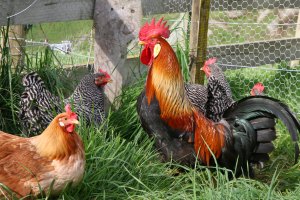
“O… how often would I have gathered thy children together, as a hen doth gather her brood under her wings, and ye would not!” ~ Luke 13:34

My chickens have been needing a new hen house for quite some time, as the old one left much to be desired. It had no electrical outlets for lights or water heaters; it was far from the house, rendering it less safe from predators; and the admittedly small fenced-in chicken yard had long since been eaten down to bare dirt. Chickens love to roam, so we built new, modern housing in a safe part of the farmyard where they could free range and not be at risk from every fox or hawk in the neighborhood.

At long last, the great moving day came, and we moved the chickens to their new house. What a circus that was!! Animals in general do not like a break from their routine, and chickens are no exception. Regardless of the nice amenities in the new roost – clean, metal nest boxes; heating lamp for cold nights; automatic water dispenser, so they would never be thirsty – the chickens were all out of sorts. I gave them a couple of days to adjust, and then one bright morning I flung the doors open wide so they could enjoy their new freedom.

Here’s where my dreams of happy chickens met with reality. The chickens didn’t quite know what to do with themselves. Most roamed about looking lost; a few took to eating grass and worms; then, as a group, they began drifting right back towards the old coop! Within 20 minutes, more than half the flock was clustered around the dismal chicken yard, looking for a way in. I chased them back to the grass; they ran around me and went back to the chicken yard. Finally I gave up and let them wander; sure that they would get it all sorted out sooner or later. Eventually, they did start to make use of their freedom to hunt for bugs. But, they stayed close to the old, run-down coop, unwilling to part with the familiar.

“But it is happened unto them according to the true proverb, The dog [is] turned to his own vomit again; and the sow that was washed to her wallowing in the mire.” ~ 2 Peter 2:22

Finally, the sun began to set, and as if to add insult to injury, it started to rain. The chickens didn’t know that they could run back to the new coop for safety, and they were unable to get into the old one, so they wandered around in pathetic circles, clucking moodily, dripping wet. Realizing they weren’t going to help themselves, I grabbed a flashlight and some mucking boots and began to round up the chickens. I’ll let you imagine how fun it was to be out in the cold, with the sun setting rapidly, rain pouring down and mud up to my ankles, trying to catch a bunch of irritated, drenched, smelly chickens. There is nothing glamorous about it, I can assure you of that.

Eventually, I thought I had everyone from the yard inside the new coop. But, it was fully dark now, so I did a head count… 3 chickens were still missing.

“The ox knoweth his owner, and the ass his master’s crib: but Israel doth not know, my people doth not consider.” ~ Isaiah 1:3

I don’t know how much you know about chickens, but they have a roosting instinct that is pretty powerful. That is, when the sun sets, chickens settle in for the night, and nothing will get them moving again. So, wherever my missing hens had been when the sun set, there they would stay until the sun came up, regardless of weather or danger from passing predators.

My first thought was, “Stupid chickens, if they can’t figure out how to get home at night then they can just stay outside.” I was rather sodden myself at this point, and none too eager to continue the Great Chicken Roundup in the rain at night. But then, I had chosen to raise these animals; I had chosen to move them to a new home; I simply couldn’t in good conscience go indoors where it was warm and dry, knowing that I had three hapless, helpless hens lost in the darkness. The responsibilities of owning live animals go beyond succumbing to personal convenience; so I started trudging.

Turns out, they weren’t all that hard to find: they had found a dry spot underneath the old chicken coop. Wet, vulnerable, they were lined up like a little smorgasbord, still as statues for anyone who wanted them to carry them off. Thankfully, I found them before a fox or raccoon did. Of course, I had to crawl through chicken manure to get to them.

But, as I finally carried those maddening hens back to safety, a powerful feeling of compassion washed over me. After all, they were only chickens, doing what chickens do. With the roosting instinct kicked in, they were helpless to save themselves; without intervention, they would have spent a very cold and miserable night, if not eaten outright by morning.

“And when he cometh home, he calleth together his friends and neighbours, saying unto them, Rejoice with me; for I have found my sheep which was lost. I say unto you, that likewise joy shall be in heaven over one sinner that repenteth, more than over ninety and nine just persons, which need no repentance.” ~ Luke 15:6-7

The story of the shepherd seeking his lost sheep became very, very real to me that night, and I’m not ashamed to admit that those stupid lost hens brought me to tears of humility. Do we not do the same to our Heavenly Father? He shows us green fields, and we race back to the emptiness of what’s familiar.

When the night sneaks up on us, and the rains begin to fall, it is so easy to fall back on our own understanding and get lost in the storm, vulnerable to attack and injury. Then we get stuck, hopelessly lost and confused until—praise God!—we see a light in the darkness, and here comes our Lord, ready to crawl through the mud and manure to find us and carry us home.

“But God commendeth his love toward us, in that, while we were yet sinners, Christ died for us.” ~ Romans 5:8

Our Farmer God

Maybe you’ve been struggling through a dark time in your life. We all have them; and even those with years of experience in walking with God, we can be caught unawares. All of us, at some time or another, stray away from God’s best (Isaiah 53:6), and need the Shepherd to come find us.

Sometimes we need the reminder that in our own strength we are unable to weather the storm. Sometimes we just need the practice in waiting, learning to trust, because the truth is God will *always* come for His children. Even when we’re surrounded with failures, He never fails.

Even when we fall, He is able – and willing! – to help us back to our feet. I am thankful, so very thankful, that we serve a God whose faithfulness and mercy endures forever (Psalm 136).

The steadfast love of the lord never ceases
His mercies never come to an end
They are new every morning, new every morning.
Great is thy faithfulness, O Lord;
Great is thy faithfulness!

Contributed by Joelle Heilemann

Bookmark and Share


.
.
.

Heart Search


Facebook Twitter More...

Search me, O God, and know my heart: try me, and know my thoughts: And see if there be any wicked way in me, and lead me in the way everlasting.~ Psalm 139:23-24

Do we ask God to “search” our hearts and to test us as to know our thoughts? To see if there be any offensive way in us? We certainly should!!

God already knows the state of our thoughts and hearts, but many times we do not. By His “searching” and “testing” it is revealed to us what we are truly like in these areas. When we hold our thoughts and actions up to the Word of God, do they line up in obedience to it?

The Psalmist knew that his did not always pass the test, but he also knew that he belonged to God and that God would never forsake His child!

When the Holy Spirit that indwells each Christian convicts us of a sin we need to address and change from, we are to do as it says in 1 John 1:9 and confess it to God. Then we are to put it behind us and move on with a purpose in our heart to be more obedient to God.

When we read, meditate upon, and apply Scripture to our lives everyday, we are being lead in the everlasting way! There will be no room for unrest and anxiety when we stay focused on Christ. He brings peace, joy, and contentment when we are centered in Him!!

Lord, help me to live a life that is obedient to Your Word and thus pleasing to You, for this is my true desire!!

Contributed by Mary Heuss Nelson

Bookmark and Share

Gone Fishin’


Facebook Twitter More...

Now as he walked by the sea of Galilee, he saw Simon and Andrew his brother casting a net into the sea: for they were fishers. And Jesus said unto them, Come ye after me, and I will make you to become fishers of men. And straightway they forsook their nets, and followed him. And when he had gone a little farther thence, he saw James the son of Zebedee, and John his brother, who also were in the ship mending their nets. And straightway he called them: and they left their father Zebedee in the ship with the hired servants, and went after him.~ Mark 1:16-20

This account of Jesus calling Simon (Peter) and Andrew, and James and John to be His disciples gives us an object lesson on ministry and mindset.

Ministry. First, we notice that both pairs of brothers were fishermen when Jesus called them to follow Him and become fishers of men. Since fishermen use nets to catch fish in the sea, Jesus would equip His disciples with the Gospel to catch men in the world. But fishermen not only cast their nets, as Simon and Andrew were doing, they also have to spend time preparing their nets, as were James and John. Similarly, the Church has two main ministries under which all its activities fall: Evangelism and Discipleship.

Evangelism is concerned with casting the Gospel net far and wide so that God can fill it with new Believers.

Discipleship, on the other hand, is about preparing the Gospel, teaching it to Believers so that it can be delivered to the world. Every Christian is expected to be busy at work daily either casting nets as they share the word with non-believers, or preparing the Gospel to be cast out as they teach and encourage believers about God.

Mindset. Second, we learn that all four fishermen responded immediately to Jesus’ call; leaving their nets behind to join His ministry.

It is important to understand that this was not the first time they had heard of Jesus. The Gospel of John (John 1:35-42) tells us that Andrew was already a disciple of John the Baptist when he and another of John the Baptist’s disciples approached Jesus to learn about His ministry. After his experience with Jesus, he went and told his brother Simon that he had found the Messiah.

We also know that the four men were business partners (Luke 5:10), therefore it is quite likely that James and John were recruited by Simon and Andrew, or that they too were disciples of John the Baptist passed on to Jesus.

Thus, by the time Jesus called them, they already knew who He was; and had developed a mindset for service:

“Simon Peter went up, and drew the net to land full of great fishes, an hundred and fifty and three: and for all there were so many, yet was not the net broken.” ~ John 21:11

They were waiting on His call!

Similarly, many Believers have already spent time journeying with Jesus, learning about Him in church, in Bible studies, Christian literature/media and (hopefully) their own personal study of His Word (The Bible). Hence, the questions we must ask are,

  • When Jesus calls you/me into ministry (any kind of ministry; Romans 12:4-8), what will be our response?
  • Will we immediately make the step of faith? Or will we hold back (making the usual excuses)?
  • When Jesus makes the call, do we have our minds set for service?

We must also keep in mind that the disciples didn’t have perfect faith, even after Jesus’ death AND resurrection some still doubted (Matthew 28:17). BUT they all made the step of faith to follow Him, to join His ministry.

Just like them, we don’t have to wait until our faith is big and/or perfect; if we do, then we will NEVER go. We will always just be sitting on the sidelines. Yes, we believe in Jesus, but we never put it into practice; we never exercise that faith.

Moreover, we must be very careful when we choose to sit on the sidelines of Christianity, because Scripture tells us plainly that there is no such thing as faith without action:

Even so faith, if it hath not works, is dead, being alone… shew me thy faith without thy works, and I will shew thee my faith by my works… For as the body without the spirit is dead, so faith without works is dead also. ~ James 2:17, 18b, 26

Therefore, if we know who Jesus is, if we have some idea of His plan, then let us no longer sit back. Let us rise to the challenge; let us put fears, doubts and distractions aside; and join Him, as He prepares us to carry on His ministry, in whatever way He chooses.

Having then gifts differing according to the grace that is given to us, whether prophecy, let us prophesy according to the proportion of faith; Or ministry, let us wait on our ministering: or he that teacheth, on teaching; Or he that exhorteth, on exhortation: he that giveth, let him do it with simplicity; he that ruleth, with diligence; he that sheweth mercy, with cheerfulness. ~ Romans 12:6-8

And he [Jesus] gave some, apostles; and some, prophets; and some, evangelists; and some, pastors and teachers; For the perfecting of the saints, for the work of the ministry, for the edifying of the body of Christ ~ Ephesians 4:11-12

Bookmark and Share

The Forgiveness of a Father


Facebook Twitter More...

‎”If we confess our sins, he is faithful and just to forgive us our sins, and to cleanse us from all unrighteousness.~ 1 John 1:9

I will always remember an example in my own life that really explained this verse perfectly to me by example.

When I was a teen I lied to my dad about something, I knew I lied and he knew I lied, but I would not admit it to him: I stuck to my story! As the week went on my dad (who usually was very happy and upbeat with me, kidding around, etc.), just wasn’t the same, there was a sadness in his eyes when he looked at me.

Finally, I just was so convicted for having lied to him I went to him one night and said, “Dad I lied to you and I am sorry, will you forgive me?”

My dad, who had been sitting down at the time, flew up out of his chair and gave me a huge hug and said, “Of course I do honey, I love you, please don’t lie to me again.” Immediately, our relationship was back to normal and the fellowship was sweet!

During that week before I had confessed to my dad that I had indeed lied to him, he did not throw me out of his house; he didn’t disown me or write me out of his will! I was STILL his child, but our fellowship was broken.

It is exactly the same with our Heavenly Father: When there is a sin in our lives that needs to be dealt with, the Holy Spirit within us will convict us to bring that sin out in the open before God and confess it to Him, and purpose in our heart to not commit it again. This verse is NOT implying that we lose our salvation.

The Book of 1st John was written to people who already know Jesus as Savior. The “forgiveness” John is speaking of here is PARENTAL, not judicial. Judicial forgiveness is forgiveness from the penalty of sin, which the child of God receives when placing their faith in the blood of Christ for the forgiveness of our sins. It is called judicial because God is acting as JUDGE, the penalty for our sins—past, present and future—has been paid in full by Christ. JUDICIAL forgiveness happens only ONCE: at the time of our salvation; as Scripture tells us:

And I [Jesus] give unto them eternal life; and they shall never perish, neither shall any man pluck them out of my hand. My Father, which gave them me, is greater than all; and no man is able to pluck them out of my Father’s hand. ~ John 10:28-29

In whom ye also trusted, after that ye heard the word of truth, the gospel of your salvation: in whom also after that ye believed, ye were sealed with that holy Spirit of promise, Which is the earnest of our inheritance until the redemption of the purchased possession, unto the praise of his glory. ~ Ephesians 1:13-14

However, when Christians sin, we are in need of His PARENTAL forgiveness, which we will need many times throughout our lives. When we confess our sins to our Father, fellowship with Him is restored.

Thank You Jesus for saving my soul and for Your constant abiding with me, I love You so!!

Contributed by Mary Heuss Nelson

Bookmark and Share

Suffering: The Forgotten Gift


Facebook Twitter More...

For unto you it is given in the behalf of Christ, not only to believe on Him, but also to suffer for His sake~ Philippians 1:29

Our text communicates an often forgotten truth: Each and every Christian has been graciously given the opportunity to BOTH believe in Christ AND to suffer for His sake. The first gift—belief in Jesus—is frequently discussed in our churches because it is easy to grasp its centrality to salvation: becoming a born again child of God; a new creation set to work in God’s Kingdom.

However, the second gift—“to suffer for his sake”—is no less important. Indeed, the verse indicates that the gifts are given conjointly; that is to say, one gift cannot be accepted without accepting the other. To accept the gift of salvation is to accept the gift of suffering for Jesus’ sake; to receive one is to receive both: faith in Jesus and suffering for Jesus are two sides of a single coin. Indeed suffering for Christ’s sake is so fundamental to the life of a Christian that Scripture tells us:

All that will live godly in Christ Jesus shall suffer persecution. ~ 2 Timothy 3:12

If we accept this truth, then, to apply it to our lives we must first understand why it is important to suffer for Christ’s sake and how it transforms a Believer’s life.

To suffer means to undergo or to experience difficulties, harsh circumstances. For example, Jesus suffered on the cross (1 Peter 3:18); and Paul suffered lashings, beatings, a stoning, shipwrecks, weariness and painfulness, hunger and thirst, cold and nakedness (2 Corinthians 11:23-33). Similarly, many other Believers suffered various persecutions a few of which are listed in Scripture in the Book of Acts.

But why was all this suffering necessary? To answer this question, consider the following verses:

Forasmuch then as Christ hath suffered for us in the flesh, arm yourselves likewise with the same mind: for he that hath suffered in the flesh hath ceased from sin; That he no longer should live the rest of his time in the flesh to the lusts of men, but to the will of God. ~ 1 Peter 4:1-2

This passage tells us that the Believer who has suffered for Christ’s sake has ceased from sin. Notice, however, the use of the past perfect tense in verse 1. The past perfect tense tells us that the action has been completed.

Therefore, we can understand 1 Peter 4:1 as saying the Believer who has completed his course of suffering for Christ’s sake has completed the process of ceasing from sin.

“And when he had called the people unto him with his disciples also, he said unto them, Whosoever will come after me, let him deny himself, and take up his cross, and follow me.” ~ Mark 8:34

The crucial implication is that the Believer who is completing his course of suffering for Christ’s sake is completing the process of ceasing from sin. In other words, suffering for Christ’s sake transforms the Believer from sin-FULL to sin-LESS; suffering for Christ’s sake perfects Believers.

Consequently, without suffering for Christ’s sake, Believers will continually struggle with the “lusts of men”, the so-called human nature (i.e., the natural inclination to reject the things of God in favor of things that please our senses, our intellect, and our pride; 1 John 2:15-16).

And he that taketh not his cross, and followeth after me, is not worthy of me. He that findeth his life shall lose it: and he that loseth his life for my sake shall find it. ~ Matthew 10:38-39

Now, one might ask, “How does suffering for Christ’s sake transform us?” The answer to this question lies in the mechanics of choosing to suffer for Christ’s sake.

Self-preservation is the most basic instinct seen in man. Human beings only choose to override this instinct when there is something more important to them at stake. For instance, many parents will sacrifice their lives to protect their children.  Another, contemporaneous, example are the workers at the nuclear power plants in Fukushima, Japan who are risking their lives to keep the reactors from meltdown which could cause great harm to millions of their fellow citizens.

In each circumstance, the individual has to make a choice between the instinct to preserve his/her own life and devotion to a cause or person(s). Similarly, when Believers choose to suffer for Christ’s sake, they are consciously overriding their instinctive desire to protect themselves because of their devotion to Christ. This outward struggle between self-preservation and suffering for Christ’s sake exactly mirrors the battle in every Believer between The Holy Spirit and the “natural man”:

For I know that in me (that is, in my flesh,) dwelleth no good thing: for to will is present with me; but how to perform that which is good I find not. For the good that I would I do not: but the evil which I would not, that I do… For I delight in the law of God after the inward man: But I see another law in my members, warring against the law of my mind, and bringing me into captivity to the law of sin which is in my members. O wretched man that I am! who shall deliver me from the body of this death? ~ Romans 7:18-19, 22-24

Constantly, Believers must choose between serving our own natural desires/instincts and serving the commands of Christ Jesus. Thus, when believers choose to suffer harm for Christ’s sake, it becomes much easier to make the internal choice of God’s will over our natural desires.

“Now therefore fear the LORD, and serve him in sincerity and in truth… choose you this day whom ye will serve…” ~Joshua 24:14-15

Studies have shown that soldiers returning from war, where they are constantly making life and death decisions for themselves and their fellow troops, often find regular life to be somewhat trivial. Likewise, when a Believer stands up for the Gospel of Christ, even to the point of suffering for it, then standing up to the daily temptations of the human nature grows less difficult. After we have laid our lives on the line for Jesus, it is much easier to lay our desires on the line for Him too.

On a broader scale, suffering is also crucial for the church. Early Church history shows that the conversion of the Roman emperor, Constantine, to Christianity coincided with the beginning of the decline of the Church. What seemed like a triumph was actually a loss, because the removal of institutional persecution made the church weaker rather than stronger.

Therefore, a crucial question we must ask ourselves is, “How have I suffered for Christ’s sake?” If we are not suffering for Jesus’ sake then we are not being perfected, we are not learning to cease from sin, our human nature still dominates our lives. If we are not suffering for Christ then clearly we are not standing up for The Gospel, we are not sharing in His ministry.

Remember the word that I said unto you, The servant is not greater than his lord. If they have persecuted me, they will also persecute you… ~ John 15:20a

If we are involved in Jesus’ ministry then persecution and the suffering that accompanies it will enter our lives. The problem we face today is that we have been trained to avoid suffering/persecution at all costs. We chase after comfort rather than chase after Christ.

  • We trade sharing the Gospel for the safety of silence.
  • We trade relationship with the needy for the ease of just giving money instead.
  • Instead of visiting the sick when they are sick, we give them a welcome back hug when they are well.
  • We give just enough money so we won’t miss it, but not so much that it would stretch our faith.

So our Christian walk is often reduced to a passive, impotent belief in a Jesus we have never experienced outside of an emotionally charged worship service in a comfy church. If our outward comfort is at the center of our decisions, then our inward comfort will be there too. Our willingness to put service over comfort, mirrors our willingness to put God’s will over human nature.

Let us, therefore, remember the great and gracious gift of suffering for Christ’s sake, given to us by our Lord. Let us embrace that gift, for it will change us from victims of our sinful human nature to VICTORS walking in the Power of God. Let us serve Jesus, whatever the cost to our personal comfort may be.

Fear none of those things which thou shalt suffer: behold, the devil shall cast some of you into prison, that ye may be tried; and ye shall have tribulation ten days: be thou faithful unto death, and I will give thee a crown of life. ~ Revelation 2:10

Bookmark and Share

LIFE in the Kingdom of God


Facebook Twitter More...

14 Then came to him the disciples of John, saying, Why do we and the Pharisees fast oft, but thy disciples fast not? 15 And Jesus said unto them, Can the children of the bridechamber mourn, as long as the bridegroom is with them? but the days will come, when the bridegroom shall be taken from them, and then shall they fast. ~ Matthew 9:14-15

NOTES

  1. Fellowship is the Focus
  2. Fellowship is the Fulcrum

CHORDS

In Jesus’ day, fasting (i.e., abstaining from food for religious reasons) was seen as an important demonstration of piety. Therefore, those who fasted were spiritual and those who didn’t fast were carnal/worldly. With this mindset one can understand why the devout disciples of John the Baptist were puzzled/perplexed when they noticed that Jesus’ disciples didn’t fast. However, as we will discuss below, Jesus makes it clear that their understanding and approach to fasting was wrong. Moreover, by reorienting their concept of spirituality, Jesus explains what it means to live in the Kingdom of God: Living in the Kingdom of God is all about fellowship with Jesus.

Fellowship is the Focus

In Jesus’ day, the guests at a wedding feast would neither eat nor begin any celebrating until the bridegroom arrived. Instead, they would wait patiently until they heard the signal that the bridegroom was on his way; only then would they get the party started. Moreover, when the bridegroom did arrive, the best seats in the house were the ones closest to him. Similar traditions continue in many wedding today, where seats are reserved at the front of a wedding reception for the special guests (usually, family and closest friends).

“I will praise thee with uprightness of heart, when I shall have learned thy righteous judgments.” ~ Psalm 119:7

It was the presence or the absence of the bridegroom that determined the activity: the focus was on the bridegroom, or, more specifically the focus was on interacting (fellowshipping) with the bridegroom. Therefore, when Jesus asked, “Can the children of the bridechamber mourn, as long as the bridegroom is with them?” He was making the point that the ONLY reason for fasting, or any other spiritual exercise, is fellowship with Him (the bridegroom).

Jesus must be the focus of any religious ritual in the Kingdom of God. Sadly, we have often allowed ourselves to lose that focus, instead concentrating (wrongly) on the ritual rather than the Redeemer. Like the disciples of John the Baptist, we engage in rituals regardless of the state of our relationship to Jesus. Therefore, we go to church, sing and pray as the ritual dictates rather than as our relationship with God directs. However, Jesus tells us:

But the hour cometh, and now is, when the true worshippers shall worship the Father in spirit and in truth: for the Father seeketh such to worship him. God is a Spirit: and they that worship him must worship him in spirit and in truth~ John 4:23-24

Worship has nothing to do with the external/physical, but has everything to do with the spiritual. It doesn’t matter whether we jump high or sit low, shout or whisper, run around or stand quietly; pick the one that you like. The only thing that does matter is whether we are truly communing with God spiritually, whether the worship is authentic.

If we are not walking closely with Jesus, then clapping hands or not clapping hands won’t make our exercise into true worship. Rituality can’t take the place of the reality of our relationship with God. Consequently, Believers must preoccupy themselves with the Bridegroom: We must keep focused on fellowshipping with Jesus, hour-by-hour, day-by-day.

Jesus said unto him, Thou shalt love the Lord thy God with all thy heart, and with all thy soul, and with all thy mind. This is the first and great commandment. ~ Matthew 22:37-38

Thus saith the LORD, Let not the wise man glory in his wisdom, neither let the mighty man glory in his might, let not the rich man glory in his riches: But let him that glorieth glory in this, that he understandeth and knoweth me… ~ Jeremiah 9:23-24

Wherewith shall I come before the LORD, and bow myself before the high God? …He hath shewed thee, O man, what is good; and what doth the LORD require of thee, but to do justly, and to love mercy, and to walk humbly with thy God~ Micah 6:6, 8

Fellowship is the Fulcrum

“The LORD is my strength and my shield; my heart trusted in him, and I am helped: therefore my heart greatly rejoiceth; and with my song will I praise him.” ~ Psalm 28:7

If fellowship with Jesus is our focus, then it also must be the fulcrum, the pivot, on which we make our decisions. Jesus indicated that the spiritual discipline of fasting was necessary, and expected, when He was absent. Just as in the Jewish wedding ceremonies of that day, feasting only takes place when the bridegroom is present, otherwise the guests fast till he comes. Therefore, the decision on whether to fast or not is determined solely by the presence of the bridegroom. In other words, our fellowship with Jesus determines our worship response.

Righteousness gives birth to worship, NOT vice-versa. We don’t accomplish worship by deciding to perform a ritual, whether that is fasting or attending church, or anything else. Rather, it is our relationship with Jesus that gives birth to our worship of Him.

Jesus’ disciples would fast when Jesus returned to heaven and was less accessible to them than when He was with them in the flesh. Therefore, their decision to fast depended on their ability to commune with Him. On the other hand, John’s disciples (also Believers) had no motivation for the ritual, except that it was expected of them. For John’s disciples, the ritual of fasting was an end in itself.

We have lost our way when we do something only because it is “supposed to be done”. If we only go to church “because we are supposed to” , then we might as well not go. When we sing just because, it’s time to sing; and pray just because it’s time to pray, then we are clearly neither worshipping in spirit nor in truth.

To further illustrate this point, let us consider a few verses from Psalm 63

1O God, thou art my God; early will I seek thee: my soul thirsteth for thee, my flesh longeth for thee in a dry and thirsty land, where no water is;
3Because thy lovingkindness is better than life, my lips shall praise thee.
7Because thou hast been my help, therefore in the shadow of thy wings will I rejoice~ Psalm 63:1, 3, 7

In Psalm 63 it is evident that the writer’s worship of God comes out of his experience with God and/or his need for God.

He seeks God because of the thirst in his soul. He praises God because he has experienced God’s lovingkindness. He rejoices in his relationship with God because he has experienced God’s help.  Every expression of worship springs from his relationship with God.

Likewise, let our fellowship with The Father be the fulcrum of our worship activity. Let us choose to worship, not because we are supposed to worship, but because we have experienced intimate fellowship with Him.

CODA

  • Can we worship God, without first fellowshipping with God?
  • Does worship produce fellowship (with God), or does fellowship (with God) produce worship?
  • If we are not walking with Jesus in our everyday lives, does the music/worship-style (at church) matter?
  • If we fail to fellowship with Jesus when we are away from church, can we expect to find fellowship with Jesus when we attend church?
  • Does church attendance (alone) make us acceptable to God?
Bookmark and Share

Faithfulness: Foremost for Followers


Facebook Twitter More...

Moreover it is required in stewards, that a man be found faithful.~ 1 Corinthians 4:2

A steward is a person employed to manage another’s property, a person whose responsibility it is to take care of something. All believers are stewards in God’s Kingdom (Ephesians 2:10, 4:8-12). God has given each believer a job to do and our text (above) shows us that the key quality of a successful steward is faithfulness.

Faithfulness is that quality of doing what is required regardless of the situation in which we find ourselves. A faithful witness declares the goodness of God inside of church (when it is easy) AND outside of church (when it is hard). A faithful missionary declares the Gospel whether there are a few or there are many. A faithful child does the will of The Father when everyone is around AND when everyone is gone.

It is our faithful obedience to God, in the face of monotony and/or adversity, that reveals the true condition of our character.

In the Matthew 25, Jesus showed us that it is the faithfulness of preparation (parable of the wise and the foolish virgins), the faithfulness of application (parable of the talents) and the faithfulness of brotherly affection (parable sheep and the goats) that identify authentic Believers and gain approval of the Master.

God is not concerned about the height of the ‘tower’ we build, but He is concerned with how we build it. Did we carefully follow His plan, toiling day-by-day until we accomplished the task? Or, did we follow our own plan: working on our own time chasing after the glory of man rather than the glory of God?

In Babylon, Daniel and his friends (Shadrach, Meshach and Abednego) remained faithful to God; abiding by the teachings of His word while everyone else compromised their faith (Daniel 1:5-8). And God rewarded them for their faithfulness to Him (Daniel 1:17-21).

Therefore, as we serve God, in whatever way He has called us, let us keep in mind that God does not measure the size or the celebrity of our ministry; God measures our faithfulness to the ministry He gave us.

He that is faithful in that which is least is faithful also in much… ~ Luke 16:10a

Bookmark and Share

WANTED!!!: Wisdom


Facebook Twitter More...

‎”If any of you lack wisdom, let him ask of God, that giveth to all men liberally, and upbraideth not; and it shall be given him.~ James 1:5

We like to think of ourselves as wise, yes? But, outside of Christ, mankind is most foolish!

There is a way which seemeth right unto a man, but the end thereof are the ways of death. ~ Proverbs 14:12

For the LORD giveth wisdom: out of his mouth cometh knowledge and understanding. ~ Proverbs 2:6

When we accept Jesus as Savior and the Holy Spirit indwells us, we will have access to the wisdom of God through His Word, the Bible, and the promptings of The Holy Spirit.

God wants us to ask His wisdom in everyday situations, as our verse says. When we follow our own so-called wisdom, we get into a world of hurt! How do we know God’s wisdom? The great “filter” for all things truly wise in God’s eyes is the Bible. If it lines up with Scripture then we can rest assured that God is favor of it. God is the Author of true wisdom! And, when we ask Him, He doesn’t give it to us sparingly; no, He gives His wisdom to us generously!!

Don’t you just love God?!

He doesn’t condemn us for not knowing what is the wise thing to do, but gives us His wisdom when we seek it.

However, when we seek His wisdom and we know what the wise thing to do is, but choose to do the unwise thing, then we are to be pitied for our lack of trust in God, who gave us the wisdom which we ignored! Most of us have fallen into this category and have paid the consequences for it. But, if we go to God and confess our sins (as John 1:9 points out), then we can get back to following His perfect wisdom!

Lord help me to seek Your wisdom in all that I do and say everyday in my life, Thank You for loving me so!!

Contributed by Mary Heuss Nelson

Bookmark and Share

Elisha and The Feeding of the Hundred, Part 1: The Overcomer


Facebook Twitter More...

And there came a man from Baalshalisha, and brought the man of God bread of the firstfruits, twenty loaves of barley, and full ears of corn in the husk thereof. And he [Elisha] said, ‘Give unto the people, that they may eat.’  And his servitor said, ‘What, should I set this before an hundred men?’ He said again, ‘Give the people, that they may eat: for thus saith the LORD, They shall eat, and shall leave thereof.’  So he set it before them, and they did eat, and left thereof, according to the word of the LORD.~ 2 Kings 4:42-44

There was a famine in the land of Israel (“…there was a dearth in the land…” 2 Kings 4:38) and Elisha and the prophets with him didn’t have much to eat. One day a man from Baàl-Shalisha gave to them twenty loaves of bread made from the firstfruits of his crop, along with some corn (v. 42). The loaves were not the jumbo-sized ones in modern supermarkets; they were probably closer in size to a bagel. So, from a human perspective, the amount of food received appeared insufficient to feed everyone (v. 43). However, Elisha instructed his servant to serve the food to the hundred men that were there because God had told him the food would be more than enough. And, foreshadowing Jesus’ feeding of the multitudes (Matthew 14:13-21, Matthew 15:32-39), God miraculously made what appeared to be insufficient into an abundance.

This passage teaches us at least two lessons for Believers coping with hard times: (1) be determined to honor God (2) adopt God’s perspective on God’s provision. We will explore the first of these points below.

In the time of Elisha, Gilgal, like the rest of Israel (the northern Kingdom), was soaked in idolatry. From Jeroboam onward, all their kings had led the people into idol worship, with only a remnant remaining faithful to God. The man from Baàl-Shalisha was one of the faithful few.

As servant of God, the man from Baàl-Shalisha remembered that the firstfruits of his increase belonged to God.

“The first of the firstfruits of thy land thou shalt bring into the house of the LORD thy God.” ~ Exodus 23:19

“Honour the LORD with thy substance, and with the firstfruits of all thine increase” ~ Proverbs 3:9

However, to honor God, the man from Baàl-Shalisha had to overcome food/financial insecurity, cultural depravity, religious apostasy, and arduous geography.

Overcoming Fear (the Famine of Faith)

“For he shall be as a tree planted by the waters, and that spreadeth out her roots by the river, and shall not see when heat cometh, but her leaf shall be green; and shall not be careful in the year of drought, neither shall cease from yielding fruit.” ~ Jeremiah 17:8

Baàl-Shalisha was known for its fertility, but in a time of famine food would have been scarce there too. Farming crops do not mature all at once, and so firstfruits were the earliest gathered fruits from the harvest. To set aside a portion of one’s harvest during a time of famine was a real challenge: a true act of faith. There was no guarantee of a harvest the following year. From a human standpoint, it would be entirely reasonable to store up as much as possible for an uncertain future.  However, it is clear that the man from Baàl-Shalisha considered honoring God more important than hoarding goods.

Consider this, if we can’t see into the future shouldn’t we put our trust into One who can? As we too face financial insecurity in our lives will we accept the challenge to Honor God with our increase? Or, will we hoard away the blessings that God has bestowed on us? Like the man from Baàl-Shalisha, let us find our security in faith in God instead of goods; let us not allow lack of goods to become lack of faith. Let us not allow a famine of food/funds become a famine of faith. God is able to sustain us through any trial that comes our way, if we trust in Him.

“Cast thy burden upon the LORD, and he shall sustain thee: he shall never suffer the righteous to be moved.” ~ Psalm 55:22

“I have been young, and now am old; yet have I not seen the righteous forsaken, nor his seed begging bread.” ~ Psalm 37:25

Overcoming Society and Culture (the Famine of Righteousness)

Baàl-Shalisha was earlier known as simply Shalisha (1 Samuel 9:4), the Baàl prefix was added later in honor of the Phonecian god Baàl, which was one of the primary idols worshipped in the region at that time. The addition of the Baàl prefix meant that a town, which previously was for Jehovah, was now for Baàl: a people, which once served the true God, had turned to idol worship. In other words, the man from Baàl-Shalisha lived among a people that had no use for God. There was a famine of righteousness. But, rather than be overcome by the culture/society he lived in, the man from Baàl-Shalisha honored the Lord his God. The corrupt cultural context in which he lived would not be used as an excuse not to do what he knew was right.

“I pray not that thou shouldest take them out of the world, but that thou shouldest keep them from the evil. They are not of the world, even as I am not of the world.” (John 17:15-16)

Believers don’t always have the choice of living among like-minded people. Believers often find themselves in the midst of a culture that is moving or has moved away from God. Yet it is this culture that we must live, work, play and, above all, demonstrate the reality of salvation through Jesus Christ. Indeed, God has called Believers to be salt for a world in decay (Matthew 5:13) and light for a world in darkness (Matthew 5:14). The challenge for us is to maintain our savour and to keep the light from dimming, despite the hostility of the world around us and the loneliness of the journey of faith.

“That ye may be blameless and harmless, the sons of God, without rebuke, in the midst of a crooked and perverse nation, among whom ye shine as lights in the world” ~ Philippians 2:15

The man from Baàl-Shalisha, overcame the depravity of his culture so that he could honor his God, the only true God, Jehovah. We can do the same:

“Ye are of God, little children, and have overcome them: because greater is he that is in you, than he that is in the world.” ~ 1 John 4:4

We don’t have to follow what the world does, we don’t have to dress the way the world does, we don’t have to watch the same programs, we don’t have to listen to the same music, we don’t have to go to the same places, we don’t have to adopt the worlds values, we don’t have to believe what the world tells us, we don’t have to be squeezed into the worlds mold!

“And be not conformed to this world: but be ye transformed by the renewing of your mind, that ye may prove what is that good, and acceptable, and perfect, will of God.” ~ Romans 12:2

Not only can we be different from those who reject God, we MUST be different from those who reject God. If we are determined to honor the Lord of Hosts, we must walk a different path, just like the man from Baàl-Shalisha.

Overcoming Fake Religion (the Famine of True Priests)

According to Mosaic Law, firstfruits were to be given to the priests (Deuteronomy 26:2-11) who were supposed to be distributed among the people in Levitical cities, so that they were easy to reach (Numbers 35:1-8, Joshua 13:14). However, when Jeroboam became king of the ten northern tribes of Israel, he abolished this system and appointed priests to facilitate idolatry (2 Chronicles 11:14). Hence, when the man from Baàl-Shalisha wanted to honor God with the firstfruits of his increase, there was no priest to which he could take his offering. There was a famine of true priests.

“For the time will come when they will not endure sound doctrine; but after their own lusts shall they heap to themselves teachers… But watch thou in all things… make full proof of thy ministry.” ~ 2 Timothy 4:3-5

In other words, the religious establishment of his day was not longer a conduit/channel to God, it no longer facilitated true worship. Similarly, many churches today are not the places of worship they should be; many churches have been sidetracked from bringing the Word of God to a people perishing for lack of direction. Too many churches watch the books more than they preach The Book.

But, the man from Baàl-Shalisha teaches us that even when the religious establishment fails, Believers can still honor God. No Believer is captive to a failing church. It is far too easy to complain of the failures of the modern church, instead of focusing on each individual relationship with God. Regardless of how good or bad churches might be, each believer has DIRECT access to God though the indwelling Holy Spirit and each Believer is called on to honor God. Indeed, God tells us the WE, true Believers in Christ, are His Royal Priesthood

“But ye are a chosen generation, a royal priesthood, an holy nation, a peculiar people; that ye should shew forth the praises of him who hath called you out of darkness into his marvellous light” ~ 1 Peter 2:9-10

Priests and pastors may be ‘missing-in-action’ but each Believer can still stand up for what is right. When we meet the Lord, what matters is what each of us did with our lives to honor God.

“So then every one of us shall give account of himself to God.” ~ Romans 14:12

“Every man’s work shall be made manifest: for the day shall declare it, because it shall be revealed by fire; and the fire shall try every man’s work of what sort it is. If any man’s work abide which he hath built thereupon, he shall receive a reward.” ~ 1 Corinthians 3:13-14

(On personal note, this writer has known far too many Christians who moved away from a comfortable home church, found themselves in a new city with different churches, found it difficult to adapt and then fell away from the faith. Perhaps all those churches were bad, but God never leaves us alone. He will make a way for us to remain in Him if we will obey His Word and honor Him.)

To be clear, this is NOT a call to boycott churches because they don’t suit us. On the contrary, this is a call to honor God in whatever church situation you are in. God has commanded us to maintain fellowship with the body of believers (Hebrews 10:26). We must honor Him with our obedience to His WORD.

Overcoming Location (the Famine of Comfort)

“But ye shall receive power… and ye shall be witnesses unto me… unto the uttermost part of the earth.” ~ Acts 1:8

Gilgal was a thirty-mile journey, over a mountain, from Baàl-Shalisha. In Israel, no one in the populated areas would be more than about ten miles away from a Levitical city. That is, no one would have to travel more than ten miles to give their offerings. The man from Baàl-Shalisha traveled three times that distance to get to Elisha and his men. How far are we willing to go to honor God? The man from Baàl-Shalisha had no nearby opportunity to give his offering to God. Actually, it appears that he baked the firstfruits into bread exactly because he knew he had a long journey to make (bread would be easier to carry than barley).

Far too often we honor God only when it is easy: when nearby opportunities abound. How far are we willing to drive to attend a Bible-Believing, Bible-Teaching Church? How far are we willing to go to visit someone who is sick, or in prison? How far will we go to reach a lost soul?

But there is more to opportunity and sacrifice than just distance. In effect, the man from Baàl-Shalisha was willing to go far out of his comfort zone to honor the God he believed in and served. So the real challenge presented to us, is how uncomfortable are we willing to be to honor God. Are we willing to be in the uncomfortable position of telling a co-worker or neighbor about God? No, not just inviting them to church so the pastor can do it for us; but rather sharing with our neighbor/colleague our belief and testimony of who God is.

Are we willing to stand up for right when the group we are in does something wrong? Will we get up when we realize the movie everyone in watching dishonors God? That can be very uncomfortable indeed.

How about reaching out to that obnoxious, socially repugnant colleague/school-mate/neighbor; the one no one really likes and everyone tries to avoid. That is a long rough path to travel.

But no one has traveled as far a Jesus did: He left the perfection of Heaven, gave up His divine glory, and journeyed to earth so that, by His death, He could become a firstfruits (the Perfect offering) that removes our dishonor!!!

“But now is Christ risen from the dead, and become the firstfruits of them that slept.” ~ 1 Corinthians 15:20

The Faithful are the Firstfruits

Yes, Christ is the firstfruits of mankind, when we could not provide a suitable offering to remove our sins, God went on the greatest journey to provide the offering on our behalf. But even as Christ is the firstfruits for us, we who have received His salvation, who have had been planted in the field of the Master gardener, who have been engrafted into the Vine, we are the firstfruits of all God’s creatures.

“Of his own will begat he us with the word of truth, that we should be a kind of firstfruits of his creatures.” ~ James 1:18

“These are they which… follow the Lamb whithersoever he goeth. These were redeemed from among men, being the firstfruits unto God and to the Lamb.” ~ Revelation 14:4

And, as the firstfruits of all God’s creatures, our whole lives, every facet of our being, is intended to be an offering to Him. Every breath we take, every beat of our hearts is meant to be for His honor because we have been separated unto Him.

Finally, it is important to remember that firstfruits are meant to be eaten. Firstfruits were usually eaten by the Priests/Levites and in this passage they were eaten by Elisha and his men. Likewise, as the firstfruits of all God’s creatures, our purpose is to be “eaten” by men. It is our testimony that provides spiritual food for the communities we live in. So that they can get a “taste” of what God is like; so that they can “taste and see that the Lord is Good” (Psalm 34:8).

If we determine to honor God with our lives, regardless of the obstacles and setbacks we face, then, just like the firsfruits delivered by the man from Baàl-Shalisha, the testimony of our lives will be more than enough: “…They shall eat, and shall leave thereof”.

Bookmark and Share

Kneeling Down Will Lift Us Up


Facebook Twitter More...

‎”Humble yourselves in the sight of the Lord, and he shall lift you up.~ James 4:10

I was listening to a sermon one time and the speaker made this comment, “You can either humble yourselves privately as a child of God, or He will do it publicly! I have always remembered this line from the sermon even though it was many years ago. I choose to humble myself privately before God!! The alternative does not sound like fun!

In Luke 10:38-42 is the story of Mary and Martha, Jesus was at their house and Martha was scurrying around to put a meal on the table, her sister Mary was sitting at Jesus’ feet listening to Him talk. Martha got upset at her little sister and asked Jesus to instruct Mary to help her. But Jesus looked at Martha and said,

Martha, Martha, thou art careful and troubled about many things: But one thing is needful: and Mary hath chosen that good part, which shall not be taken away from her. ~ Luke 10:41b-42

The pride of putting on a good meal had taken the place of learning in the dust at the Master’s feet for Martha. Humanly speaking we can all understand how Martha must have felt, but feelings will lead us astray many times, our pride has to take a back seat to what God wants us to do in life!

God will expose the pride in our lives to us. What we do with that knowledge from that point, is up to us. Like our verse for today says, we can humble ourselves and be lifted up by Him. Or, we can choose to cling to our selfish pride and self-destruct our own lives!

Wherefore God also hath highly exalted him, and given him a name which is above every name:  That at the name of Jesus every knee should bow, of things in heaven, and things in earth, and things under the earth;  And that every tongue should confess that Jesus Christ is Lord, to the glory of God the Father. ~ Philippians 2:9-11

Lord help me to be ever aware of any prideful spirit in me, and to humble myself immediately at Your feet!!

Contributed by Mary Heuss Nelson

Bookmark and Share