Latest Posts

The Man with the Palsy | Deeds vs. Declarations: How do you see your brother?

Bookmark and Share

2And, behold, they brought to him a man sick of the palsy, lying on a bed: and Jesus seeing their faith said unto the sick of the palsy; Son, be of good cheer; thy sins be forgiven thee. 3And, behold, certain of the scribes said within themselves, ‘This man blasphemeth.’ 4And Jesus knowing their thoughts said, Wherefore think ye evil in your hearts? 5For whether is easier, to say, Thy sins be forgiven thee; or to say, Arise, and walk? 6But that ye may know that the Son of man hath power on earth to forgive sins, (then saith he to the sick of the palsy,) Arise, take up thy bed, and go unto thine house. 7And he arose, and departed to his house. ~ Matthew 9:2-7 (Also in Mark 2:1-12 and Luke 5:17-26)

Qualifications for the Kingdom, Part 2: Deeds vs. Declarations: How do you see your brother?

When Jesus forgave the palsied man of his sins, the scribes (who were part of the religious elite) questioned in their hearts His authority to do so. Jesus, knowing their thoughts asked them: “For whether is easier, to say, Thy sins be forgiven thee; or to say, ‘Arise, and walk?’” (Matt. 9:5).

The religious leaders had great socio-political influence and the common people were generally afraid of upsetting them (John 5:12-16, John 9:18-23). They determined who was breaking the (Mosaic) law and who was obeying it. Those who broke the law and those who had certain physical ailments (like blindness (John 9) or palsy) were excommunicated (made social outcasts).

Jesus, however, constantly contended with the religious leaders because they made no effort to uplift the people and reveal to them God’s love, grace and mercy; they never actually tried to help those in need: neither spiritually nor physically.

But woe unto you, scribes and Pharisees, hypocrites! for ye shut up the kingdom of heaven against men: for ye neither go in yourselves, neither suffer ye them that are entering to go in… Woe unto you, scribes and Pharisees, hypocrites! for ye pay tithe of mint and anise and cummin, and have omitted the weightier matters of the law, judgment, mercy, and faith… Even so ye also outwardly appear righteous unto men, but within ye are full of hypocrisy and iniquity. ~ Matthew 23:13, 23, 28
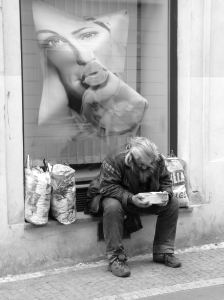
“What doth it profit, my brethren, though a man say he hath faith, and have not works? can faith save him? If a brother or sister be naked, and destitute of daily food, And one of you say unto them, Depart in peace, be ye warmed and filled; notwithstanding ye give them not those things which are needful to the body; what doth it profit? Even so faith, if it hath not works, is dead, being alone.” ~ James 2:14-17

Therefore, one of the reasons Jesus asked the question (v. 5) was to remind them of how easy it was to just talk about who was a sinner/lawbreaker and who was not. (The other reason was to initiate a legal debate.) Verbal declarations are easy (whether positive or negative); the true challenge was in helping people in spiritual and/or physical need. The scribes had a problem with Jesus forgiving the man’s sins, but what had they done to help him spiritually or physically… Nothing! It’s always easier to talk than walk. They simply ignored people, like the palsied man, in their plight. The religious leaders of Jesus’ day had nothing to offer those in need.

Jesus then did what they wouldn’t and couldn’t do, he helped the palsied man, by healing him miraculously. Indeed, both the power to forgive sins and the power to heal come from God alone.

As it was in Jesus’ day, people around us today are in great need, both spiritually and physically (though the spiritual needs are of far greater importance, the Bible makes it clear that the physical needs of our fellow man should never be neglected, e.g., Matthew 25:31-46, James 1:27). It is easy for believers to talk about the situation the world is in; hold meetings and conduct talk-shops. But it is our deeds that are really important, not our declarations: “Faith without works is dead” (James 2:26b).

What will we do to help those in need? If the society is in decay, what will you do to stop it? The world grows darker only when our (believers) lights grow dimmer. Church attendance is crucial (Hebrews 10:25). However, it is often what we do outside, rather than inside, of church that has the greater impact. Which is easier, to talk and moan about the unsaved, or to live the Gospel for them to see, to speak the Gospel for them to hear and to help them in their needs because of the Gospel?

Jesus did all he could to help the palsied man, both spiritually and physically. Let us do ALL we can do to minister to the needs of people that come our way. The least we can do is, like the palsied man’s friends, carry those in need to Jesus (Mark 2:3). Qualification for the Kingdom is evidenced in deeds, in how we treat others, not just in what we say. Those who are qualified for the Kingdom of God do, those who aren’t qualified, don’t… They just talk.

But whoso hath this world’s good, and seeth his brother have need, and shutteth up his bowels of compassion from him, how dwelleth the love of God in him? My little children, let us not love in word, neither in tongue; but in deed and in truth. ~ 1 John 3:17-18

Therefore, we must ask ourselves the question: How do we see our brothers/sisters? Are our brothers/sisters worth enough to us that we will do whatever we can to meet their spiritual and physical needs? Or, is it enough to just talk about them, to discuss their plight, what they’re doing wrong and what not doing right?

——————————————————————————————————————-
**This is the 2nd installment in a 3-part series on Qualifications for the Kingdom given in Matthew 9:2-8, Mark 2:1-12 and Luke 5:17-26**

Bookmark and Share


.

License, Loopholes, Legislation and Legitimacy

Bookmark and Share

2…Jesus seeing their faith said unto the sick of the palsy; Son, be of good cheer; thy sins be forgiven thee. 3And, behold, certain of the scribes said within themselves, ‘This man blasphemeth.’ 4And Jesus knowing their thoughts said, Wherefore think ye evil in your hearts? 5For whether is easier, to say, Thy sins be forgiven thee; or to say, Arise, and walk? ~ Matthew 9:2-5 (Also in Mark 2:1-12 & Luke 5:17-26)

The scribes were the (Mosaic) Law scholars of Jesus’ day

The more highly esteemed the Law became in the eyes of the people, the more its study and interpretation became a lifework by itself, and thus there developed a class of scholars who, though not priests, devoted themselves assiduously to the Law. These became known as the scribes… the professional students of the Law. 1

When Jesus stated that the palsied man’s sins were forgiven, the scribes considered that Jesus (whom they thought of as only a man) had elevated Himself to equality with God and thereby blasphemed (cheapened God’s standing). Jesus responds to their (unstated) allegations by asking them a scholarly legal question:

Wherefore think ye evil in your hearts? For whether is easier, to say, Thy sins be forgiven thee; or to say, Arise, and walk? ~ Matt 9:4-5

The answer to Jesus’ question hung on the following two (related) points:

  1. For Jesus to have broken the Law by blaspheming, His declaration of the man’s sins as being forgiven would have to be shown as being contradictory to God’s will. In other words, if God was in agreement with Jesus, then clearly Jesus could not have blasphemed.
  2. To prove a violation of a law it was necessary to provide evidence of said violation.

“Now faith is the substance of things hoped for, the EVIDENCE of things not seen.” ~ Hebrews 11:1

However, the scribes could not argue either point legally. They could not prove (this was a loophole in their approach to the Law) whether God agreed with Jesus that the man’s sins were forgiven or not.

Therefore, there was no evidence that the law was violated. They could not verify if Jesus had the license to forgive sins. Thus, in essence, it was always easier to say “Thy sins be forgiven thee” (vv. 2, 5) since one cannot prove guilt without evidence.

For example, if someone went to the courts/police and said, “I just stole ten cars”, the police/courts could not prosecute that person without evidence of some sort to corroborate with the assertion.

Conversely, if Jesus had said “Arise, and walk” they could determine whether Jesus was a false prophet, or not, by examining the evidence (i.e., whether the man arose and walked, or not).

It is important to note, however, that Jesus was not philosophizing for fun. Rather, He was exposing a major weakness in the scribes’ (the legal scholars) approach to the Law. For them, the Law was an end in itself. If one did not break the Law, they then deduced such a person to be righteous. But they were wrong, dead wrong.

Although a person cannot be convicted of a crime without evidence, lack of evidence does not prove lack of guilt. However, lack of evidence to verify an allegation does not mean the allegation is false.

For example, an athlete’s drug use can be determined from tests of his/her bodily fluids. However, it is well known in sport that the tests can be fooled by using:

  1. A smart drug administration regimen,
  2. Masking agent(s), or
  3. Drugs for which tests have not yet been developed.

Therefore, even if they don’t show any drug use, the tests results only mean that there was no evidence of drug use, NOT that the athlete is clean (drug free).

Likewise, the Mosaic Law could only provide evidence by its contravention/breaking/violation: it could only reveal sin.

…by the law is the knowledge of sin. ~ Romans 3:20b

Lack of evidence only proves lack of evidence; it does not prove righteousness.

  • The Law could not prove that a man’s heart was clean;
  • The Law could not prove a man’s thoughts were pure,
  • The Law could not tell if someone loved/hated God; the Law could not tell if someone even believed in God.

“Abide in me, and I in you. As the branch cannot bear fruit of itself, except it abide in the vine; no more can ye, except ye abide in me. I am the vine, ye are the branches: He that abideth in me, and I in him, the same bringeth forth much fruit: for without me ye can do nothing.” ~ John 15:4-5

The Law, in the paradigm of the scribes, was loaded with loopholes. Righteousness is not proven by what you don’t do; it is not proven by what laws you don’t break. Righteousness IS proven by what you DO!!!

The Law was not intended to be an end in itself. Rather, it was designed as a tool by which man could recognize his sinfulness before a Holy God (Romans 3:23). One who recognizes his/her own sinfulness can seek Salvation supplied by God’s grace, through faith (Ephesians 2:8-9). Evidence of a person’s Salvation would then be demonstrated in his/her actions:

Ye shall know them by their fruits. Do men gather grapes of thorns, or figs of thistles? Even so every good tree bringeth forth good fruit; but a corrupt tree bringeth forth evil fruit. A good tree cannot bring forth evil fruit, neither can a corrupt tree bring forth good fruit… Wherefore by their fruits ye shall know them.
Not every one that saith unto me, Lord, Lord, shall enter into the kingdom of heaven; but he that doeth the will of my Father which is in heaven. ~ Matthew 7:16-17, 19-20

Having stymied the scribes with His scholarly legal question, Jesus goes on to heal the palsied man miraculously:

But that ye may know that the Son of man hath power on earth to forgive sins, (then saith he to the sick of the palsy,) Arise, take up thy bed, and go unto thine house. And he arose, and departed to his house. ~ Matthew 9:6-7

By this action, Jesus validated his authority to forgive sins and PROVED conclusively that He was indeed the Messiah; He confirmed His legitimacy. That was evidence that the scribes could not deny.

Bookmark and Share

The Man with the Palsy | Spiritual vs. Physical: How do you see yourself?

Bookmark and Share

2And, behold, they brought to him a man sick of the palsy, lying on a bed: and Jesus seeing their faith said unto the sick of the palsy; Son, be of good cheer; thy sins be forgiven thee. 3And, behold, certain of the scribes said within themselves, ‘This man blasphemeth.’ 4And Jesus knowing their thoughts said, Wherefore think ye evil in your hearts? 5For whether is easier, to say, Thy sins be forgiven thee; or to say, Arise, and walk? 6But that ye may know that the Son of man hath power on earth to forgive sins, (then saith he to the sick of the palsy,) Arise, take up thy bed, and go unto thine house. 7And he arose, and departed to his house. ~ Matthew 9:2-7 (Also in Mark 2:1-12 and Luke 5:17-26)

Qualifications for the Kingdom, Part 1: Spiritual vs. Physical: How do you see yourself?

When the man with the palsy was brought to Jesus, the expectation was that Jesus would heal him. Aside from the simple fact of his suffering, prevailing Jewish religious thought/philosophy taught that disease was a sign of sin (John 9:1-3). And, according to Scripture, the sinful are rejected by God. Therefore, according to the religious scholars of Jesus’ day, having the palsy disqualified the sick man from God’s Kingdom. Thus, from the people’s perspective, the only way to help the man was to heal him physically.

“But after that the kindness and love of God our Saviour toward man appeared, Not by works of righteousness which we have done, but according to his mercy he saved us, by the washing of regeneration, and renewing of the Holy Ghost; Which he shed on us abundantly through Jesus Christ our Saviour; That being justified by his grace, we should be made heirs according to the hope of eternal life.” (Titus 3:4-7)

However, Jesus (as he often does) did the unexpected: He forgave the man’s sins first, instead of dealing with his paralysis first. By forgiving the palsied man of his sins, Jesus prioritized the man’s spiritual health over his physical health. Jesus demonstrated that qualification for the Kingdom is based on spiritual state ALONE.

As Jesus explained (and as shown in Paul’s life), physical sickness is not necessarily linked to sin. Our physical state (healthy or sick, rich or poor, thin or fat, red or yellow) neither qualifies nor disqualifies us for entrance into the Kingdom of God: the ONLY thing that matters is our Spiritual state: whether our sins have been forgiven. If God forgives your sin, then you are in.

Indeed, the scribes in particular should have known that the lame had equal standing among the people of God. Speaking through Jeremiah God had specifically included the blind and the lame among those who He would call into fellowship as His people returned from captivity:

Behold, I will bring them from the north country, and gather them from the coasts of the earth, and with them the blind and the lame, the woman with child and her that travaileth with child together: a great company shall return thither. ~ Jeremiah 31:8

The story doesn’t end there, however. Jesus does go on to heal the man of his physical illness. It is clear, therefore, that Jesus DOES care about our physical condition. Jesus takes no pleasure in our physical ailments; He is not untouched by our infirmities (Matthew 8:16-17).

A defective nervous system paralyzed the man’s body and a defective (sinful) nature paralyzed his spirit. However, while his body would only be alive for a few years on earth, his spirit would live eternally, either in Heaven or in hell. Therefore, his spiritual state was infinitely more critical than his physical state. And so, Jesus fixed his spiritual problem, first.

“Surely he hath borne our griefs, and carried our sorrows… In all their affliction he was afflicted… in his love and in his pity he redeemed them; and he bare them, and carried them all the days of old.” (Isaiah 53:4a; 63:9)

Accordingly, God is preoccupied with our spiritual condition; that is why Jesus died on the cross to save us. Illness/disease is a scourge on our lives, but they don’t last forever, and God can still work through physical illnesses to minister to mankind.

And he [the LORD] said unto me, ‘My grace is sufficient for thee: for my strength is made perfect in weakness.’ Most gladly therefore will I rather glory in my infirmities, that the power of Christ may rest upon me. ~ 2 Cor. 12:9

But spiritual illness, sin-sickness, completely blocks our ability to fellowship with God and serve Him (which is our calling).

Jesus answered and said unto him, Verily, verily, I say unto thee, Except a man be born again, he cannot see the kingdom of God. ~ John 3:3

Because the carnal mind is enmity against God: for it is not subject to the law of God, neither indeed can be. So then they that are in the flesh cannot please God. ~ Romans 8:7-8

The worst that physical sickness can do is to end our life here on earth, but spiritual sickness, uncured, leads to eternal death.

Marvel not at this: for the hour is coming, in the which all that are in the graves shall hear his voice, And shall come forth; they that have done good, unto the resurrection of life; and they that have done evil, unto the resurrection of damnation. ~ John 5:28-29

The questions we must ask therefore are,

  • How do we see ourselves?
  • When we look at ourselves, do we only see our physical needs?
  • Or, do we also see our spiritual needs?
  • Which one (physical or spiritual) do we want God to fix most?
  • Which one keeps us up at night? For which one do we spend most of our time praying for help?
  • Are we preoccupied by our physical state or consumed by our spiritual state?

——————————————————————————————————————-
**This is the 1st installment in a 3-part series on Qualifications for the Kingdom given in Matthew 9:2-8, Mark 2:1-12 and Luke 5:17-26**

Bookmark and Share

One Step at a Time…

Bookmark and Share

“…Blessed be the LORD God… I being in the way, the LORD led me…” ~ Genesis 24:27

When we discover the context of these words of Scripture we realize they are teaching us a principle of how God often works in the lives of His people. It is easier to steer a moving vehicle than one that is stationary. God can sometimes steer us more easily when we are moving. That’s why we will find that one step frequently leads to the next step when we have faith to be led by the Holy Spirit.

The words above were spoken by Abraham’s servant who was commissioned by Abraham to travel to the land of his people to find a wife for Isaac. As he journals the events of his search, he writes that while he was “in the way” the Lord led him he encountered the family of Rebekah. When he met her he knew that his search had ended.

We who are committed followers of Christ were commissioned two thousand years ago to go to all nations and make disciples for Jesus Christ. A journey of a thousand miles begins with the first step. Like the servant of Abraham, as we embark on the adventure of obeying our great commission, we should expect that each step will lead to the next step.

We don’t always have to know where the road leads as long as we know it is the right road. While we are “in the way” our Lord has commissioned us to go we must have the faith to take that first step and then, one step at a time, expect our Lord to show us His will about the next step.

Adapted from One Step at a Time… by Dick Woodward.

Bookmark and Share

You Are Loved

“Who shall separate us from the love of Christ? shall tribulation, or distress, or persecution, or famine, or nakedness, or peril, or sword? …Nay, in all these things we are more than conquerors through him that loved us. For I am persuaded, that neither death, nor life, nor angels, nor principalities, nor powers, nor things present, nor things to come, Nor height, nor depth, nor any other creature, shall be able to separate us from the love of God, which is in Christ Jesus our Lord.” ~ Romans 8:35, 37-39


Bookmark and Share


By Patti Hanan

You don’t have to be on the A team.
You don’t have to be on the B team.
You don’t have to have made the team.
You are loved.

You don’t have to belong to the right club.
You don’t have to go to the right school.
You don’t have to come from the right neighborhood.
You are loved.

“And we have seen and do testify that the Father sent the Son to be the Saviour of the world. Whosoever shall confess that Jesus is the Son of God, God dwelleth in him, and he in God. And we have known and believed the love that God hath to us. God is love; and he that dwelleth in love dwelleth in God, and God in him. Herein is our love made perfect, that we may have boldness in the day of judgment: because as he is, so are we in this world… We love him, because he FIRST loved us.” ~ 1 John 4:14-17, 19

You don’t need a lot of money.
You don’t need a fancy car.
You don’t need a stylish wardrobe.
You are loved.

You don’t need to be highly educated.
You don’t need to be famous.
You don’t need to be a hero.
You are loved.

You don’t need to be up to date.
You don’t need to be sophisticated.
You don’t need to be well connected.
You are loved.

You can stumble and fall.
You can blow the deal.
You can strike out.
You are still loved.

You can fail to make it to the top.
You can miss the boat.
You can fall into a ditch.
You are still loved.

You can be overlooked.
You can be unappreciated.
You can be disrespected.
You are still loved.

You can be called worthless.
You can be called unimportant.
You can be called a loser.
That’s not what God calls you.
He says you are made in His image,
And that you are fearfully
And wonderfully made.
He loves you so much, He sent his only son, Jesus,
to die for you so you could be reconciled to Him.

By Patti Hanan

The Original can be found here.

Bookmark and Share


.
.

A Testimony of Tears and Triumph

Bookmark and Share

My Testimony

By Joanne “CaryJo” Norton

"Save me, O God; for the waters are come in unto my soul. I sink in deep mire, where there is no standing: I am come into deep waters, where the floods overflow me." ~ Psalm 69:1-2

WHEN I lived in the world in my sin and my shame,
You came to me often, You whispered my name.
You said, “You’re a princess, not the orphan you feel”.
I didn’t believe You; the shame was too real.

SO YOU sent some to tell me, “Life’s more than this pain.”
And my heart filled with longing to break those strong chains.
A teacher, a friend, a man on the street,
Passed by just to tell me life could be complete.

HOW I wished to believe them, I sought to be free,
For the freedom I’d found didn’t satisfy me.
I lived in the ’60’s, a child of rebellion
Churning forward and back in a black, fire-hot caldron.

BUT YOU wove the web tighter, this Love-web You’d spun,
And You tightened Your grip so that I couldn’t run.
And I couldn’t resist You–I had to be saved.
From the curses of Sin, Death, Hell and the Grave.

"Deliver me out of the mire, and let me not sink: let me be delivered from them that hate me, and out of the deep waters. Let not the waterflood overflow me, neither let the deep swallow me up, and let not the pit shut her mouth upon me. Hear me, O LORD; for thy lovingkindness is good: turn unto me according to the multitude of thy tender mercies. And hide not thy face from thy servant; for I am in trouble: hear me speedily. Draw nigh unto my soul, and redeem it" ~ Psalm 69:14-18b

I STILL wasn’t happy although You’d received me.
The patterns of sin and abuse had deceived me.
For You were a Father, and Fathers are cruel,
With promises broken and strong hands to rule.

I LEARNED to obey You, to yield to Your Way,
But lived in deep heart-pain, as day followed day.
As month followed month, and year followed year.
With no hope that the sunshine would ever appear.

AND WHEN a dear friend died, I mourned and I wept,
But You chose then to touch me; a promise You kept.
In the night hours of sorrow, You said, “You’ll be free.
You learned to trust this man; You’ll learn to trust me.”

AND IN time that’s what happened, and I’ll never know how.
But I learned to walk with You like a small, trusting child.
My life wasn’t easy; day by day chaos reigned.
But I knew that You loved me, so endured life’s sharp pain.

.

THROUGH MORE years of darkness, oppression and sorrow,
I grew to trust for today, and to hope for tomorrow,
For I knew since You loved me it brought You no joy
To watch as I suffered, while I saw sin employed.

"I waited patiently for the LORD; and he inclined unto me, and heard my cry. He brought me up also out of an horrible pit, out of the miry clay, and set my feet upon a rock, and established my goings. And he hath put a new song in my mouth, even praise unto our God: many shall see it, and fear, and shall trust in the LORD." ~ Psalm 40:1-3

AND ONE day it happened. My bonds dropped away.
And grateful and joy-filled, I faced a Bright day.
But – without the constraints of life’s darkness and pain,
In freedom, I stumbled, tripped up by those chains.

AND THE torment endured was new every day.
I thought Your mercies had fled, so I withered away.
Winter’s ice-blasted fingers encircled our town
And, my soul, like the grasses, turned lifeless and brown.

"I will praise thee: for thou hast heard me, and art become my salvation." ~ Psalm 118:21

I FORGOT there’s a truth, in the soul and the earth:
Winter is fleeting; with Spring comes rebirth.
And You said, “Child, Watch! As Spring comes to your door,
Like the robins and lilacs, your soul I’ll restore.”

YOU SPOKE the word “Queenly” to my heart every day
And reminded this waif of a much nobler Way,
And gently restoring your Fatherhood cover,
Enhanced it, with grace, as my Soul’s Holy Lover.

NOW WITH Savior and Father and Lover and Friend,
MY soul knows no darkness when shadows descend.
In Your love and Your kindness my heart safely rests,
And I am, among women, most wonderfully blest.

By Joanne “CaryJo” Norton
The original can be found here.

=================
“I wrote this some time ago, based on Song of Solomon, but even today, I know that without His faithful and forceful and never-ending reconciliation, there would be no hope, no true life. I’m one grateful God-child.” ~ Joanne “CaryJo” Norton

Bookmark and Share

Thoughts on God… from ‘a Softer Voice’

Bookmark and Share

An Awareness of God

“O lord, thou hast searched me, and known me. Thou knowest my downsitting and mine uprising… and art acquainted with all my ways… Whither shall I go from thy spirit? or whither shall I flee from thy presence?” ~ Psalm 139:1-3, 7

An awareness of God
I’m beginning to see
The depth of His love
That reaches to me.

Though I am unworthy
Of His mercy and grace,
He looks upon me
As I seek His face.

He speaks softly to me
Then, to Him, I respond
And I know He is seeking
An everlasting bond.

The Creator of heaven
Of earth and of sea
Wants to be my Father
And spend time with me.

By Nancy K. Sullivan (1989)

.

.

Learning to Live

“I will praise thee; for I am fearfully and wonderfully made: marvellous are thy works; and that my soul knoweth right well… Search me, O God, and know my heart: try me, and know my thoughts: And see if there be any wicked way in me, and lead me in the way everlasting.” ~ Psalm 139:14,23-24

Learning to live a life that is free
Is learning to pray and wait patiently.
Learning to live a life full of hope
Is yielding to God when we cannot cope.
Learning to live a life that is strong
Is trusting while healing – when days seem so long.

Learning to live a life we can’t see
Is reaching our hand through eternity:
To the God who knows our needs and our cares
And lovingly, thoughtfully answers our prayers;
To the God who is waiting for us to release
The things that deny us our comfort and peace;
To the God who created and made us His own,
Who reaches to heal us from His mighty throne.

By Nancy K. Sullivan

.

Bookmark and Share

The Word is for Washing

“Sanctify them through thy truth: thy word is truth.” ~ John 17:17


In Jesus’ (High Priestly) Prayer for His disciples, recorded for us in John 17, He prayed for their sanctification through God’s truth (i.e., God’s Word).   Sanctification is the process by which someone/something becomes Holy: exclusively set apart unto God for His service.

Mosaic law instructs that an item or a person must go through a sanctification process that typically involved washing and/or anointing, followed by a dedication ceremony in order to be ready to serve God. Only after sanctification could that item be used in the worship ceremony or that person approach God to serve and/or worship Him.

By His grace, God imputes His Holiness to us to enable us, imperfect as we are, to serve Him. However, God also prepares us for (ever greater) usefulness by cleansing (sanctifying) us with His Word (truth).

…Christ also loved the church, and gave himself for it; That he might sanctify and cleanse it with the washing of water by the word, That he might present it to himself a glorious church, not having spot, or wrinkle, or any such thing; but that it should be holy and without blemish. ~ Ephesians 5:25b-27

A Believer is washed by The Word of God as he/she studies it. And as the Believer studies God’s Word his/her mind is renewed (Romans 12:2; Ephesians 4:23), into the very mind of Christ. And this enables the believer to know the very Will of God, which is necessary to effectively do the Work of God.

“Wherewithal shall a young man cleanse his way? by taking heed thereto according to thy word.” ~ Psalm 119:9

Consequently, if we fail to study His word, if we do not avail ourselves (our minds) to be washed clean by it, then our spiritual growth will be stunted. We will struggle through life, spiritually immature and carnal: trapped by the base desires of our sinful nature, not growing into the full stature of the fullness of Christ (Ephesians 4:13).

By mercy and truth iniquity is purged: and by the fear of the LORD men depart from evil. ~ Proverbs 16:6

Believers must study God’s word; there is no other way: this is the method that He has chosen for us, His disciples/church, to grow. It is foolish and futile for us to moan over our lack of spiritual growth if we are unwilling to apply ourselves to the study of God’s Word. We will never be prepared for service without studying God’s word. Just as it would be foolhardy for a hospital to hire doctors who don’t study medicine, we cannot expect God to employ those who don’t study His Word.

Jesus had just spent three years teaching His disciples, but without the ongoing sanctification with Gods truth, without the constant washing with the Word, He knew that they would fail in the mission He was about to send them. Certainly, we are no greater than they.  Therefore, without the conscientious, careful and constant study of God’s Word we will fail too.

Finally, these words were a part of Jesus’ prayers for His disciples. This was not a teaching given to a multitude. Therefore, this message is for those who are committed to working in the Kingdom of God. This message is not intended for Christians “in-name-only”, those who practice their own unique version of a faith based on the most convenient parts of the Scripture. This message is not for those who use Christianity as “fire insurance”: who do not feel constrained to work in the Kingdom of God though they (think they) are in it.

Jesus’ prayer was for those who would “Hunger and thirst after righteousness” (Matthew 5:6), those who are willing to respond to the call to serve in the Kingdom of God.

If we indeed intend to heed God’s call to service, let us then commit ourselves to sanctification: to being washed by His Word. Let us determine to study God’s Word that He might set us apart unto Himself, for His use ONLY. For as God sanctifies us, as we grow in Him, the devil will not be able to trick us into serving his unholy purposes. Neither will we seek our own agenda. No, we will be available to God, exclusively, for work in His Kingdom.

“Now ye are clean through the word which I have spoken unto you.” ~ John 15:3

And, let every one that nameth the name of Christ depart from iniquity. But in a great house there are not only vessels of gold and of silver, but also of wood and of earth; and some to honour, and some to dishonour. If a man therefore purge himself from these, he shall be a vessel unto honour, sanctified, and meet for the master’s use, and prepared unto every good work. Flee also youthful lusts: but follow righteousness, faith, charity, peace, with them that call on the Lord out of a pure heart. ~ 2 Timothy 2:19b-22

All scripture is given by inspiration of God, and is profitable for doctrine, for reproof, for correction, for instruction in righteousness: That the man of God may be perfect, throughly furnished unto all good works. ~ 2 Timothy 3:16-17

A Prayer for Perspective

Bookmark and Share

Heavenly Father, help us remember that the jerk who cut us off in traffic last night is a single mother who worked nine hours that day and is rushing home to cook dinner, help with homework, do the laundry and spend a few precious moments with her children.

Dear God, help us to remember that the pierced, tattooed, disinterested young man who can’t make change correctly is a worried 19-year-old college student, balancing his apprehension over final exams with his fear of not getting his student loans for next semester.

Remind us, Lord, that the scary looking bum, begging for money in the same spot every day (who really ought to get a job!) is a slave to addictions that we can only imagine in our worst nightmares.

Help us to remember that the old couple walking annoyingly slow through the store aisles and blocking our shopping progress are savoring this moment, knowing that, based on the biopsy report she got back last week, this will be the last year that they go shopping together.

Heavenly Father, remind us each day that, of all the gifts you give us, the greatest gift is love. Remind us that it is not enough to share that love with those we hold dear. Dear God, open our hearts not to just those who are close to us, but to all humanity. And help us to be slow to judge and quick to forgive, ready to share your patience, your empathy and your love.

AMEN.

~ Adapted, author unknown

“Thus speaketh the LORD of hosts, saying, Execute true judgment, and shew mercy and compassions every man to his brother” ~ Zechariah 7:9

Though I speak with the tongues of men and of angels, and have not charity, I am become as sounding brass, or a tinkling cymbal.
And though I have the gift of prophecy, and understand all mysteries, and all knowledge; and though I have all faith, so that I could remove mountains, and have not charity, I am nothing.
And though I bestow all my goods to feed the poor, and though I give my body to be burned, and have not charity, it profiteth me nothing.
Charity suffereth long, and is kind; charity envieth not; charity vaunteth not itself, is not puffed up,
Doth not behave itself unseemly, seeketh not her own, is not easily provoked, thinketh no evil;
Rejoiceth not in iniquity, but rejoiceth in the truth;
Beareth all things, believeth all things, hopeth all things, endureth all things.
Charity never faileth: but whether there be prophecies, they shall fail; whether there be tongues, they shall cease; whether there be knowledge, it shall vanish away.
For we know in part, and we prophesy in part.
But when that which is perfect is come, then that which is in part shall be done away.
When I was a child, I spake as a child, I understood as a child, I thought as a child: but when I became a man, I put away childish things.
For now we see through a glass, darkly; but then face to face: now I know in part; but then shall I know even as also I am known.
And now abideth faith, hope, charity, these three; but the greatest of these is charity. ~ 1 Corinthians 13

Bookmark and Share

Faithful Stewards

“Moreover it is required in stewards, that a man be found faithful… And what hast thou that thou didst not receive?” ~ 1 Corinthians 4:2, 7

The biblical word “steward” is not fully understood or appreciated. It is actually one of the most important words in the New Testament. A synonym for this word is “manager.” Many people believe this word primarily relates to a person’s money. But that application falls far short of the essential meaning of this word.

"...Give an account of thy stewardship..." ~ Luke 16:2

When Paul asks the probing question: “And what do you have that you did not receive?” he is telling us that our stewardship applies to everything we have received from God. This means our time, energy, gifts and talents, our health and all the things that make up the essence of our very life, including all of our money and possessions.

There was a successful businessman that had what he referred to as a “halftime” experience when he came to fully appreciate this word “steward.” His regular custom was to draw a line down the middle of the top page of a legal pad. On the left side of that line he wrote “My business” while on the right side of the line he wrote “God’s business.” When he fully appreciated this word “steward” he erased that line because, as a very successful wealthy businessman, he realized it was all God’s business.

Remember, the important thing about a steward is that he/she be found faithful. Do you realize there is nothing in your life you did not receive from God? Do you know that you are to faithfully manage everything you have received from God? Are you willing to have a “halftime” experience and erase the line between what is yours and what is God’s? How will you be spending the time and money that God has entrusted to your stewardship?

Adapted from “Faithful Stewards” by Dick Woodward.